

64
1
General Principles
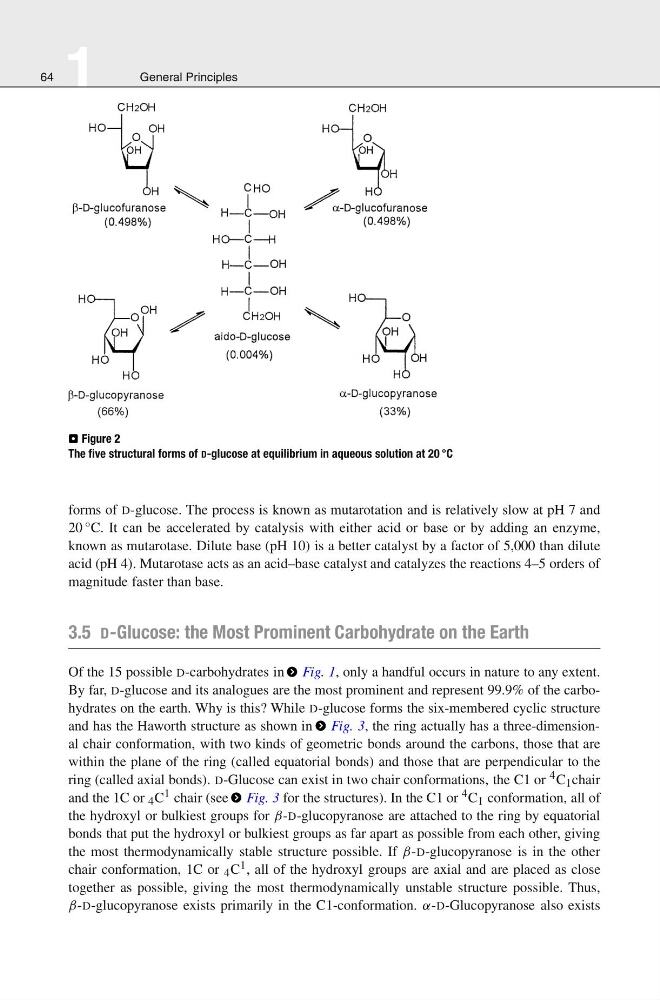
⊡ Figure 2
The five structural forms of D-glucose at equilibrium in aqueous solution at 20 °C
forms of D-glucose. The process is known as mutarotation and is relatively slow at pH 7 and
20 °C. It can be accelerated by catalysis with either acid or base or by adding an enzyme,
known as mutarotase. Dilute base (pH 10) is a better catalyst by a factor of 5,000 than dilute
acid (pH 4). Mutarotase acts as an acid–base catalyst and catalyzes the reactions 4–5 orders of
magnitude faster than base.
3.5 D-Glucose: the Most Prominent Carbohydrate on the Earth
Of the 15 possible D-carbohydrates in > Fig. 1, only a handful occurs in nature to any extent.
By far, D-glucose and its analogues are the most prominent and represent 99.9% of the carbohydrates on the earth. Why is this? While D-glucose forms the six-membered cyclic structure
and has the Haworth structure as shown in > Fig. 3, the ring actually has a three-dimensional chair conformation, with two kinds of geometric bonds around the carbons, those that are
within the plane of the ring (called equatorial bonds) and those that are perpendicular to the
ring (called axial bonds). D-Glucose can exist in two chair conformations, the C1 or 4 C 1 chair
and the 1C or 4 C 1 chair (see > Fig. 3 for the structures). In the C1 or 4 C 1 conformation, all of
the hydroxyl or bulkiest groups for β-D-glucopyranose are attached to the ring by equatorial
bonds that put the hydroxyl or bulkiest groups as far apart as possible from each other, giving
the most thermodynamically stable structure possible. If β-D-glucopyranose is in the other
chair conformation, 1C or 4 C 1 , all of the hydroxyl groups are axial and are placed as close
together as possible, giving the most thermodynamically unstable structure possible. Thus,
β-D-glucopyranose exists primarily in the C1-conformation. α-D-Glucopyranose also exists
1
General Principles
⊡ Figure 2
The five structural forms of D-glucose at equilibrium in aqueous solution at 20 °C
forms of D-glucose. The process is known as mutarotation and is relatively slow at pH 7 and
20 °C. It can be accelerated by catalysis with either acid or base or by adding an enzyme,
known as mutarotase. Dilute base (pH 10) is a better catalyst by a factor of 5,000 than dilute
acid (pH 4). Mutarotase acts as an acid–base catalyst and catalyzes the reactions 4–5 orders of
magnitude faster than base.
3.5 D-Glucose: the Most Prominent Carbohydrate on the Earth
Of the 15 possible D-carbohydrates in > Fig. 1, only a handful occurs in nature to any extent.
By far, D-glucose and its analogues are the most prominent and represent 99.9% of the carbohydrates on the earth. Why is this? While D-glucose forms the six-membered cyclic structure
and has the Haworth structure as shown in > Fig. 3, the ring actually has a three-dimensional chair conformation, with two kinds of geometric bonds around the carbons, those that are
within the plane of the ring (called equatorial bonds) and those that are perpendicular to the
ring (called axial bonds). D-Glucose can exist in two chair conformations, the C1 or 4 C 1 chair
and the 1C or 4 C 1 chair (see > Fig. 3 for the structures). In the C1 or 4 C 1 conformation, all of
the hydroxyl or bulkiest groups for β-D-glucopyranose are attached to the ring by equatorial
bonds that put the hydroxyl or bulkiest groups as far apart as possible from each other, giving
the most thermodynamically stable structure possible. If β-D-glucopyranose is in the other
chair conformation, 1C or 4 C 1 , all of the hydroxyl groups are axial and are placed as close
together as possible, giving the most thermodynamically unstable structure possible. Thus,
β-D-glucopyranose exists primarily in the C1-conformation. α-D-Glucopyranose also exists