

General Properties, Occurrence, and Preparation
1.2
63
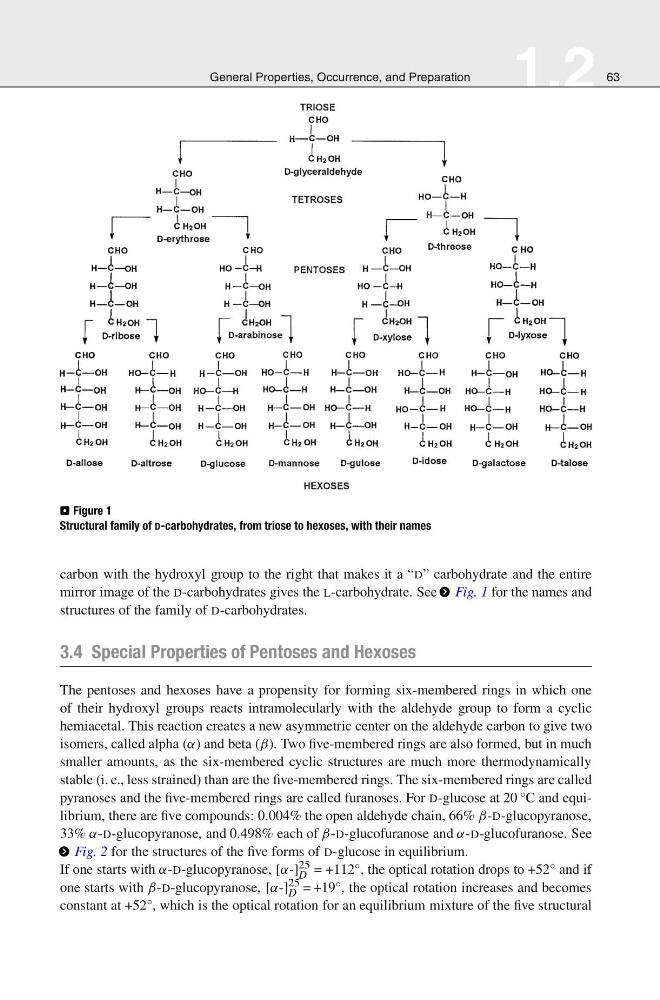
⊡ Figure 1
Structural family of D-carbohydrates, from triose to hexoses, with their names
carbon with the hydroxyl group to the right that makes it a “D” carbohydrate and the entire
mirror image of the D-carbohydrates gives the L-carbohydrate. See > Fig. 1 for the names and
structures of the family of D-carbohydrates.
3.4 Special Properties of Pentoses and Hexoses
The pentoses and hexoses have a propensity for forming six-membered rings in which one
of their hydroxyl groups reacts intramolecularly with the aldehyde group to form a cyclic
hemiacetal. This reaction creates a new asymmetric center on the aldehyde carbon to give two
isomers, called alpha (α) and beta (β). Two five-membered rings are also formed, but in much
smaller amounts, as the six-membered cyclic structures are much more thermodynamically
stable (i. e., less strained) than are the five-membered rings. The six-membered rings are called
pyranoses and the five-membered rings are called furanoses. For D-glucose at 20 °C and equilibrium, there are five compounds: 0.004% the open aldehyde chain, 66% β-D-glucopyranose,
33% α-D-glucopyranose, and 0.498% each of β-D-glucofuranose and α-D-glucofuranose. See
> Fig. 2 for the structures of the five forms of D-glucose in equilibrium.
If one starts with α-D-glucopyranose, [α-] 25
D = +112°, the optical rotation drops to +52° and if
one starts with β-D-glucopyranose, [α-] 25
D = +19°, the optical rotation increases and becomes
constant at +52°, which is the optical rotation for an equilibrium mixture of the five structural
1.2
63
⊡ Figure 1
Structural family of D-carbohydrates, from triose to hexoses, with their names
carbon with the hydroxyl group to the right that makes it a “D” carbohydrate and the entire
mirror image of the D-carbohydrates gives the L-carbohydrate. See > Fig. 1 for the names and
structures of the family of D-carbohydrates.
3.4 Special Properties of Pentoses and Hexoses
The pentoses and hexoses have a propensity for forming six-membered rings in which one
of their hydroxyl groups reacts intramolecularly with the aldehyde group to form a cyclic
hemiacetal. This reaction creates a new asymmetric center on the aldehyde carbon to give two
isomers, called alpha (α) and beta (β). Two five-membered rings are also formed, but in much
smaller amounts, as the six-membered cyclic structures are much more thermodynamically
stable (i. e., less strained) than are the five-membered rings. The six-membered rings are called
pyranoses and the five-membered rings are called furanoses. For D-glucose at 20 °C and equilibrium, there are five compounds: 0.004% the open aldehyde chain, 66% β-D-glucopyranose,
33% α-D-glucopyranose, and 0.498% each of β-D-glucofuranose and α-D-glucofuranose. See
> Fig. 2 for the structures of the five forms of D-glucose in equilibrium.
If one starts with α-D-glucopyranose, [α-] 25
D = +112°, the optical rotation drops to +52° and if
one starts with β-D-glucopyranose, [α-] 25
D = +19°, the optical rotation increases and becomes
constant at +52°, which is the optical rotation for an equilibrium mixture of the five structural