

772
3
Chemical Glycosylation Reactions
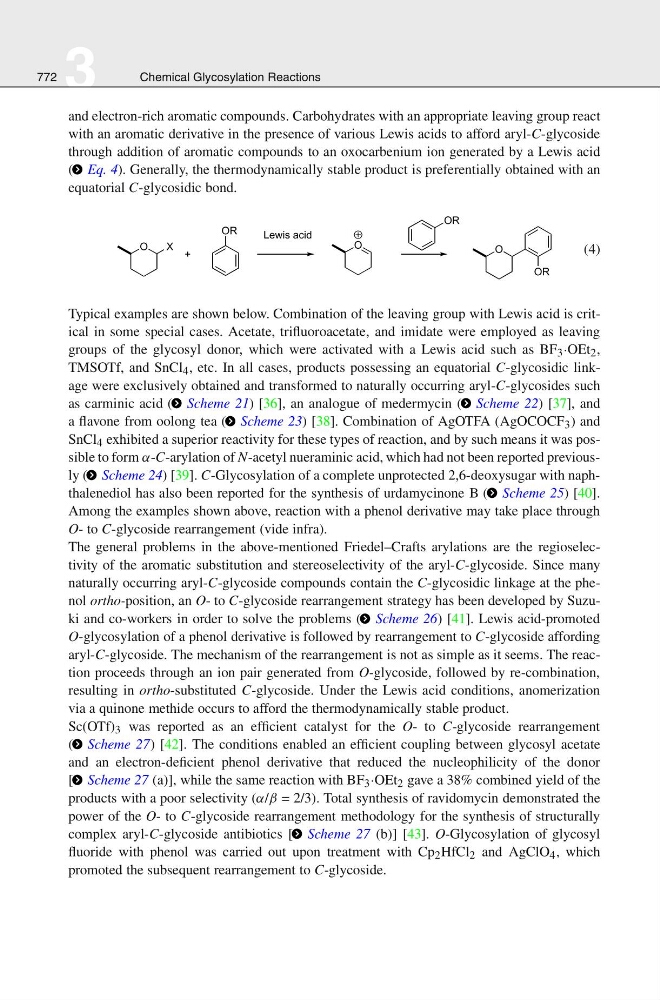
and electron-rich aromatic compounds. Carbohydrates with an appropriate leaving group react
with an aromatic derivative in the presence of various Lewis acids to afford aryl-C-glycoside
through addition of aromatic compounds to an oxocarbenium ion generated by a Lewis acid
( > Eq. 4). Generally, the thermodynamically stable product is preferentially obtained with an
equatorial C-glycosidic bond.
(4)
Typical examples are shown below. Combination of the leaving group with Lewis acid is critical in some special cases. Acetate, trifluoroacetate, and imidate were employed as leaving
groups of the glycosyl donor, which were activated with a Lewis acid such as BF 3 ·OEt 2 ,
TMSOTf, and SnCl 4 , etc. In all cases, products possessing an equatorial C-glycosidic linkage were exclusively obtained and transformed to naturally occurring aryl-C-glycosides such
as carminic acid ( > Scheme 21) [36], an analogue of medermycin ( > Scheme 22) [37], and
a flavone from oolong tea ( > Scheme 23) [38]. Combination of AgOTFA (AgOCOCF 3 ) and
SnCl 4 exhibited a superior reactivity for these types of reaction, and by such means it was possible to form α-C-arylation of N-acetyl nueraminic acid, which had not been reported previously ( > Scheme 24) [39]. C-Glycosylation of a complete unprotected 2,6-deoxysugar with naphthalenediol has also been reported for the synthesis of urdamycinone B ( > Scheme 25) [40].
Among the examples shown above, reaction with a phenol derivative may take place through
O- to C-glycoside rearrangement (vide infra).
The general problems in the above-mentioned Friedel–Crafts arylations are the regioselectivity of the aromatic substitution and stereoselectivity of the aryl-C-glycoside. Since many
naturally occurring aryl-C-glycoside compounds contain the C-glycosidic linkage at the phenol ortho-position, an O- to C-glycoside rearrangement strategy has been developed by Suzuki and co-workers in order to solve the problems ( > Scheme 26) [41]. Lewis acid-promoted
O-glycosylation of a phenol derivative is followed by rearrangement to C-glycoside affording
aryl-C-glycoside. The mechanism of the rearrangement is not as simple as it seems. The reaction proceeds through an ion pair generated from O-glycoside, followed by re-combination,
resulting in ortho-substituted C-glycoside. Under the Lewis acid conditions, anomerization
via a quinone methide occurs to afford the thermodynamically stable product.
Sc(OTf) 3 was reported as an efficient catalyst for the O- to C-glycoside rearrangement
( > Scheme 27) [42]. The conditions enabled an efficient coupling between glycosyl acetate
and an electron-deficient phenol derivative that reduced the nucleophilicity of the donor
[ > Scheme 27 (a)], while the same reaction with BF 3 ·OEt 2 gave a 38% combined yield of the
products with a poor selectivity (α/β = 2/3). Total synthesis of ravidomycin demonstrated the
power of the O- to C-glycoside rearrangement methodology for the synthesis of structurally
complex aryl-C-glycoside antibiotics [ > Scheme 27 (b)] [43]. O-Glycosylation of glycosyl
fluoride with phenol was carried out upon treatment with Cp 2 HfCl 2 and AgClO 4 , which
promoted the subsequent rearrangement to C-glycoside.