

C-Glycosylation
3.8
771
⊡ Scheme 19
⊡ Scheme 20
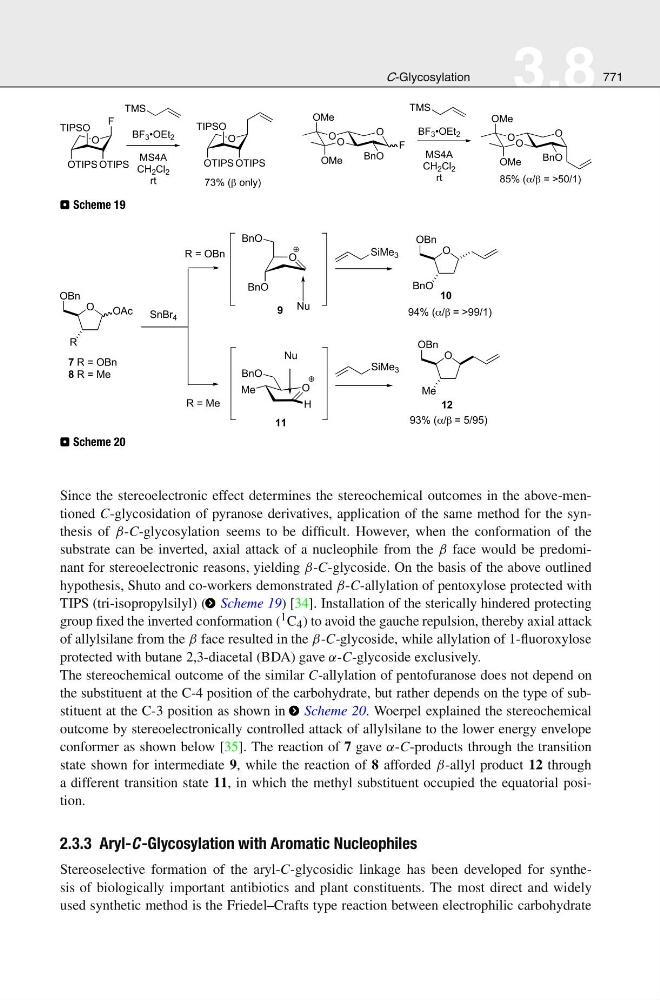
Since the stereoelectronic effect determines the stereochemical outcomes in the above-mentioned C-glycosidation of pyranose derivatives, application of the same method for the synthesis of β-C-glycosylation seems to be difficult. However, when the conformation of the
substrate can be inverted, axial attack of a nucleophile from the β face would be predominant for stereoelectronic reasons, yielding β-C-glycoside. On the basis of the above outlined
hypothesis, Shuto and co-workers demonstrated β-C-allylation of pentoxylose protected with
TIPS (tri-isopropylsilyl) ( > Scheme 19) [34]. Installation of the sterically hindered protecting
group fixed the inverted conformation ( 1 C 4 ) to avoid the gauche repulsion, thereby axial attack
of allylsilane from the β face resulted in the β-C-glycoside, while allylation of 1-fluoroxylose
protected with butane 2,3-diacetal (BDA) gave α-C-glycoside exclusively.
The stereochemical outcome of the similar C-allylation of pentofuranose does not depend on
the substituent at the C-4 position of the carbohydrate, but rather depends on the type of substituent at the C-3 position as shown in > Scheme 20. Woerpel explained the stereochemical
outcome by stereoelectronically controlled attack of allylsilane to the lower energy envelope
conformer as shown below [35]. The reaction of 7 gave α-C-products through the transition
state shown for intermediate 9, while the reaction of 8 afforded β-allyl product 12 through
a different transition state 11, in which the methyl substituent occupied the equatorial position.
2.3.3 Aryl-C-Glycosylation with Aromatic Nucleophiles
Stereoselective formation of the aryl-C-glycosidic linkage has been developed for synthesis of biologically important antibiotics and plant constituents. The most direct and widely
used synthetic method is the Friedel–Crafts type reaction between electrophilic carbohydrate