

740
3
Chemical Glycosylation Reactions
Pyrolysis of a variety of monosaccharides has been shown to afford the corresponding
1,6-anhydro sugars; however, the yields are lower than that seen when using the glycan
precursors. It has been proposed that the pyrolysis of simple sugars proceeds by way of an
initial condensation to intermediate polysaccharides, which then thermally depolymerize,
affording the 1,6-anhydro sugars [3].
In addition to the pyrolytic procedures described above, there are three main synthetic routes
to 1,6-anhydro sugars. The first method relies on selective activation of C-1 or C-6 with
a suitable leaving group, such as a halide or sulfonate, and displacement of this group by
an oxyanion, generated with base, at the alternate position. Large scale, one-pot syntheses of
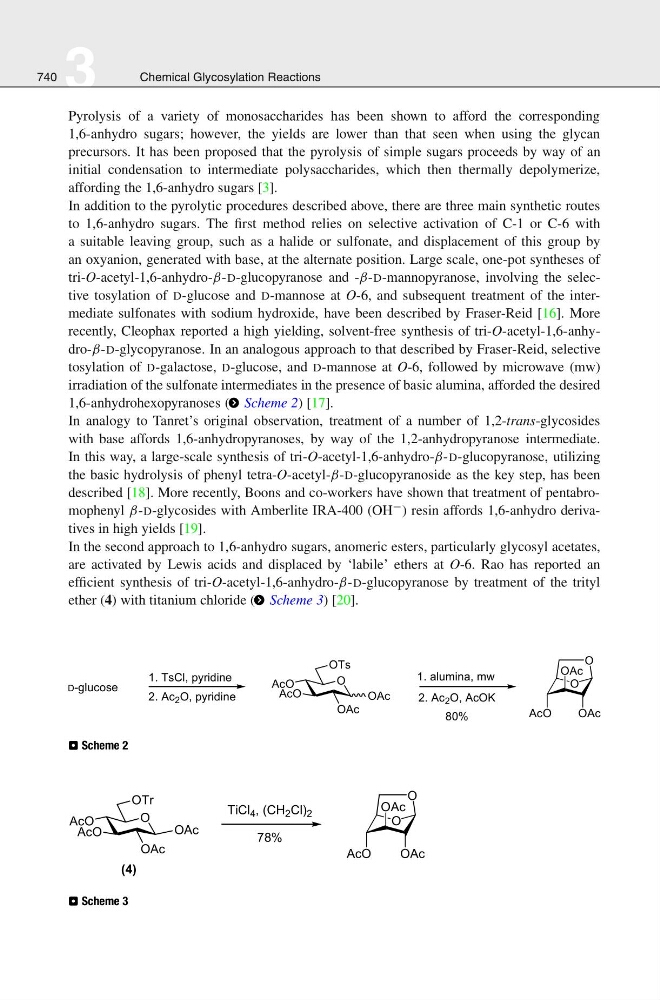
tri-O-acetyl-1,6-anhydro-β-D-glucopyranose and -β-D-mannopyranose, involving the selective tosylation of D-glucose and D-mannose at O-6, and subsequent treatment of the intermediate sulfonates with sodium hydroxide, have been described by Fraser-Reid [16]. More
recently, Cleophax reported a high yielding, solvent-free synthesis of tri-O-acetyl-1,6-anhydro-β-D-glycopyranose. In an analogous approach to that described by Fraser-Reid, selective
tosylation of D-galactose, D-glucose, and D-mannose at O-6, followed by microwave (mw)
irradiation of the sulfonate intermediates in the presence of basic alumina, afforded the desired
1,6-anhydrohexopyranoses ( > Scheme 2) [17].
In analogy to Tanret’s original observation, treatment of a number of 1,2-trans-glycosides
with base affords 1,6-anhydropyranoses, by way of the 1,2-anhydropyranose intermediate.
In this way, a large-scale synthesis of tri-O-acetyl-1,6-anhydro-β-D-glucopyranose, utilizing
the basic hydrolysis of phenyl tetra-O-acetyl-β-D-glucopyranoside as the key step, has been
described [18]. More recently, Boons and co-workers have shown that treatment of pentabromophenyl β-D-glycosides with Amberlite IRA-400 (OH − ) resin affords 1,6-anhydro derivatives in high yields [19].
In the second approach to 1,6-anhydro sugars, anomeric esters, particularly glycosyl acetates,
are activated by Lewis acids and displaced by ‘labile’ ethers at O-6. Rao has reported an
efficient synthesis of tri-O-acetyl-1,6-anhydro-β-D-glucopyranose by treatment of the trityl
ether (4) with titanium chloride ( > Scheme 3) [20].
⊡ Scheme 2
⊡ Scheme 3