

Anomeric Anhydro Sugars
3.7
739
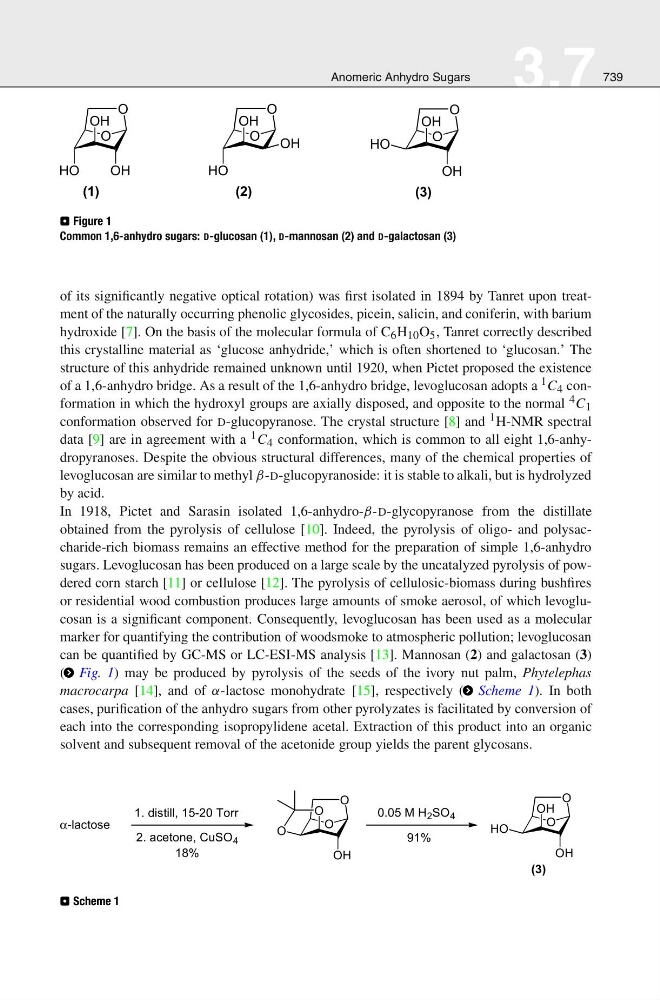
⊡ Figure 1
Common 1,6-anhydro sugars: D-glucosan (1), D-mannosan (2) and D-galactosan (3)
of its significantly negative optical rotation) was first isolated in 1894 by Tanret upon treatment of the naturally occurring phenolic glycosides, picein, salicin, and coniferin, with barium
hydroxide [7]. On the basis of the molecular formula of C 6 H 10 O 5 , Tanret correctly described
this crystalline material as ‘glucose anhydride,’ which is often shortened to ‘glucosan.’ The
structure of this anhydride remained unknown until 1920, when Pictet proposed the existence
of a 1,6-anhydro bridge. As a result of the 1,6-anhydro bridge, levoglucosan adopts a 1 C 4 conformation in which the hydroxyl groups are axially disposed, and opposite to the normal 4 C 1
conformation observed for D-glucopyranose. The crystal structure [8] and 1 H-NMR spectral
data [9] are in agreement with a 1 C 4 conformation, which is common to all eight 1,6-anhydropyranoses. Despite the obvious structural differences, many of the chemical properties of
levoglucosan are similar to methyl β-D-glucopyranoside: it is stable to alkali, but is hydrolyzed
by acid.
In 1918, Pictet and Sarasin isolated 1,6-anhydro-β-D-glycopyranose from the distillate
obtained from the pyrolysis of cellulose [10]. Indeed, the pyrolysis of oligo- and polysaccharide-rich biomass remains an effective method for the preparation of simple 1,6-anhydro
sugars. Levoglucosan has been produced on a large scale by the uncatalyzed pyrolysis of powdered corn starch [11] or cellulose [12]. The pyrolysis of cellulosic-biomass during bushfires
or residential wood combustion produces large amounts of smoke aerosol, of which levoglucosan is a significant component. Consequently, levoglucosan has been used as a molecular
marker for quantifying the contribution of woodsmoke to atmospheric pollution; levoglucosan
can be quantified by GC-MS or LC-ESI-MS analysis [13]. Mannosan (2) and galactosan (3)
( > Fig. 1) may be produced by pyrolysis of the seeds of the ivory nut palm, Phytelephas
macrocarpa [14], and of α-lactose monohydrate [15], respectively ( > Scheme 1). In both
cases, purification of the anhydro sugars from other pyrolyzates is facilitated by conversion of
each into the corresponding isopropylidene acetal. Extraction of this product into an organic
solvent and subsequent removal of the acetonide group yields the parent glycosans.
⊡ Scheme 1