

726
3
Chemical Glycosylation Reactions
9 Preparation of exo-Glycals
Exomethylene monosaccharide derivatives became of interest in connection with increased
application of C-glycosyl synthons in the preparation of glycomimetics intended as glycosidase inhibitors and glycoconjugates. Their syntheses and uses have been comprehensively
reviewed [240].
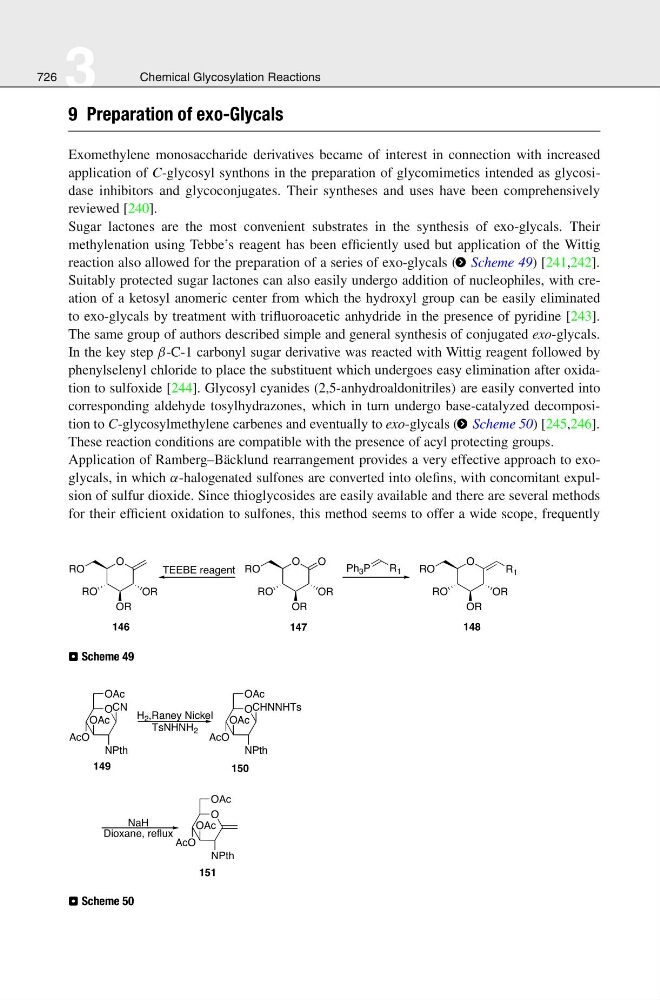
Sugar lactones are the most convenient substrates in the synthesis of exo-glycals. Their
methylenation using Tebbe’s reagent has been efficiently used but application of the Wittig
reaction also allowed for the preparation of a series of exo-glycals ( > Scheme 49) [241,242].
Suitably protected sugar lactones can also easily undergo addition of nucleophiles, with creation of a ketosyl anomeric center from which the hydroxyl group can be easily eliminated
to exo-glycals by treatment with trifluoroacetic anhydride in the presence of pyridine [243].
The same group of authors described simple and general synthesis of conjugated exo-glycals.
In the key step β-C-1 carbonyl sugar derivative was reacted with Wittig reagent followed by
phenylselenyl chloride to place the substituent which undergoes easy elimination after oxidation to sulfoxide [244]. Glycosyl cyanides (2,5-anhydroaldonitriles) are easily converted into
corresponding aldehyde tosylhydrazones, which in turn undergo base-catalyzed decomposition to C-glycosylmethylene carbenes and eventually to exo-glycals ( > Scheme 50) [245,246].
These reaction conditions are compatible with the presence of acyl protecting groups.
Application of Ramberg–Bäcklund rearrangement provides a very effective approach to exoglycals, in which α-halogenated sulfones are converted into olefins, with concomitant expulsion of sulfur dioxide. Since thioglycosides are easily available and there are several methods
for their efficient oxidation to sulfones, this method seems to offer a wide scope, frequently
⊡ Scheme 49
⊡ Scheme 50