

Glycal Derivatives
3.6
725
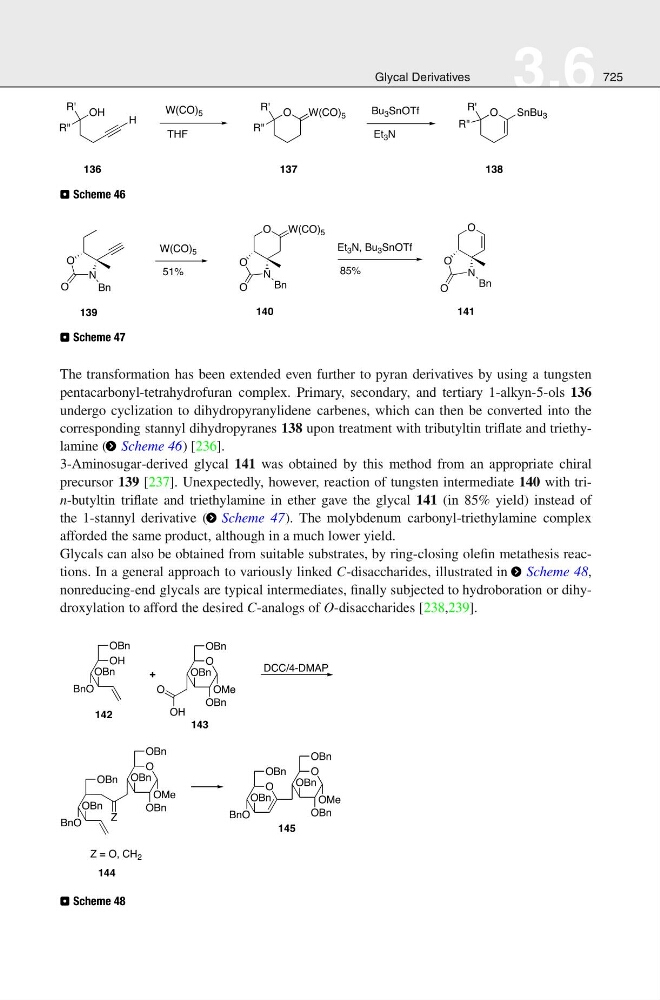
⊡ Scheme 46
⊡ Scheme 47
The transformation has been extended even further to pyran derivatives by using a tungsten
pentacarbonyl-tetrahydrofuran complex. Primary, secondary, and tertiary 1-alkyn-5-ols 136
undergo cyclization to dihydropyranylidene carbenes, which can then be converted into the
corresponding stannyl dihydropyranes 138 upon treatment with tributyltin triflate and triethylamine ( > Scheme 46) [236].
3-Aminosugar-derived glycal 141 was obtained by this method from an appropriate chiral
precursor 139 [237]. Unexpectedly, however, reaction of tungsten intermediate 140 with trin-butyltin triflate and triethylamine in ether gave the glycal 141 (in 85% yield) instead of
the 1-stannyl derivative ( > Scheme 47). The molybdenum carbonyl-triethylamine complex
afforded the same product, although in a much lower yield.
Glycals can also be obtained from suitable substrates, by ring-closing olefin metathesis reactions. In a general approach to variously linked C-disaccharides, illustrated in > Scheme 48,
nonreducing-end glycals are typical intermediates, finally subjected to hydroboration or dihydroxylation to afford the desired C-analogs of O-disaccharides [238,239].
⊡ Scheme 48