

718
3
Chemical Glycosylation Reactions
Ferrier rearrangement prediction, that soft bases preferentially form bonds with a carbenium
ion at C-3, leading to novel glycals modified at C-3 (see below the synthesis of 3-thiomethyl
glycal 86), and that borderline bases can form both C-1 and C-3 substituted products [170].
Priebe and Zamojski also clearly demonstrated that reaction of glycals with nucleophiles is
reversible and that substrates, as well as kinetically controlled products, are prone to generate
intermediate carbenium ions before attaining thermodynamic equilibrium [170]. Thus, alcohols and other O-nucleophiles end up as anomeric (a hard acidic center) substituents, while S(86) [170], N- [173,174], and C- [175] anions tend to form a new bond at C-3 (soft center),
which leads to substituted glycals ( > Scheme 29).
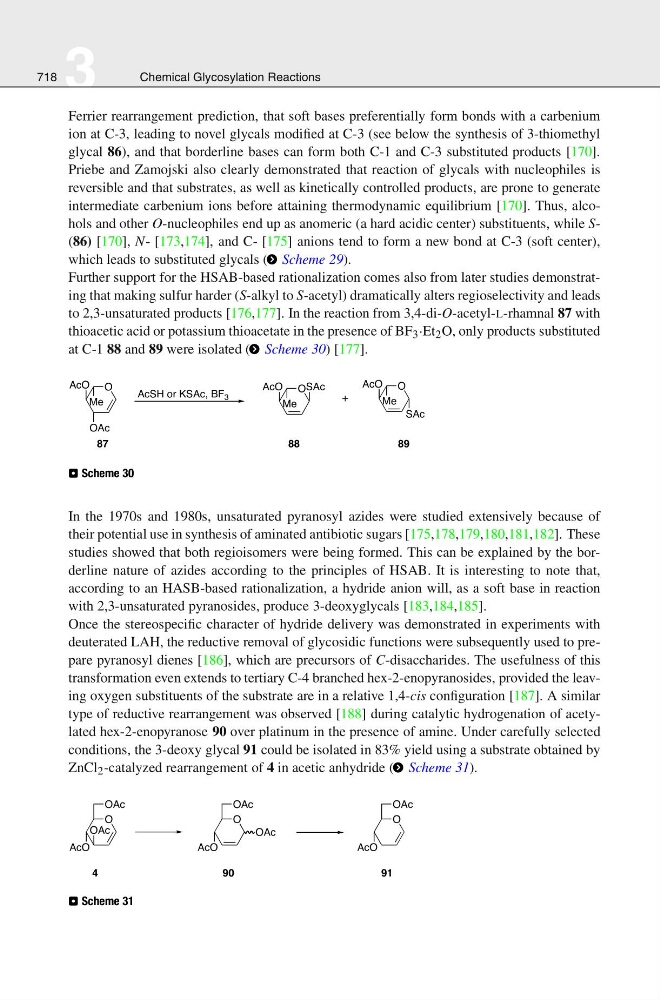
Further support for the HSAB-based rationalization comes also from later studies demonstrating that making sulfur harder (S-alkyl to S-acetyl) dramatically alters regioselectivity and leads
to 2,3-unsaturated products [176,177]. In the reaction from 3,4-di-O-acetyl-L-rhamnal 87 with
thioacetic acid or potassium thioacetate in the presence of BF 3 ·Et 2 O, only products substituted
at C-1 88 and 89 were isolated ( > Scheme 30) [177].
⊡ Scheme 30
In the 1970s and 1980s, unsaturated pyranosyl azides were studied extensively because of
their potential use in synthesis of aminated antibiotic sugars [175,178,179,180,181,182]. These
studies showed that both regioisomers were being formed. This can be explained by the borderline nature of azides according to the principles of HSAB. It is interesting to note that,
according to an HASB-based rationalization, a hydride anion will, as a soft base in reaction
with 2,3-unsaturated pyranosides, produce 3-deoxyglycals [183,184,185].
Once the stereospecific character of hydride delivery was demonstrated in experiments with
deuterated LAH, the reductive removal of glycosidic functions were subsequently used to prepare pyranosyl dienes [186], which are precursors of C-disaccharides. The usefulness of this
transformation even extends to tertiary C-4 branched hex-2-enopyranosides, provided the leaving oxygen substituents of the substrate are in a relative 1,4-cis configuration [187]. A similar
type of reductive rearrangement was observed [188] during catalytic hydrogenation of acetylated hex-2-enopyranose 90 over platinum in the presence of amine. Under carefully selected
conditions, the 3-deoxy glycal 91 could be isolated in 83% yield using a substrate obtained by
ZnCl 2 -catalyzed rearrangement of 4 in acetic anhydride ( > Scheme 31).
⊡ Scheme 31