

Glycal Derivatives
3.6
717
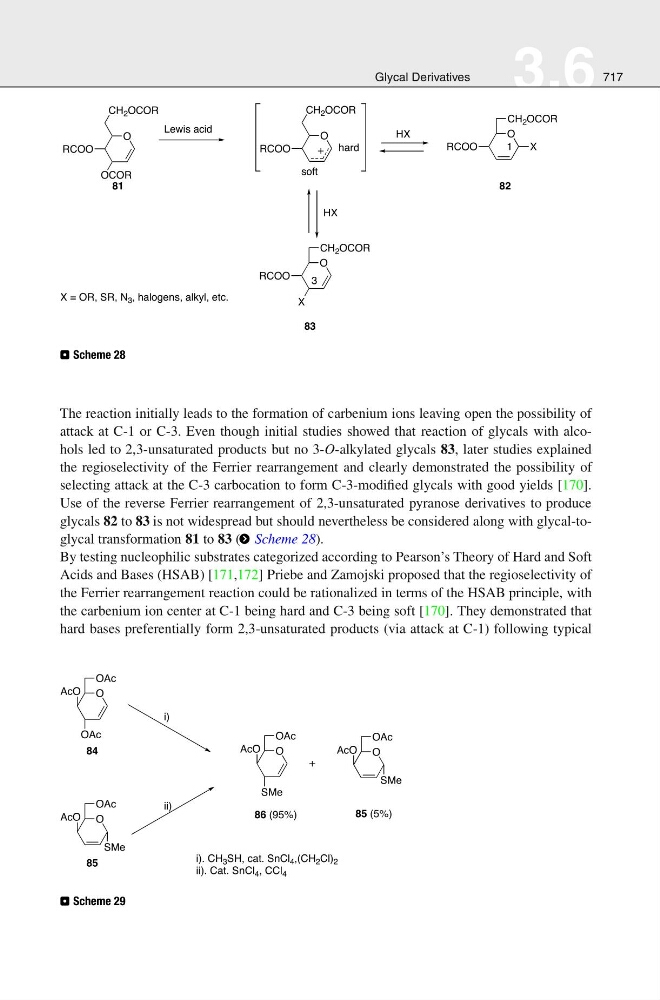
⊡ Scheme 28
The reaction initially leads to the formation of carbenium ions leaving open the possibility of
attack at C-1 or C-3. Even though initial studies showed that reaction of glycals with alcohols led to 2,3-unsaturated products but no 3-O-alkylated glycals 83, later studies explained
the regioselectivity of the Ferrier rearrangement and clearly demonstrated the possibility of
selecting attack at the C-3 carbocation to form C-3-modified glycals with good yields [170].
Use of the reverse Ferrier rearrangement of 2,3-unsaturated pyranose derivatives to produce
glycals 82 to 83 is not widespread but should nevertheless be considered along with glycal-toglycal transformation 81 to 83 ( > Scheme 28).
By testing nucleophilic substrates categorized according to Pearson’s Theory of Hard and Soft
Acids and Bases (HSAB) [171,172] Priebe and Zamojski proposed that the regioselectivity of
the Ferrier rearrangement reaction could be rationalized in terms of the HSAB principle, with
the carbenium ion center at C-1 being hard and C-3 being soft [170]. They demonstrated that
hard bases preferentially form 2,3-unsaturated products (via attack at C-1) following typical
⊡ Scheme 29