

S-Glycosylation
3.5
683
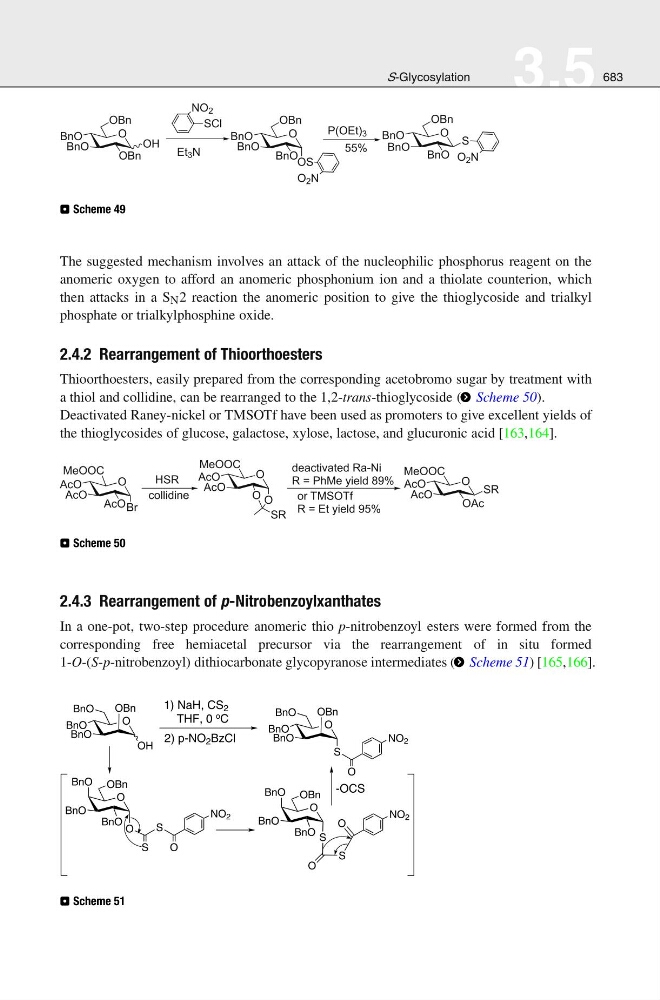
⊡ Scheme 49
The suggested mechanism involves an attack of the nucleophilic phosphorus reagent on the
anomeric oxygen to afford an anomeric phosphonium ion and a thiolate counterion, which
then attacks in a S N 2 reaction the anomeric position to give the thioglycoside and trialkyl
phosphate or trialkylphosphine oxide.
2.4.2 Rearrangement of Thioorthoesters
Thioorthoesters, easily prepared from the corresponding acetobromo sugar by treatment with
a thiol and collidine, can be rearranged to the 1,2-trans-thioglycoside ( > Scheme 50).
Deactivated Raney-nickel or TMSOTf have been used as promoters to give excellent yields of
the thioglycosides of glucose, galactose, xylose, lactose, and glucuronic acid [163,164].
⊡ Scheme 50
2.4.3 Rearrangement of p-Nitrobenzoylxanthates
In a one-pot, two-step procedure anomeric thio p-nitrobenzoyl esters were formed from the
corresponding free hemiacetal precursor via the rearrangement of in situ formed
1-O-(S-p-nitrobenzoyl) dithiocarbonate glycopyranose intermediates ( > Scheme 51) [165,166].
⊡ Scheme 51