

682
3
Chemical Glycosylation Reactions
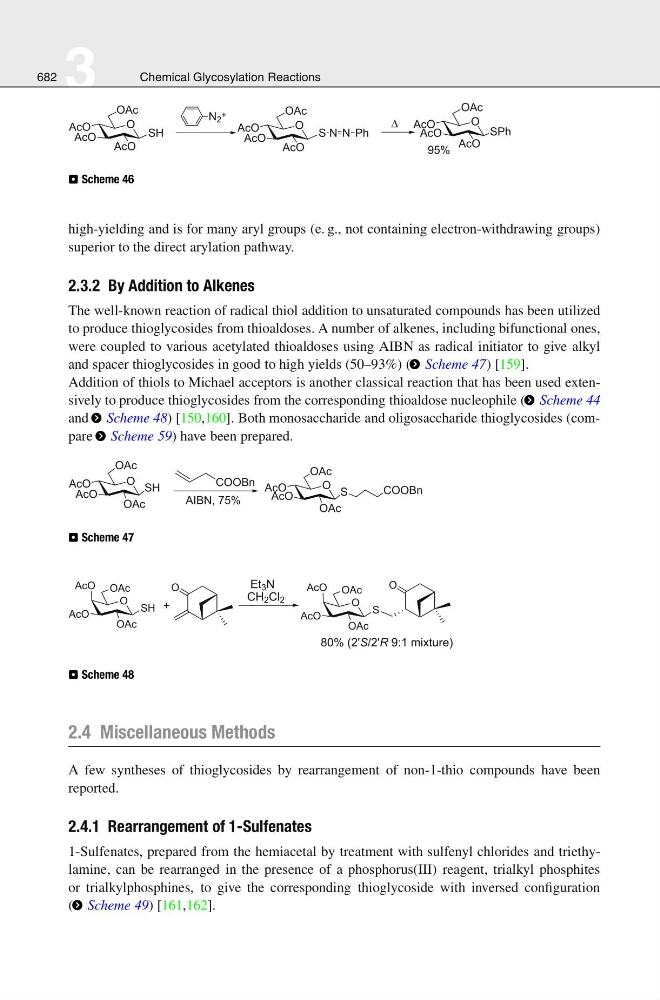
⊡ Scheme 46
high-yielding and is for many aryl groups (e. g., not containing electron-withdrawing groups)
superior to the direct arylation pathway.
2.3.2 By Addition to Alkenes
The well-known reaction of radical thiol addition to unsaturated compounds has been utilized
to produce thioglycosides from thioaldoses. A number of alkenes, including bifunctional ones,
were coupled to various acetylated thioaldoses using AIBN as radical initiator to give alkyl
and spacer thioglycosides in good to high yields (50–93%) ( > Scheme 47) [159].
Addition of thiols to Michael acceptors is another classical reaction that has been used extensively to produce thioglycosides from the corresponding thioaldose nucleophile ( > Scheme 44
and > Scheme 48) [150,160]. Both monosaccharide and oligosaccharide thioglycosides (compare > Scheme 59) have been prepared.
⊡ Scheme 47
⊡ Scheme 48
2.4 Miscellaneous Methods
A few syntheses of thioglycosides by rearrangement of non-1-thio compounds have been
reported.
2.4.1 Rearrangement of 1-Sulfenates
1-Sulfenates, prepared from the hemiacetal by treatment with sulfenyl chlorides and triethylamine, can be rearranged in the presence of a phosphorus(III) reagent, trialkyl phosphites
or trialkylphosphines, to give the corresponding thioglycoside with inversed configuration
( > Scheme 49) [161,162].