

604
3
Chemical Glycosylation Reactions
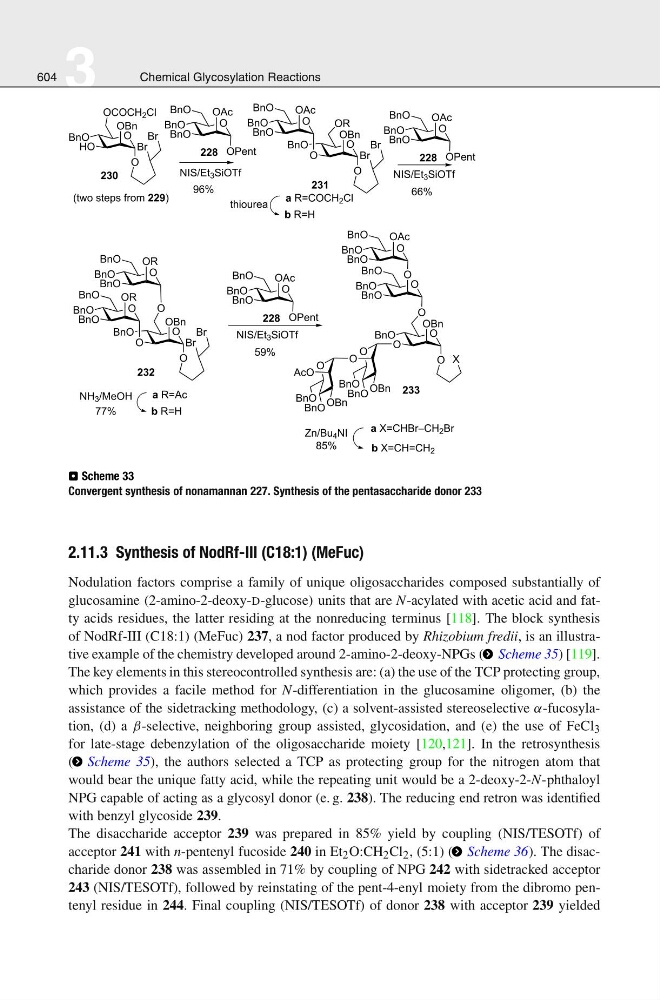
⊡ Scheme 33
Convergent synthesis of nonamannan 227. Synthesis of the pentasaccharide donor 233
2.11.3 Synthesis of NodRf-III (C18:1) (MeFuc)
Nodulation factors comprise a family of unique oligosaccharides composed substantially of
glucosamine (2-amino-2-deoxy-D-glucose) units that are N-acylated with acetic acid and fatty acids residues, the latter residing at the nonreducing terminus [118]. The block synthesis
of NodRf-III (C18:1) (MeFuc) 237, a nod factor produced by Rhizobium fredii, is an illustrative example of the chemistry developed around 2-amino-2-deoxy-NPGs ( > Scheme 35) [119].
The key elements in this stereocontrolled synthesis are: (a) the use of the TCP protecting group,
which provides a facile method for N-differentiation in the glucosamine oligomer, (b) the
assistance of the sidetracking methodology, (c) a solvent-assisted stereoselective α-fucosylation, (d) a β-selective, neighboring group assisted, glycosidation, and (e) the use of FeCl 3
for late-stage debenzylation of the oligosaccharide moiety [120,121]. In the retrosynthesis
( > Scheme 35), the authors selected a TCP as protecting group for the nitrogen atom that
would bear the unique fatty acid, while the repeating unit would be a 2-deoxy-2-N-phthaloyl
NPG capable of acting as a glycosyl donor (e. g. 238). The reducing end retron was identified
with benzyl glycoside 239.
The disaccharide acceptor 239 was prepared in 85% yield by coupling (NIS/TESOTf) of
acceptor 241 with n-pentenyl fucoside 240 in Et 2 O:CH 2 Cl 2 , (5:1) ( > Scheme 36). The disaccharide donor 238 was assembled in 71% by coupling of NPG 242 with sidetracked acceptor
243 (NIS/TESOTf), followed by reinstating of the pent-4-enyl moiety from the dibromo pentenyl residue in 244. Final coupling (NIS/TESOTf) of donor 238 with acceptor 239 yielded