

O-Glycosyl Donors
3.4
603
2.11.2 The Nonamannan Component of High Mannose Glycoproteins
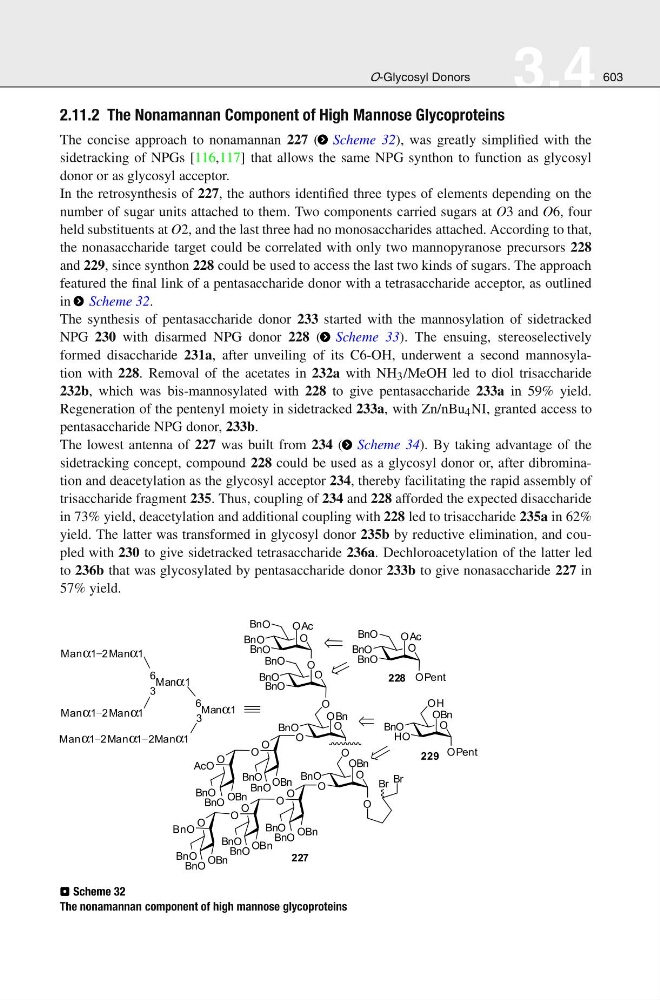
The concise approach to nonamannan 227 ( > Scheme 32), was greatly simplified with the
sidetracking of NPGs [116,117] that allows the same NPG synthon to function as glycosyl
donor or as glycosyl acceptor.
In the retrosynthesis of 227, the authors identified three types of elements depending on the
number of sugar units attached to them. Two components carried sugars at O3 and O6, four
held substituents at O2, and the last three had no monosaccharides attached. According to that,
the nonasaccharide target could be correlated with only two mannopyranose precursors 228
and 229, since synthon 228 could be used to access the last two kinds of sugars. The approach
featured the final link of a pentasaccharide donor with a tetrasaccharide acceptor, as outlined
in > Scheme 32.
The synthesis of pentasaccharide donor 233 started with the mannosylation of sidetracked
NPG 230 with disarmed NPG donor 228 ( > Scheme 33). The ensuing, stereoselectively
formed disaccharide 231a, after unveiling of its C6-OH, underwent a second mannosylation with 228. Removal of the acetates in 232a with NH 3 /MeOH led to diol trisaccharide
232b, which was bis-mannosylated with 228 to give pentasaccharide 233a in 59% yield.
Regeneration of the pentenyl moiety in sidetracked 233a, with Zn/nBu 4 NI, granted access to
pentasaccharide NPG donor, 233b.
The lowest antenna of 227 was built from 234 ( > Scheme 34). By taking advantage of the
sidetracking concept, compound 228 could be used as a glycosyl donor or, after dibromination and deacetylation as the glycosyl acceptor 234, thereby facilitating the rapid assembly of
trisaccharide fragment 235. Thus, coupling of 234 and 228 afforded the expected disaccharide
in 73% yield, deacetylation and additional coupling with 228 led to trisaccharide 235a in 62%
yield. The latter was transformed in glycosyl donor 235b by reductive elimination, and coupled with 230 to give sidetracked tetrasaccharide 236a. Dechloroacetylation of the latter led
to 236b that was glycosylated by pentasaccharide donor 233b to give nonasaccharide 227 in
57% yield.
⊡ Scheme 32
The nonamannan component of high mannose glycoproteins