

554
3
Chemical Glycosylation Reactions
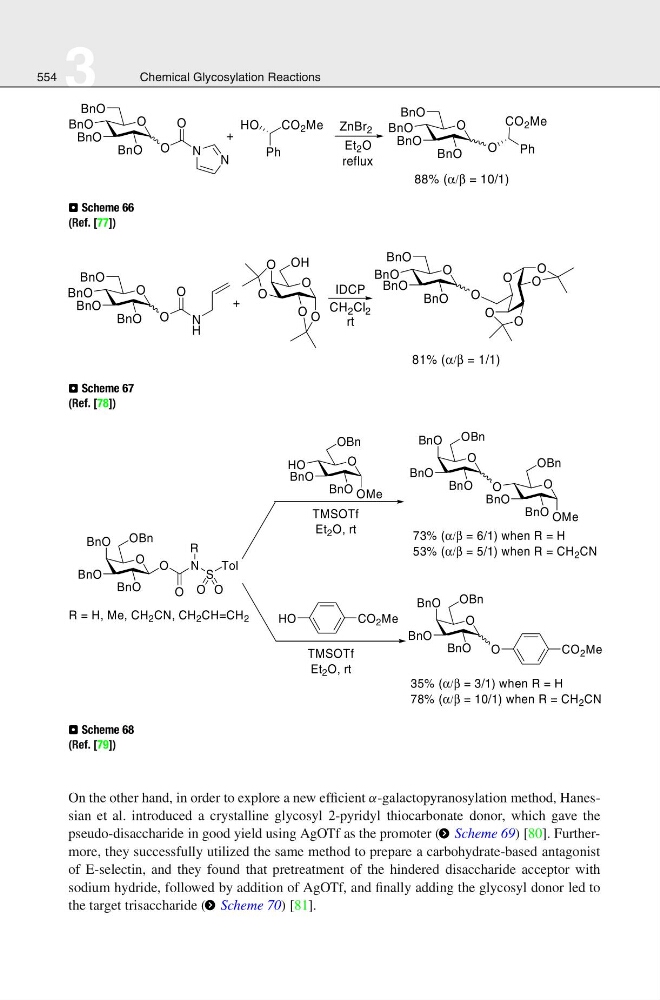
⊡ Scheme 66
(Ref. [77])
⊡ Scheme 67
(Ref. [78])
⊡ Scheme 68
(Ref. [79])
On the other hand, in order to explore a new efficient α-galactopyranosylation method, Hanessian et al. introduced a crystalline glycosyl 2-pyridyl thiocarbonate donor, which gave the
pseudo-disaccharide in good yield using AgOTf as the promoter ( > Scheme 69) [80]. Furthermore, they successfully utilized the same method to prepare a carbohydrate-based antagonist
of E-selectin, and they found that pretreatment of the hindered disaccharide acceptor with
sodium hydride, followed by addition of AgOTf, and finally adding the glycosyl donor led to
the target trisaccharide ( > Scheme 70) [81].
3
Chemical Glycosylation Reactions
⊡ Scheme 66
(Ref. [77])
⊡ Scheme 67
(Ref. [78])
⊡ Scheme 68
(Ref. [79])
On the other hand, in order to explore a new efficient α-galactopyranosylation method, Hanessian et al. introduced a crystalline glycosyl 2-pyridyl thiocarbonate donor, which gave the
pseudo-disaccharide in good yield using AgOTf as the promoter ( > Scheme 69) [80]. Furthermore, they successfully utilized the same method to prepare a carbohydrate-based antagonist
of E-selectin, and they found that pretreatment of the hindered disaccharide acceptor with
sodium hydride, followed by addition of AgOTf, and finally adding the glycosyl donor led to
the target trisaccharide ( > Scheme 70) [81].