

Further Anomeric Esters
3.3
553
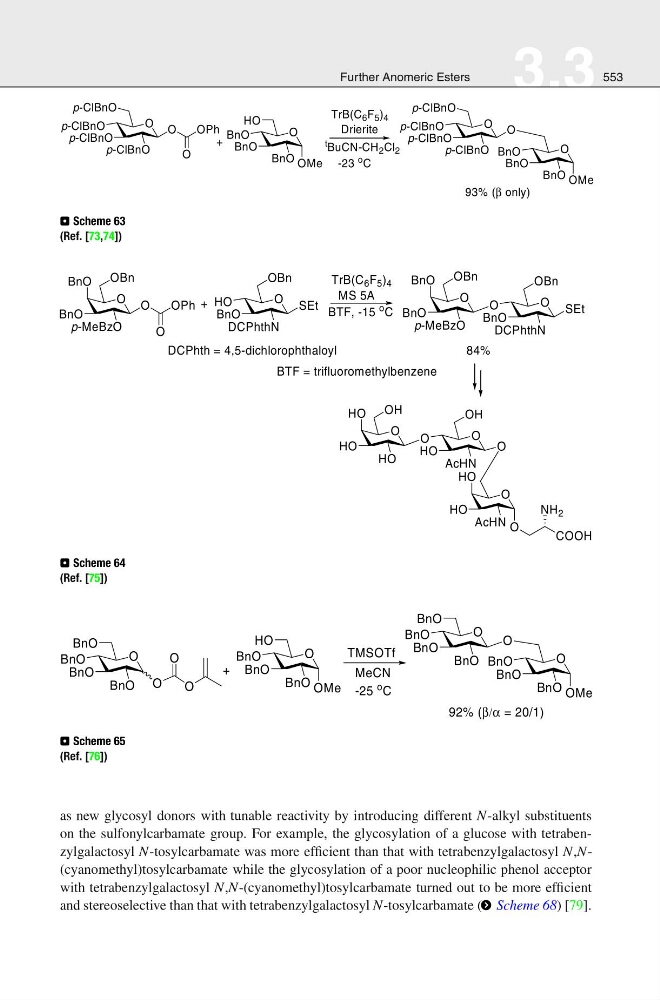
⊡ Scheme 63
(Ref. [73,74])
⊡ Scheme 64
(Ref. [75])
⊡ Scheme 65
(Ref. [76])
as new glycosyl donors with tunable reactivity by introducing different N-alkyl substituents
on the sulfonylcarbamate group. For example, the glycosylation of a glucose with tetrabenzylgalactosyl N-tosylcarbamate was more efficient than that with tetrabenzylgalactosyl N,N(cyanomethyl)tosylcarbamate while the glycosylation of a poor nucleophilic phenol acceptor
with tetrabenzylgalactosyl N,N-(cyanomethyl)tosylcarbamate turned out to be more efficient
and stereoselective than that with tetrabenzylgalactosyl N-tosylcarbamate ( > Scheme 68) [79].
3.3
553
⊡ Scheme 63
(Ref. [73,74])
⊡ Scheme 64
(Ref. [75])
⊡ Scheme 65
(Ref. [76])
as new glycosyl donors with tunable reactivity by introducing different N-alkyl substituents
on the sulfonylcarbamate group. For example, the glycosylation of a glucose with tetrabenzylgalactosyl N-tosylcarbamate was more efficient than that with tetrabenzylgalactosyl N,N(cyanomethyl)tosylcarbamate while the glycosylation of a poor nucleophilic phenol acceptor
with tetrabenzylgalactosyl N,N-(cyanomethyl)tosylcarbamate turned out to be more efficient
and stereoselective than that with tetrabenzylgalactosyl N-tosylcarbamate ( > Scheme 68) [79].