

Further Anomeric Esters
3.3
531
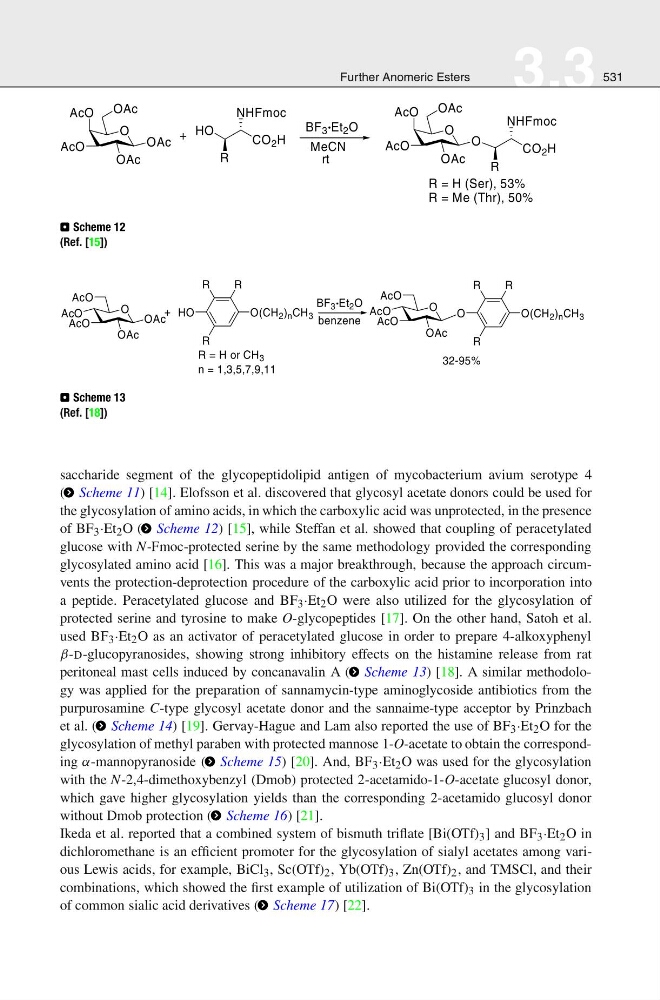
⊡ Scheme 12
(Ref. [15])
⊡ Scheme 13
(Ref. [18])
saccharide segment of the glycopeptidolipid antigen of mycobacterium avium serotype 4
( > Scheme 11) [14]. Elofsson et al. discovered that glycosyl acetate donors could be used for
the glycosylation of amino acids, in which the carboxylic acid was unprotected, in the presence
of BF 3 ·Et 2 O ( > Scheme 12) [15], while Steffan et al. showed that coupling of peracetylated
glucose with N-Fmoc-protected serine by the same methodology provided the corresponding
glycosylated amino acid [16]. This was a major breakthrough, because the approach circumvents the protection-deprotection procedure of the carboxylic acid prior to incorporation into
a peptide. Peracetylated glucose and BF 3 ·Et 2 O were also utilized for the glycosylation of
protected serine and tyrosine to make O-glycopeptides [17]. On the other hand, Satoh et al.
used BF 3 ·Et 2 O as an activator of peracetylated glucose in order to prepare 4-alkoxyphenyl
β-D-glucopyranosides, showing strong inhibitory effects on the histamine release from rat
peritoneal mast cells induced by concanavalin A ( > Scheme 13) [18]. A similar methodology was applied for the preparation of sannamycin-type aminoglycoside antibiotics from the
purpurosamine C-type glycosyl acetate donor and the sannaime-type acceptor by Prinzbach
et al. ( > Scheme 14) [19]. Gervay-Hague and Lam also reported the use of BF 3 ·Et 2 O for the
glycosylation of methyl paraben with protected mannose 1-O-acetate to obtain the corresponding α-mannopyranoside ( > Scheme 15) [20]. And, BF 3 ·Et 2 O was used for the glycosylation
with the N-2,4-dimethoxybenzyl (Dmob) protected 2-acetamido-1-O-acetate glucosyl donor,
which gave higher glycosylation yields than the corresponding 2-acetamido glucosyl donor
without Dmob protection ( > Scheme 16) [21].
Ikeda et al. reported that a combined system of bismuth triflate [Bi(OTf) 3 ] and BF 3 ·Et 2 O in
dichloromethane is an efficient promoter for the glycosylation of sialyl acetates among various Lewis acids, for example, BiCl 3 , Sc(OTf) 2 , Yb(OTf) 3 , Zn(OTf) 2 , and TMSCl, and their
combinations, which showed the first example of utilization of Bi(OTf) 3 in the glycosylation
of common sialic acid derivatives ( > Scheme 17) [22].
3.3
531
⊡ Scheme 12
(Ref. [15])
⊡ Scheme 13
(Ref. [18])
saccharide segment of the glycopeptidolipid antigen of mycobacterium avium serotype 4
( > Scheme 11) [14]. Elofsson et al. discovered that glycosyl acetate donors could be used for
the glycosylation of amino acids, in which the carboxylic acid was unprotected, in the presence
of BF 3 ·Et 2 O ( > Scheme 12) [15], while Steffan et al. showed that coupling of peracetylated
glucose with N-Fmoc-protected serine by the same methodology provided the corresponding
glycosylated amino acid [16]. This was a major breakthrough, because the approach circumvents the protection-deprotection procedure of the carboxylic acid prior to incorporation into
a peptide. Peracetylated glucose and BF 3 ·Et 2 O were also utilized for the glycosylation of
protected serine and tyrosine to make O-glycopeptides [17]. On the other hand, Satoh et al.
used BF 3 ·Et 2 O as an activator of peracetylated glucose in order to prepare 4-alkoxyphenyl
β-D-glucopyranosides, showing strong inhibitory effects on the histamine release from rat
peritoneal mast cells induced by concanavalin A ( > Scheme 13) [18]. A similar methodology was applied for the preparation of sannamycin-type aminoglycoside antibiotics from the
purpurosamine C-type glycosyl acetate donor and the sannaime-type acceptor by Prinzbach
et al. ( > Scheme 14) [19]. Gervay-Hague and Lam also reported the use of BF 3 ·Et 2 O for the
glycosylation of methyl paraben with protected mannose 1-O-acetate to obtain the corresponding α-mannopyranoside ( > Scheme 15) [20]. And, BF 3 ·Et 2 O was used for the glycosylation
with the N-2,4-dimethoxybenzyl (Dmob) protected 2-acetamido-1-O-acetate glucosyl donor,
which gave higher glycosylation yields than the corresponding 2-acetamido glucosyl donor
without Dmob protection ( > Scheme 16) [21].
Ikeda et al. reported that a combined system of bismuth triflate [Bi(OTf) 3 ] and BF 3 ·Et 2 O in
dichloromethane is an efficient promoter for the glycosylation of sialyl acetates among various Lewis acids, for example, BiCl 3 , Sc(OTf) 2 , Yb(OTf) 3 , Zn(OTf) 2 , and TMSCl, and their
combinations, which showed the first example of utilization of Bi(OTf) 3 in the glycosylation
of common sialic acid derivatives ( > Scheme 17) [22].