

Further Anomeric Esters
3.3
529
noses ( > Scheme 5) [7] and the synthesis of novel meso-glycosylarylporphyrins by the similar
methodology [8].
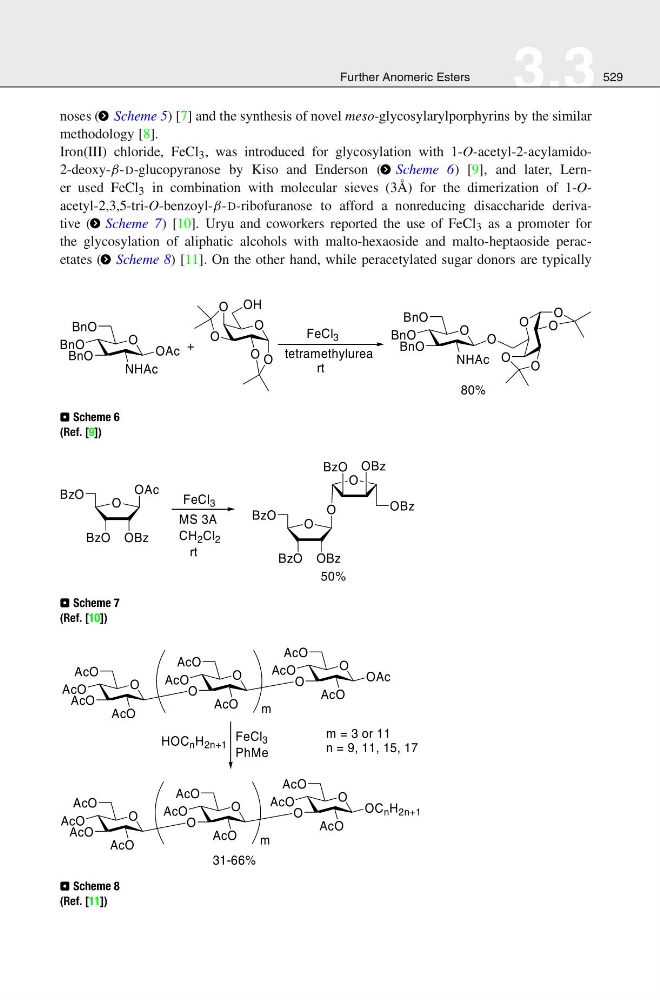
Iron(III) chloride, FeCl 3 , was introduced for glycosylation with 1-O-acetyl-2-acylamido2-deoxy-β-D-glucopyranose by Kiso and Enderson ( > Scheme 6) [9], and later, Lerner used FeCl 3 in combination with molecular sieves (3Å) for the dimerization of 1-Oacetyl-2,3,5-tri-O-benzoyl-β-D-ribofuranose to afford a nonreducing disaccharide derivative ( > Scheme 7) [10]. Uryu and coworkers reported the use of FeCl 3 as a promoter for
the glycosylation of aliphatic alcohols with malto-hexaoside and malto-heptaoside peracetates ( > Scheme 8) [11]. On the other hand, while peracetylated sugar donors are typically
⊡ Scheme 6
(Ref. [9])
⊡ Scheme 7
(Ref. [10])
⊡ Scheme 8
(Ref. [11])
3.3
529
noses ( > Scheme 5) [7] and the synthesis of novel meso-glycosylarylporphyrins by the similar
methodology [8].
Iron(III) chloride, FeCl 3 , was introduced for glycosylation with 1-O-acetyl-2-acylamido2-deoxy-β-D-glucopyranose by Kiso and Enderson ( > Scheme 6) [9], and later, Lerner used FeCl 3 in combination with molecular sieves (3Å) for the dimerization of 1-Oacetyl-2,3,5-tri-O-benzoyl-β-D-ribofuranose to afford a nonreducing disaccharide derivative ( > Scheme 7) [10]. Uryu and coworkers reported the use of FeCl 3 as a promoter for
the glycosylation of aliphatic alcohols with malto-hexaoside and malto-heptaoside peracetates ( > Scheme 8) [11]. On the other hand, while peracetylated sugar donors are typically
⊡ Scheme 6
(Ref. [9])
⊡ Scheme 7
(Ref. [10])
⊡ Scheme 8
(Ref. [11])