

Further Anomeric Esters
3.3
527
⊡ Table 1
Glycosylation with 1-O-acetyl sugar
Promoters
X
References
TsOH
H
[1,2]
ZnCl 2
H
[1]
SnCl 4
H
[3,4,5,6,7,8]
FeCl 3
H
[9,10,11,12]
BF 3 ·Et 2 O
H
[13,14,15,16,17,18,19,20,21]
BF 3 ·Et 2 O/Bi(OTf) 3
H
[22]
TMSOTf
H
[23,24,25,26,27,28,29,30,31,32,33,34,35,36,37,40,41,42]
TBSOTf
H
[35,38,39]
TrClO 4
H
[43,44]
SnCl 4 /Sn(OTf) 2 /LiClO 4
TMS [45]
SnCl 4 /AgClO 4
TMS [46,47,49]
GaCl 3 /AgClO 4
TMS [47]
Me 2 SiCl 2 /AgClO 4
H
[48]
K-10 montmorillonite
H
[50]
Yb[N(O 2 SC 4 F 9 ) 2 ] 3
H
[51]
TMSCl/Zn(OTf) 2
H
[52,53]
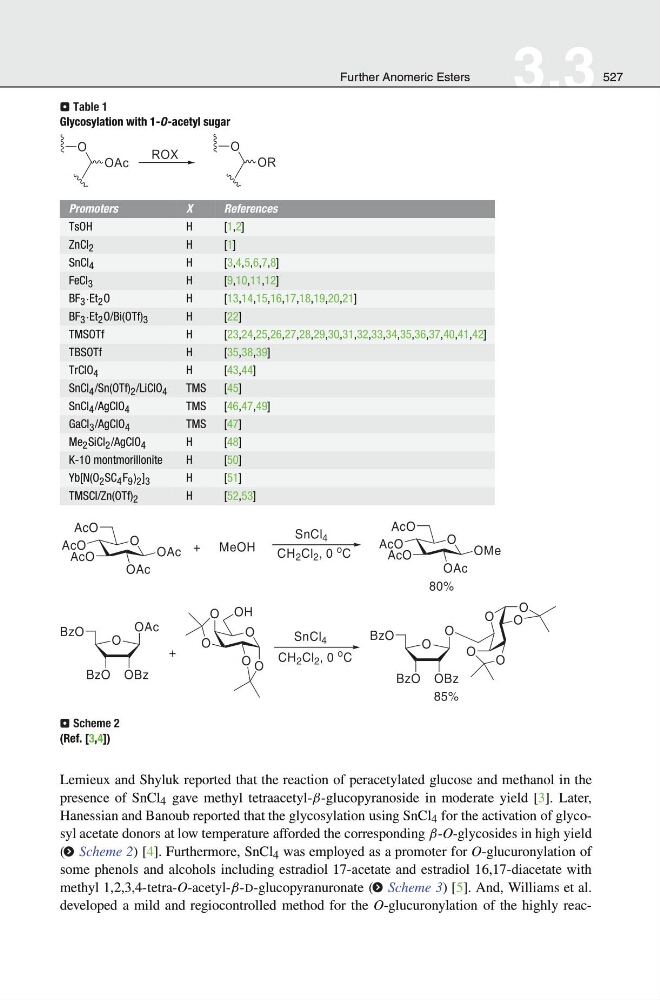
⊡ Scheme 2
(Ref. [3,4])
Lemieux and Shyluk reported that the reaction of peracetylated glucose and methanol in the
presence of SnCl 4 gave methyl tetraacetyl-β-glucopyranoside in moderate yield [3]. Later,
Hanessian and Banoub reported that the glycosylation using SnCl 4 for the activation of glycosyl acetate donors at low temperature afforded the corresponding β-O-glycosides in high yield
( > Scheme 2) [4]. Furthermore, SnCl 4 was employed as a promoter for O-glucuronylation of
some phenols and alcohols including estradiol 17-acetate and estradiol 16,17-diacetate with
methyl 1,2,3,4-tetra-O-acetyl-β-D-glucopyranuronate ( > Scheme 3) [5]. And, Williams et al.
developed a mild and regiocontrolled method for the O-glucuronylation of the highly reac-
3.3
527
⊡ Table 1
Glycosylation with 1-O-acetyl sugar
Promoters
X
References
TsOH
H
[1,2]
ZnCl 2
H
[1]
SnCl 4
H
[3,4,5,6,7,8]
FeCl 3
H
[9,10,11,12]
BF 3 ·Et 2 O
H
[13,14,15,16,17,18,19,20,21]
BF 3 ·Et 2 O/Bi(OTf) 3
H
[22]
TMSOTf
H
[23,24,25,26,27,28,29,30,31,32,33,34,35,36,37,40,41,42]
TBSOTf
H
[35,38,39]
TrClO 4
H
[43,44]
SnCl 4 /Sn(OTf) 2 /LiClO 4
TMS [45]
SnCl 4 /AgClO 4
TMS [46,47,49]
GaCl 3 /AgClO 4
TMS [47]
Me 2 SiCl 2 /AgClO 4
H
[48]
K-10 montmorillonite
H
[50]
Yb[N(O 2 SC 4 F 9 ) 2 ] 3
H
[51]
TMSCl/Zn(OTf) 2
H
[52,53]
⊡ Scheme 2
(Ref. [3,4])
Lemieux and Shyluk reported that the reaction of peracetylated glucose and methanol in the
presence of SnCl 4 gave methyl tetraacetyl-β-glucopyranoside in moderate yield [3]. Later,
Hanessian and Banoub reported that the glycosylation using SnCl 4 for the activation of glycosyl acetate donors at low temperature afforded the corresponding β-O-glycosides in high yield
( > Scheme 2) [4]. Furthermore, SnCl 4 was employed as a promoter for O-glucuronylation of
some phenols and alcohols including estradiol 17-acetate and estradiol 16,17-diacetate with
methyl 1,2,3,4-tetra-O-acetyl-β-D-glucopyranuronate ( > Scheme 3) [5]. And, Williams et al.
developed a mild and regiocontrolled method for the O-glucuronylation of the highly reac-