

526
3
Chemical Glycosylation Reactions
1 Introduction
An advantage of the 1-O-acylated glycosyl donors in the glycosylation method is undoubtedly
the ease of their preparation. The most representative anomeric functional group in this area is
the acetyl group. Glycosyl acetates seem to be promising and useful glycosylating reagents due
to a variety of advantageous properties. Among these, the most important are their availability
and chemical stability, which allows one to obtain almost any desired amounts of glycosyl
acetates which can be stored for unlimited time without special precautions. Furthermore, glycosyl acetates can be precursors for glycosylating agents of other types, for example, glycosyl
halides, 1-thioglycosides, and glycosyl trichloroacetimidates. Therefore, the use of glycosyl
acetates can make glycosylation reactions easier and less expensive.
Because of the relatively low reactivity of glycosyl acetates they used to occasionally bring
about difficulty in controlling stereoselectivity. To overcome the problem associated with glycosyl acetates, several other anomeric acyl leaving groups, for example, ester-type leaving
groups such as haloacetyl, (2-methoxyethoxy)acetyl, benzoyl, p-nitrobenzoyl, 2-pyridinecarbonyl, pivaloyl, 4-pentenoyl, and 5-hexynoyl, and carbonate-type leaving groups such as phenoxycarbonyl, isopropenyloxycarbonyl, 1-imidazolylcarbonyl, N-allyl carbamoyl, sulfonylcarbamoyl, and 2-pyridyl thiocarbonyl, have been devised as new glycosyl donors. Furthermore, the methods of intramolecular glycosylation through the 1-O-acyl linkage and glycosylation with glycosyl donors having acyl groups remote from the anomeric center have been
developed to increase efficiency and stereoselectivity.
2 Glycosylation with Glycosyl Acetates
Generally the activation of glycosyl acetates is achieved in the presence of a Lewis acid. Since
Helferich et al. introduced the use of glycosyl acetates as glycosyl donors in the reaction with
phenol in the presence of p-toluenesulfonic acid (TsOH) or ZnCl 2 in 1933 [1], several Lewis
acids have been utilized as effective promoters in the glycosylation with glycosyl acetates.
The representative promoters used for the activation of glycosyl acetate donors for the glycosylation are summarized in > Table 1. TsOH was also used as a promoter of peracetylated
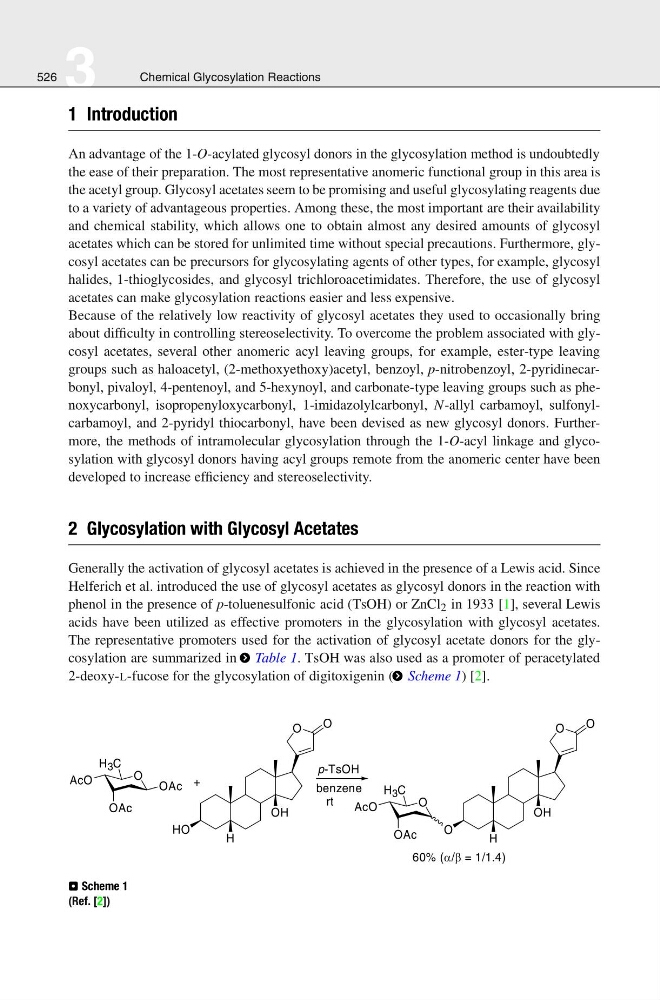
2-deoxy-L-fucose for the glycosylation of digitoxigenin ( > Scheme 1) [2].
⊡ Scheme 1
(Ref. [2])
3
Chemical Glycosylation Reactions
1 Introduction
An advantage of the 1-O-acylated glycosyl donors in the glycosylation method is undoubtedly
the ease of their preparation. The most representative anomeric functional group in this area is
the acetyl group. Glycosyl acetates seem to be promising and useful glycosylating reagents due
to a variety of advantageous properties. Among these, the most important are their availability
and chemical stability, which allows one to obtain almost any desired amounts of glycosyl
acetates which can be stored for unlimited time without special precautions. Furthermore, glycosyl acetates can be precursors for glycosylating agents of other types, for example, glycosyl
halides, 1-thioglycosides, and glycosyl trichloroacetimidates. Therefore, the use of glycosyl
acetates can make glycosylation reactions easier and less expensive.
Because of the relatively low reactivity of glycosyl acetates they used to occasionally bring
about difficulty in controlling stereoselectivity. To overcome the problem associated with glycosyl acetates, several other anomeric acyl leaving groups, for example, ester-type leaving
groups such as haloacetyl, (2-methoxyethoxy)acetyl, benzoyl, p-nitrobenzoyl, 2-pyridinecarbonyl, pivaloyl, 4-pentenoyl, and 5-hexynoyl, and carbonate-type leaving groups such as phenoxycarbonyl, isopropenyloxycarbonyl, 1-imidazolylcarbonyl, N-allyl carbamoyl, sulfonylcarbamoyl, and 2-pyridyl thiocarbonyl, have been devised as new glycosyl donors. Furthermore, the methods of intramolecular glycosylation through the 1-O-acyl linkage and glycosylation with glycosyl donors having acyl groups remote from the anomeric center have been
developed to increase efficiency and stereoselectivity.
2 Glycosylation with Glycosyl Acetates
Generally the activation of glycosyl acetates is achieved in the presence of a Lewis acid. Since
Helferich et al. introduced the use of glycosyl acetates as glycosyl donors in the reaction with
phenol in the presence of p-toluenesulfonic acid (TsOH) or ZnCl 2 in 1933 [1], several Lewis
acids have been utilized as effective promoters in the glycosylation with glycosyl acetates.
The representative promoters used for the activation of glycosyl acetate donors for the glycosylation are summarized in > Table 1. TsOH was also used as a promoter of peracetylated
2-deoxy-L-fucose for the glycosylation of digitoxigenin ( > Scheme 1) [2].
⊡ Scheme 1
(Ref. [2])