

516
3
Chemical Glycosylation Reactions
6 Related Activation Systems
O-Glycosyl trichloroacetimidates have become popular because they are easily available,
powerful glycosyl donors. Therefore, investigations were undertaken to provide glycosyl
donors which follow the principle of O-glycosyl trichloroacetimidate formation and activation. A short outline of this work is attached here.
Already previously trifluoroacetonitrile has been investigated for the generation of glycosyl
donors [12,331]. However, because trifluoroacetonitrile is a gas, its use is not as convenient as
the use of trichloroacetonitrile. In addition, preliminary glycosylation results were inferior to
those obtained with O-glycosyl trichloroacetimidates. Much more promising were studies with
dichloromalonitrile which is a suitable reagent for the base-catalyzed generation of O-glycosyl
dichloro-cyanoacetimidates [332,333]. These compounds exhibited glycosyl donor properties
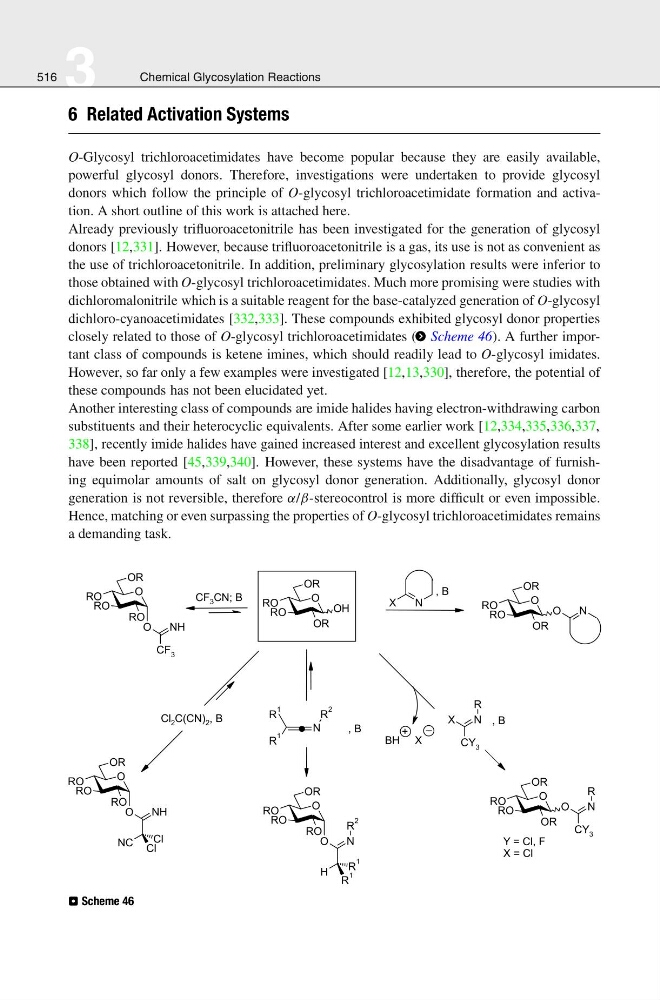
closely related to those of O-glycosyl trichloroacetimidates ( > Scheme 46). A further important class of compounds is ketene imines, which should readily lead to O-glycosyl imidates.
However, so far only a few examples were investigated [12,13,330], therefore, the potential of
these compounds has not been elucidated yet.
Another interesting class of compounds are imide halides having electron-withdrawing carbon
substituents and their heterocyclic equivalents. After some earlier work [12,334,335,336,337,
338], recently imide halides have gained increased interest and excellent glycosylation results
have been reported [45,339,340]. However, these systems have the disadvantage of furnishing equimolar amounts of salt on glycosyl donor generation. Additionally, glycosyl donor
generation is not reversible, therefore α/β-stereocontrol is more difficult or even impossible.
Hence, matching or even surpassing the properties of O-glycosyl trichloroacetimidates remains
a demanding task.
⊡ Scheme 46
3
Chemical Glycosylation Reactions
6 Related Activation Systems
O-Glycosyl trichloroacetimidates have become popular because they are easily available,
powerful glycosyl donors. Therefore, investigations were undertaken to provide glycosyl
donors which follow the principle of O-glycosyl trichloroacetimidate formation and activation. A short outline of this work is attached here.
Already previously trifluoroacetonitrile has been investigated for the generation of glycosyl
donors [12,331]. However, because trifluoroacetonitrile is a gas, its use is not as convenient as
the use of trichloroacetonitrile. In addition, preliminary glycosylation results were inferior to
those obtained with O-glycosyl trichloroacetimidates. Much more promising were studies with
dichloromalonitrile which is a suitable reagent for the base-catalyzed generation of O-glycosyl
dichloro-cyanoacetimidates [332,333]. These compounds exhibited glycosyl donor properties
closely related to those of O-glycosyl trichloroacetimidates ( > Scheme 46). A further important class of compounds is ketene imines, which should readily lead to O-glycosyl imidates.
However, so far only a few examples were investigated [12,13,330], therefore, the potential of
these compounds has not been elucidated yet.
Another interesting class of compounds are imide halides having electron-withdrawing carbon
substituents and their heterocyclic equivalents. After some earlier work [12,334,335,336,337,
338], recently imide halides have gained increased interest and excellent glycosylation results
have been reported [45,339,340]. However, these systems have the disadvantage of furnishing equimolar amounts of salt on glycosyl donor generation. Additionally, glycosyl donor
generation is not reversible, therefore α/β-stereocontrol is more difficult or even impossible.
Hence, matching or even surpassing the properties of O-glycosyl trichloroacetimidates remains
a demanding task.
⊡ Scheme 46