

Glycosyl Trichloroacetimidates
3.2
469
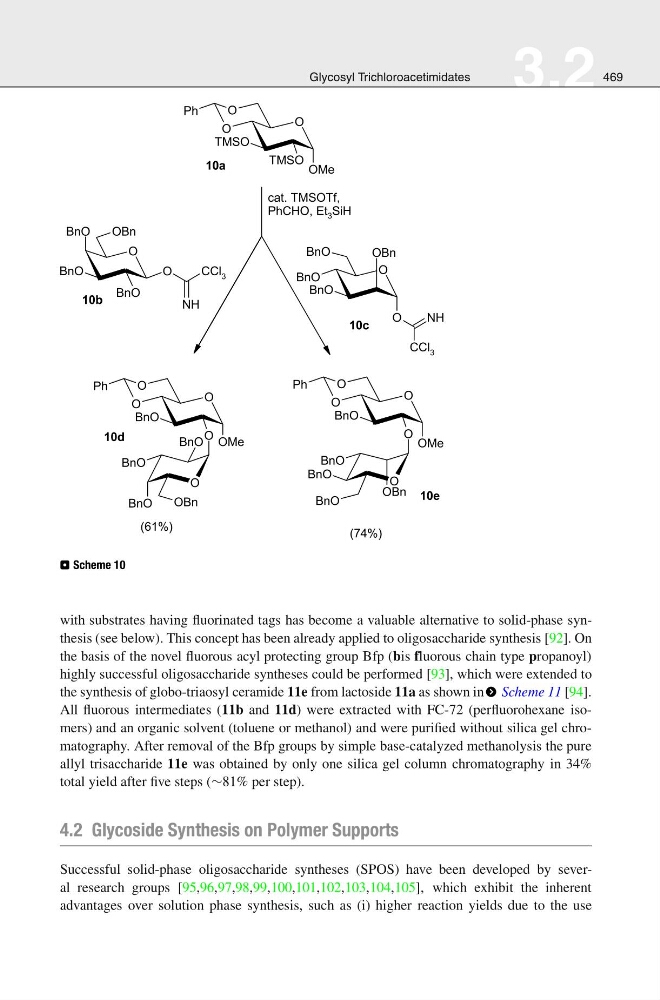
⊡ Scheme 10
with substrates having fluorinated tags has become a valuable alternative to solid-phase synthesis (see below). This concept has been already applied to oligosaccharide synthesis [92]. On
the basis of the novel fluorous acyl protecting group Bfp (bis fluorous chain type propanoyl)
highly successful oligosaccharide syntheses could be performed [93], which were extended to
the synthesis of globo-triaosyl ceramide 11e from lactoside 11a as shown in > Scheme 11 [94].
All fluorous intermediates (11b and 11d) were extracted with FC-72 (perfluorohexane isomers) and an organic solvent (toluene or methanol) and were purified without silica gel chromatography. After removal of the Bfp groups by simple base-catalyzed methanolysis the pure
allyl trisaccharide 11e was obtained by only one silica gel column chromatography in 34%
total yield after five steps (∼81% per step).
4.2 Glycoside Synthesis on Polymer Supports
Successful solid-phase oligosaccharide syntheses (SPOS) have been developed by several research groups [95,96,97,98,99,100,101,102,103,104,105], which exhibit the inherent
advantages over solution phase synthesis, such as (i) higher reaction yields due to the use
3.2
469
⊡ Scheme 10
with substrates having fluorinated tags has become a valuable alternative to solid-phase synthesis (see below). This concept has been already applied to oligosaccharide synthesis [92]. On
the basis of the novel fluorous acyl protecting group Bfp (bis fluorous chain type propanoyl)
highly successful oligosaccharide syntheses could be performed [93], which were extended to
the synthesis of globo-triaosyl ceramide 11e from lactoside 11a as shown in > Scheme 11 [94].
All fluorous intermediates (11b and 11d) were extracted with FC-72 (perfluorohexane isomers) and an organic solvent (toluene or methanol) and were purified without silica gel chromatography. After removal of the Bfp groups by simple base-catalyzed methanolysis the pure
allyl trisaccharide 11e was obtained by only one silica gel column chromatography in 34%
total yield after five steps (∼81% per step).
4.2 Glycoside Synthesis on Polymer Supports
Successful solid-phase oligosaccharide syntheses (SPOS) have been developed by several research groups [95,96,97,98,99,100,101,102,103,104,105], which exhibit the inherent
advantages over solution phase synthesis, such as (i) higher reaction yields due to the use