

468
3
Chemical Glycosylation Reactions
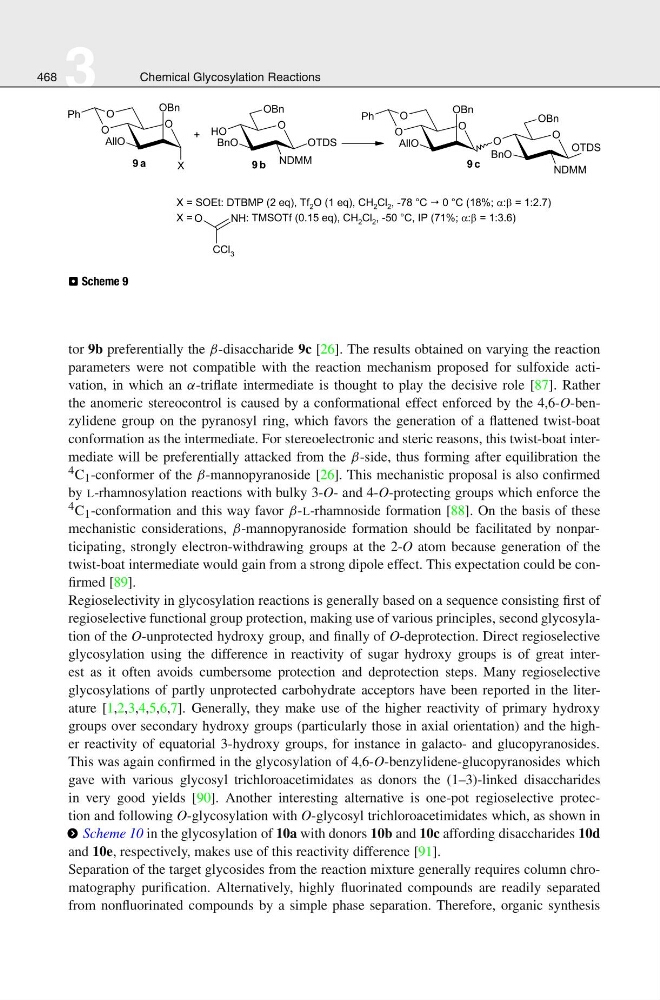
⊡ Scheme 9
tor 9b preferentially the β-disaccharide 9c [26]. The results obtained on varying the reaction
parameters were not compatible with the reaction mechanism proposed for sulfoxide activation, in which an α-triflate intermediate is thought to play the decisive role [87]. Rather
the anomeric stereocontrol is caused by a conformational effect enforced by the 4,6-O-benzylidene group on the pyranosyl ring, which favors the generation of a flattened twist-boat
conformation as the intermediate. For stereoelectronic and steric reasons, this twist-boat intermediate will be preferentially attacked from the β-side, thus forming after equilibration the
4 C 1 -conformer of the β-mannopyranoside [26]. This mechanistic proposal is also confirmed
by L-rhamnosylation reactions with bulky 3-O- and 4-O-protecting groups which enforce the
4 C 1 -conformation and this way favor β-L-rhamnoside formation [88]. On the basis of these
mechanistic considerations, β-mannopyranoside formation should be facilitated by nonparticipating, strongly electron-withdrawing groups at the 2-O atom because generation of the
twist-boat intermediate would gain from a strong dipole effect. This expectation could be confirmed [89].
Regioselectivity in glycosylation reactions is generally based on a sequence consisting first of
regioselective functional group protection, making use of various principles, second glycosylation of the O-unprotected hydroxy group, and finally of O-deprotection. Direct regioselective
glycosylation using the difference in reactivity of sugar hydroxy groups is of great interest as it often avoids cumbersome protection and deprotection steps. Many regioselective
glycosylations of partly unprotected carbohydrate acceptors have been reported in the literature [1,2,3,4,5,6,7]. Generally, they make use of the higher reactivity of primary hydroxy
groups over secondary hydroxy groups (particularly those in axial orientation) and the higher reactivity of equatorial 3-hydroxy groups, for instance in galacto- and glucopyranosides.
This was again confirmed in the glycosylation of 4,6-O-benzylidene-glucopyranosides which
gave with various glycosyl trichloroacetimidates as donors the (1–3)-linked disaccharides
in very good yields [90]. Another interesting alternative is one-pot regioselective protection and following O-glycosylation with O-glycosyl trichloroacetimidates which, as shown in
> Scheme 10 in the glycosylation of 10a with donors 10b and 10c affording disaccharides 10d
and 10e, respectively, makes use of this reactivity difference [91].
Separation of the target glycosides from the reaction mixture generally requires column chromatography purification. Alternatively, highly fluorinated compounds are readily separated
from nonfluorinated compounds by a simple phase separation. Therefore, organic synthesis
3
Chemical Glycosylation Reactions
⊡ Scheme 9
tor 9b preferentially the β-disaccharide 9c [26]. The results obtained on varying the reaction
parameters were not compatible with the reaction mechanism proposed for sulfoxide activation, in which an α-triflate intermediate is thought to play the decisive role [87]. Rather
the anomeric stereocontrol is caused by a conformational effect enforced by the 4,6-O-benzylidene group on the pyranosyl ring, which favors the generation of a flattened twist-boat
conformation as the intermediate. For stereoelectronic and steric reasons, this twist-boat intermediate will be preferentially attacked from the β-side, thus forming after equilibration the
4 C 1 -conformer of the β-mannopyranoside [26]. This mechanistic proposal is also confirmed
by L-rhamnosylation reactions with bulky 3-O- and 4-O-protecting groups which enforce the
4 C 1 -conformation and this way favor β-L-rhamnoside formation [88]. On the basis of these
mechanistic considerations, β-mannopyranoside formation should be facilitated by nonparticipating, strongly electron-withdrawing groups at the 2-O atom because generation of the
twist-boat intermediate would gain from a strong dipole effect. This expectation could be confirmed [89].
Regioselectivity in glycosylation reactions is generally based on a sequence consisting first of
regioselective functional group protection, making use of various principles, second glycosylation of the O-unprotected hydroxy group, and finally of O-deprotection. Direct regioselective
glycosylation using the difference in reactivity of sugar hydroxy groups is of great interest as it often avoids cumbersome protection and deprotection steps. Many regioselective
glycosylations of partly unprotected carbohydrate acceptors have been reported in the literature [1,2,3,4,5,6,7]. Generally, they make use of the higher reactivity of primary hydroxy
groups over secondary hydroxy groups (particularly those in axial orientation) and the higher reactivity of equatorial 3-hydroxy groups, for instance in galacto- and glucopyranosides.
This was again confirmed in the glycosylation of 4,6-O-benzylidene-glucopyranosides which
gave with various glycosyl trichloroacetimidates as donors the (1–3)-linked disaccharides
in very good yields [90]. Another interesting alternative is one-pot regioselective protection and following O-glycosylation with O-glycosyl trichloroacetimidates which, as shown in
> Scheme 10 in the glycosylation of 10a with donors 10b and 10c affording disaccharides 10d
and 10e, respectively, makes use of this reactivity difference [91].
Separation of the target glycosides from the reaction mixture generally requires column chromatography purification. Alternatively, highly fluorinated compounds are readily separated
from nonfluorinated compounds by a simple phase separation. Therefore, organic synthesis