

20
1
General Principles
Biologically important monosaccharides contain a number of functional groups different to
those considered thus far. Aldohexopyranuronic acids favor the 4 C 1 conformation to about
the same extent as do aldopyranoses [1]. Only α-L-iduronic and α-alturonic acids contain significant amounts of other conformations and the former is particularly complicated
because the 2 S O conformation is also populated [158]. Interestingly, the 2-sulfate of methyl
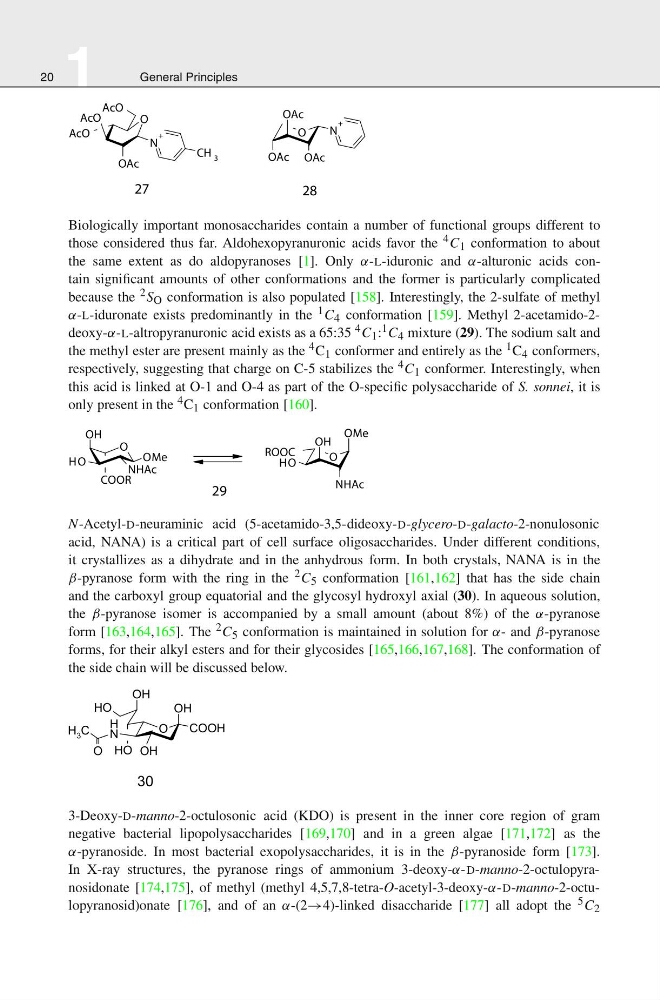
α-L-iduronate exists predominantly in the 1 C 4 conformation [159]. Methyl 2-acetamido-2deoxy-α-L-altropyranuronic acid exists as a 65:35 4 C 1 : 1 C 4 mixture (29). The sodium salt and
the methyl ester are present mainly as the 4 C 1 conformer and entirely as the 1 C 4 conformers,
respectively, suggesting that charge on C-5 stabilizes the 4 C 1 conformer. Interestingly, when
this acid is linked at O-1 and O-4 as part of the O-specific polysaccharide of S. sonnei, it is
only present in the 4 C 1 conformation [160].
N-Acetyl-D-neuraminic acid (5-acetamido-3,5-dideoxy-D-glycero-D-galacto-2-nonulosonic
acid, NANA) is a critical part of cell surface oligosaccharides. Under different conditions,
it crystallizes as a dihydrate and in the anhydrous form. In both crystals, NANA is in the
β-pyranose form with the ring in the 2 C 5 conformation [161,162] that has the side chain
and the carboxyl group equatorial and the glycosyl hydroxyl axial (30). In aqueous solution,
the β-pyranose isomer is accompanied by a small amount (about 8%) of the α-pyranose
form [163,164,165]. The 2 C 5 conformation is maintained in solution for α- and β-pyranose
forms, for their alkyl esters and for their glycosides [165,166,167,168]. The conformation of
the side chain will be discussed below.
3-Deoxy-D-manno-2-octulosonic acid (KDO) is present in the inner core region of gram
negative bacterial lipopolysaccharides [169,170] and in a green algae [171,172] as the
α-pyranoside. In most bacterial exopolysaccharides, it is in the β-pyranoside form [173].
In X-ray structures, the pyranose rings of ammonium 3-deoxy-α-D-manno-2-octulopyranosidonate [174,175], of methyl (methyl 4,5,7,8-tetra-O-acetyl-3-deoxy-α-D-manno-2-octulopyranosid)onate [176], and of an α-(2→4)-linked disaccharide [177] all adopt the 5 C 2
1
General Principles
Biologically important monosaccharides contain a number of functional groups different to
those considered thus far. Aldohexopyranuronic acids favor the 4 C 1 conformation to about
the same extent as do aldopyranoses [1]. Only α-L-iduronic and α-alturonic acids contain significant amounts of other conformations and the former is particularly complicated
because the 2 S O conformation is also populated [158]. Interestingly, the 2-sulfate of methyl
α-L-iduronate exists predominantly in the 1 C 4 conformation [159]. Methyl 2-acetamido-2deoxy-α-L-altropyranuronic acid exists as a 65:35 4 C 1 : 1 C 4 mixture (29). The sodium salt and
the methyl ester are present mainly as the 4 C 1 conformer and entirely as the 1 C 4 conformers,
respectively, suggesting that charge on C-5 stabilizes the 4 C 1 conformer. Interestingly, when
this acid is linked at O-1 and O-4 as part of the O-specific polysaccharide of S. sonnei, it is
only present in the 4 C 1 conformation [160].
N-Acetyl-D-neuraminic acid (5-acetamido-3,5-dideoxy-D-glycero-D-galacto-2-nonulosonic
acid, NANA) is a critical part of cell surface oligosaccharides. Under different conditions,
it crystallizes as a dihydrate and in the anhydrous form. In both crystals, NANA is in the
β-pyranose form with the ring in the 2 C 5 conformation [161,162] that has the side chain
and the carboxyl group equatorial and the glycosyl hydroxyl axial (30). In aqueous solution,
the β-pyranose isomer is accompanied by a small amount (about 8%) of the α-pyranose
form [163,164,165]. The 2 C 5 conformation is maintained in solution for α- and β-pyranose
forms, for their alkyl esters and for their glycosides [165,166,167,168]. The conformation of
the side chain will be discussed below.
3-Deoxy-D-manno-2-octulosonic acid (KDO) is present in the inner core region of gram
negative bacterial lipopolysaccharides [169,170] and in a green algae [171,172] as the
α-pyranoside. In most bacterial exopolysaccharides, it is in the β-pyranoside form [173].
In X-ray structures, the pyranose rings of ammonium 3-deoxy-α-D-manno-2-octulopyranosidonate [174,175], of methyl (methyl 4,5,7,8-tetra-O-acetyl-3-deoxy-α-D-manno-2-octulopyranosid)onate [176], and of an α-(2→4)-linked disaccharide [177] all adopt the 5 C 2