

Structure and Conformation of Carbohydrates
1.1
19
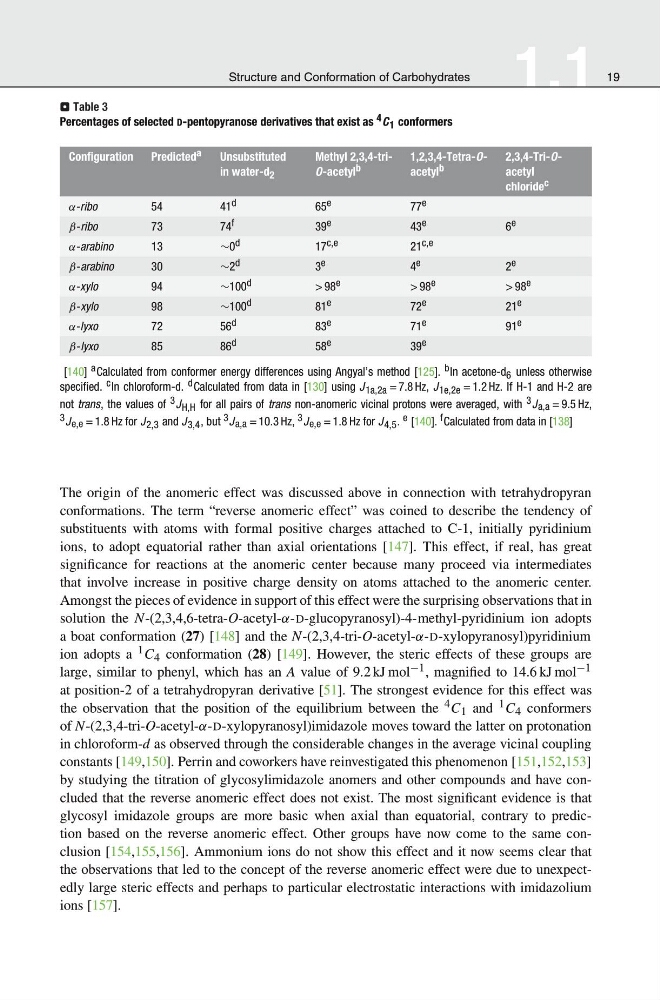
⊡ Table 3
Percentages of selected D-pentopyranose derivatives that exist as 4 C 1 conformers
Configuration Predicted a
Unsubstituted
in water-d 2
Methyl 2,3,4-triO-acetyl b
1,2,3,4-Tetra-Oacetyl b
2,3,4-Tri-Oacetyl
chloride c
α-ribo
54
41 d
65 e
77 e
β-ribo
73
74 f
39 e
43 e
6 e
α-arabino
13
∼0 d
17 c,e
21 c,e
β-arabino
30
∼2 d
3 e
4 e
2 e
α-xylo
94
∼100 d
> 98 e
> 98 e
> 98 e
β-xylo
98
∼100 d
81 e
72 e
21 e
α-lyxo
72
56 d
83 e
71 e
91 e
β-lyxo
85
86 d
58 e
39 e
[140] a Calculated from conformer energy differences using Angyal’s method [125]. b In acetone-d 6 unless otherwise
specified. c In chloroform-d. d Calculated from data in [130] using J 1a,2a = 7.8 Hz, J 1e,2e = 1.2 Hz. If H-1 and H-2 are
not trans, the values of 3 J H,H for all pairs of trans non-anomeric vicinal protons were averaged, with 3 J a,a = 9.5 Hz,
3 J e,e = 1.8 Hz for J 2,3 and J 3,4 , but 3 J a,a = 10.3 Hz, 3 J e,e = 1.8 Hz for J 4,5 . e [140]. f Calculated from data in [138]
The origin of the anomeric effect was discussed above in connection with tetrahydropyran
conformations. The term “reverse anomeric effect” was coined to describe the tendency of
substituents with atoms with formal positive charges attached to C-1, initially pyridinium
ions, to adopt equatorial rather than axial orientations [147]. This effect, if real, has great
significance for reactions at the anomeric center because many proceed via intermediates
that involve increase in positive charge density on atoms attached to the anomeric center.
Amongst the pieces of evidence in support of this effect were the surprising observations that in
solution the N-(2,3,4,6-tetra-O-acetyl-α-D-glucopyranosyl)-4-methyl-pyridinium ion adopts
a boat conformation (27) [148] and the N-(2,3,4-tri-O-acetyl-α-D-xylopyranosyl)pyridinium
ion adopts a 1 C 4 conformation (28) [149]. However, the steric effects of these groups are
large, similar to phenyl, which has an A value of 9.2 kJ mol −1 , magnified to 14.6 kJ mol −1
at position-2 of a tetrahydropyran derivative [51]. The strongest evidence for this effect was
the observation that the position of the equilibrium between the 4 C 1 and 1 C 4 conformers
of N-(2,3,4-tri-O-acetyl-α-D-xylopyranosyl)imidazole moves toward the latter on protonation
in chloroform-d as observed through the considerable changes in the average vicinal coupling
constants [149,150]. Perrin and coworkers have reinvestigated this phenomenon [151,152,153]
by studying the titration of glycosylimidazole anomers and other compounds and have concluded that the reverse anomeric effect does not exist. The most significant evidence is that
glycosyl imidazole groups are more basic when axial than equatorial, contrary to prediction based on the reverse anomeric effect. Other groups have now come to the same conclusion [154,155,156]. Ammonium ions do not show this effect and it now seems clear that
the observations that led to the concept of the reverse anomeric effect were due to unexpectedly large steric effects and perhaps to particular electrostatic interactions with imidazolium
ions [157].
1.1
19
⊡ Table 3
Percentages of selected D-pentopyranose derivatives that exist as 4 C 1 conformers
Configuration Predicted a
Unsubstituted
in water-d 2
Methyl 2,3,4-triO-acetyl b
1,2,3,4-Tetra-Oacetyl b
2,3,4-Tri-Oacetyl
chloride c
α-ribo
54
41 d
65 e
77 e
β-ribo
73
74 f
39 e
43 e
6 e
α-arabino
13
∼0 d
17 c,e
21 c,e
β-arabino
30
∼2 d
3 e
4 e
2 e
α-xylo
94
∼100 d
> 98 e
> 98 e
> 98 e
β-xylo
98
∼100 d
81 e
72 e
21 e
α-lyxo
72
56 d
83 e
71 e
91 e
β-lyxo
85
86 d
58 e
39 e
[140] a Calculated from conformer energy differences using Angyal’s method [125]. b In acetone-d 6 unless otherwise
specified. c In chloroform-d. d Calculated from data in [130] using J 1a,2a = 7.8 Hz, J 1e,2e = 1.2 Hz. If H-1 and H-2 are
not trans, the values of 3 J H,H for all pairs of trans non-anomeric vicinal protons were averaged, with 3 J a,a = 9.5 Hz,
3 J e,e = 1.8 Hz for J 2,3 and J 3,4 , but 3 J a,a = 10.3 Hz, 3 J e,e = 1.8 Hz for J 4,5 . e [140]. f Calculated from data in [138]
The origin of the anomeric effect was discussed above in connection with tetrahydropyran
conformations. The term “reverse anomeric effect” was coined to describe the tendency of
substituents with atoms with formal positive charges attached to C-1, initially pyridinium
ions, to adopt equatorial rather than axial orientations [147]. This effect, if real, has great
significance for reactions at the anomeric center because many proceed via intermediates
that involve increase in positive charge density on atoms attached to the anomeric center.
Amongst the pieces of evidence in support of this effect were the surprising observations that in
solution the N-(2,3,4,6-tetra-O-acetyl-α-D-glucopyranosyl)-4-methyl-pyridinium ion adopts
a boat conformation (27) [148] and the N-(2,3,4-tri-O-acetyl-α-D-xylopyranosyl)pyridinium
ion adopts a 1 C 4 conformation (28) [149]. However, the steric effects of these groups are
large, similar to phenyl, which has an A value of 9.2 kJ mol −1 , magnified to 14.6 kJ mol −1
at position-2 of a tetrahydropyran derivative [51]. The strongest evidence for this effect was
the observation that the position of the equilibrium between the 4 C 1 and 1 C 4 conformers
of N-(2,3,4-tri-O-acetyl-α-D-xylopyranosyl)imidazole moves toward the latter on protonation
in chloroform-d as observed through the considerable changes in the average vicinal coupling
constants [149,150]. Perrin and coworkers have reinvestigated this phenomenon [151,152,153]
by studying the titration of glycosylimidazole anomers and other compounds and have concluded that the reverse anomeric effect does not exist. The most significant evidence is that
glycosyl imidazole groups are more basic when axial than equatorial, contrary to prediction based on the reverse anomeric effect. Other groups have now come to the same conclusion [154,155,156]. Ammonium ions do not show this effect and it now seems clear that
the observations that led to the concept of the reverse anomeric effect were due to unexpectedly large steric effects and perhaps to particular electrostatic interactions with imidazolium
ions [157].