

440
3
Chemical Glycosylation Reactions
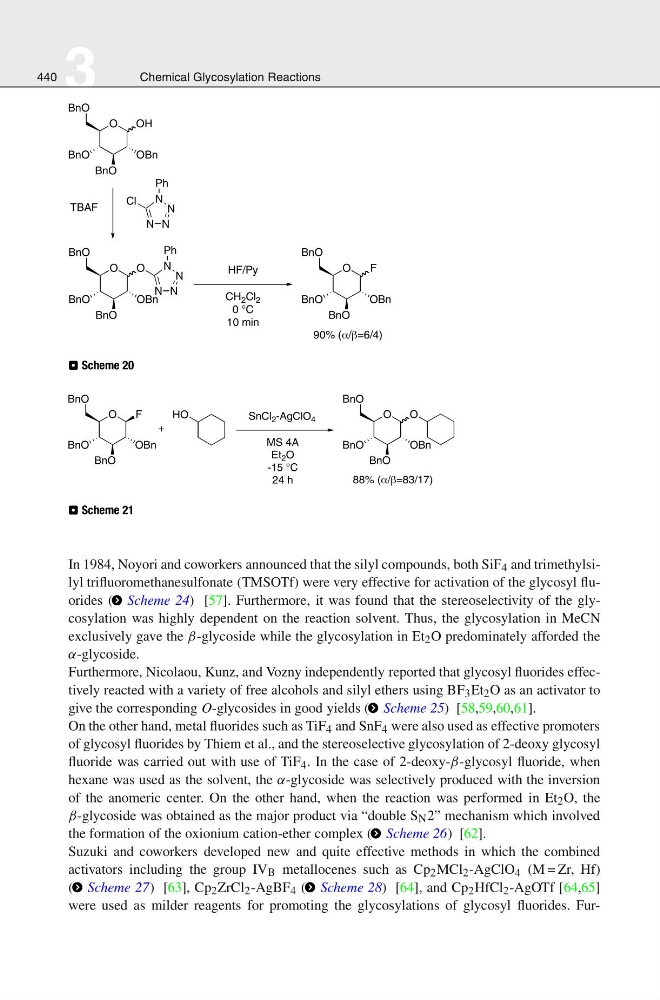
⊡ Scheme 20
⊡ Scheme 21
In 1984, Noyori and coworkers announced that the silyl compounds, both SiF 4 and trimethylsilyl trifluoromethanesulfonate (TMSOTf) were very effective for activation of the glycosyl fluorides ( > Scheme 24) [57]. Furthermore, it was found that the stereoselectivity of the glycosylation was highly dependent on the reaction solvent. Thus, the glycosylation in MeCN
exclusively gave the β-glycoside while the glycosylation in Et 2 O predominately afforded the
α-glycoside.
Furthermore, Nicolaou, Kunz, and Vozny independently reported that glycosyl fluorides effectively reacted with a variety of free alcohols and silyl ethers using BF 3 Et 2 O as an activator to
give the corresponding O-glycosides in good yields ( > Scheme 25) [58,59,60,61].
On the other hand, metal fluorides such as TiF 4 and SnF 4 were also used as effective promoters
of glycosyl fluorides by Thiem et al., and the stereoselective glycosylation of 2-deoxy glycosyl
fluoride was carried out with use of TiF 4 . In the case of 2-deoxy-β-glycosyl fluoride, when
hexane was used as the solvent, the α-glycoside was selectively produced with the inversion
of the anomeric center. On the other hand, when the reaction was performed in Et 2 O, the
β-glycoside was obtained as the major product via “double S N 2” mechanism which involved
the formation of the oxionium cation-ether complex ( > Scheme 26) [62].
Suzuki and coworkers developed new and quite effective methods in which the combined
activators including the group IV B metallocenes such as Cp 2 MCl 2 -AgClO 4 (M = Zr, Hf)
( > Scheme 27) [63], Cp 2 ZrCl 2 -AgBF 4 ( > Scheme 28) [64], and Cp 2 HfCl 2 -AgOTf [64,65]
were used as milder reagents for promoting the glycosylations of glycosyl fluorides. Fur-
3
Chemical Glycosylation Reactions
⊡ Scheme 20
⊡ Scheme 21
In 1984, Noyori and coworkers announced that the silyl compounds, both SiF 4 and trimethylsilyl trifluoromethanesulfonate (TMSOTf) were very effective for activation of the glycosyl fluorides ( > Scheme 24) [57]. Furthermore, it was found that the stereoselectivity of the glycosylation was highly dependent on the reaction solvent. Thus, the glycosylation in MeCN
exclusively gave the β-glycoside while the glycosylation in Et 2 O predominately afforded the
α-glycoside.
Furthermore, Nicolaou, Kunz, and Vozny independently reported that glycosyl fluorides effectively reacted with a variety of free alcohols and silyl ethers using BF 3 Et 2 O as an activator to
give the corresponding O-glycosides in good yields ( > Scheme 25) [58,59,60,61].
On the other hand, metal fluorides such as TiF 4 and SnF 4 were also used as effective promoters
of glycosyl fluorides by Thiem et al., and the stereoselective glycosylation of 2-deoxy glycosyl
fluoride was carried out with use of TiF 4 . In the case of 2-deoxy-β-glycosyl fluoride, when
hexane was used as the solvent, the α-glycoside was selectively produced with the inversion
of the anomeric center. On the other hand, when the reaction was performed in Et 2 O, the
β-glycoside was obtained as the major product via “double S N 2” mechanism which involved
the formation of the oxionium cation-ether complex ( > Scheme 26) [62].
Suzuki and coworkers developed new and quite effective methods in which the combined
activators including the group IV B metallocenes such as Cp 2 MCl 2 -AgClO 4 (M = Zr, Hf)
( > Scheme 27) [63], Cp 2 ZrCl 2 -AgBF 4 ( > Scheme 28) [64], and Cp 2 HfCl 2 -AgOTf [64,65]
were used as milder reagents for promoting the glycosylations of glycosyl fluorides. Fur-