

Glycosyl Halides
3.1
439
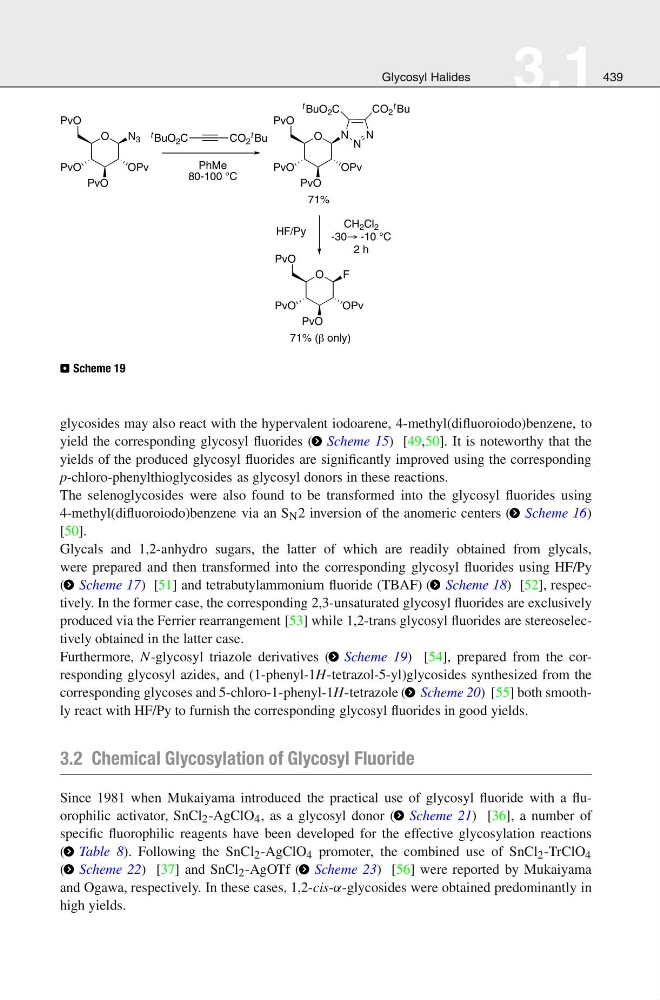
⊡ Scheme 19
glycosides may also react with the hypervalent iodoarene, 4-methyl(difluoroiodo)benzene, to
yield the corresponding glycosyl fluorides ( > Scheme 15) [49,50]. It is noteworthy that the
yields of the produced glycosyl fluorides are significantly improved using the corresponding
p-chloro-phenylthioglycosides as glycosyl donors in these reactions.
The selenoglycosides were also found to be transformed into the glycosyl fluorides using
4-methyl(difluoroiodo)benzene via an S N 2 inversion of the anomeric centers ( > Scheme 16)
[50].
Glycals and 1,2-anhydro sugars, the latter of which are readily obtained from glycals,
were prepared and then transformed into the corresponding glycosyl fluorides using HF/Py
( > Scheme 17) [51] and tetrabutylammonium fluoride (TBAF) ( > Scheme 18) [52], respectively. In the former case, the corresponding 2,3-unsaturated glycosyl fluorides are exclusively
produced via the Ferrier rearrangement [53] while 1,2-trans glycosyl fluorides are stereoselectively obtained in the latter case.
Furthermore, N-glycosyl triazole derivatives ( > Scheme 19) [54], prepared from the corresponding glycosyl azides, and (1-phenyl-1H-tetrazol-5-yl)glycosides synthesized from the
corresponding glycoses and 5-chloro-1-phenyl-1H-tetrazole ( > Scheme 20) [55] both smoothly react with HF/Py to furnish the corresponding glycosyl fluorides in good yields.
3.2 Chemical Glycosylation of Glycosyl Fluoride
Since 1981 when Mukaiyama introduced the practical use of glycosyl fluoride with a fluorophilic activator, SnCl 2 -AgClO 4 , as a glycosyl donor ( > Scheme 21) [36], a number of
specific fluorophilic reagents have been developed for the effective glycosylation reactions
( > Table 8). Following the SnCl 2 -AgClO 4 promoter, the combined use of SnCl 2 -TrClO 4
( > Scheme 22) [37] and SnCl 2 -AgOTf ( > Scheme 23) [56] were reported by Mukaiyama
and Ogawa, respectively. In these cases, 1,2-cis-α-glycosides were obtained predominantly in
high yields.
3.1
439
⊡ Scheme 19
glycosides may also react with the hypervalent iodoarene, 4-methyl(difluoroiodo)benzene, to
yield the corresponding glycosyl fluorides ( > Scheme 15) [49,50]. It is noteworthy that the
yields of the produced glycosyl fluorides are significantly improved using the corresponding
p-chloro-phenylthioglycosides as glycosyl donors in these reactions.
The selenoglycosides were also found to be transformed into the glycosyl fluorides using
4-methyl(difluoroiodo)benzene via an S N 2 inversion of the anomeric centers ( > Scheme 16)
[50].
Glycals and 1,2-anhydro sugars, the latter of which are readily obtained from glycals,
were prepared and then transformed into the corresponding glycosyl fluorides using HF/Py
( > Scheme 17) [51] and tetrabutylammonium fluoride (TBAF) ( > Scheme 18) [52], respectively. In the former case, the corresponding 2,3-unsaturated glycosyl fluorides are exclusively
produced via the Ferrier rearrangement [53] while 1,2-trans glycosyl fluorides are stereoselectively obtained in the latter case.
Furthermore, N-glycosyl triazole derivatives ( > Scheme 19) [54], prepared from the corresponding glycosyl azides, and (1-phenyl-1H-tetrazol-5-yl)glycosides synthesized from the
corresponding glycoses and 5-chloro-1-phenyl-1H-tetrazole ( > Scheme 20) [55] both smoothly react with HF/Py to furnish the corresponding glycosyl fluorides in good yields.
3.2 Chemical Glycosylation of Glycosyl Fluoride
Since 1981 when Mukaiyama introduced the practical use of glycosyl fluoride with a fluorophilic activator, SnCl 2 -AgClO 4 , as a glycosyl donor ( > Scheme 21) [36], a number of
specific fluorophilic reagents have been developed for the effective glycosylation reactions
( > Table 8). Following the SnCl 2 -AgClO 4 promoter, the combined use of SnCl 2 -TrClO 4
( > Scheme 22) [37] and SnCl 2 -AgOTf ( > Scheme 23) [56] were reported by Mukaiyama
and Ogawa, respectively. In these cases, 1,2-cis-α-glycosides were obtained predominantly in
high yields.