

Degradations and Rearrangement Reactions
2.7
419
aldolization of 362 occur to give glyceraldehyde (363). Under physiological conditions, the
AGE product 364 is formed from 362 and 369, apparently via condensation of the Amadori
compounds 365 and 366 [315,316,317]. On heating at 100 °C, a hood-processing temperature,
in methanol in a sealed vessel, 39 and 369 form an amine 368 [318] ( > Scheme 70).
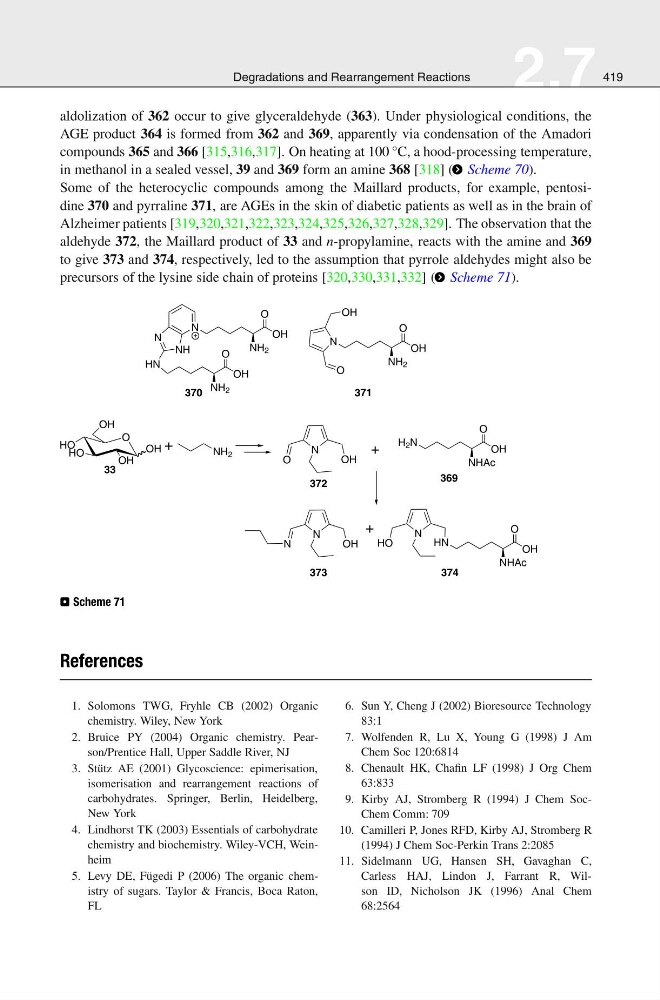
Some of the heterocyclic compounds among the Maillard products, for example, pentosidine 370 and pyrraline 371, are AGEs in the skin of diabetic patients as well as in the brain of
Alzheimer patients [319,320,321,322,323,324,325,326,327,328,329]. The observation that the
aldehyde 372, the Maillard product of 33 and n-propylamine, reacts with the amine and 369
to give 373 and 374, respectively, led to the assumption that pyrrole aldehydes might also be
precursors of the lysine side chain of proteins [320,330,331,332] ( > Scheme 71).
⊡ Scheme 71
References
1. Solomons TWG, Fryhle CB (2002) Organic
chemistry. Wiley, New York
2. Bruice PY (2004) Organic chemistry. Pearson/Prentice Hall, Upper Saddle River, NJ
3. Stütz AE (2001) Glycoscience: epimerisation,
isomerisation and rearrangement reactions of
carbohydrates. Springer, Berlin, Heidelberg,
New York
4. Lindhorst TK (2003) Essentials of carbohydrate
chemistry and biochemistry. Wiley-VCH, Weinheim
5. Levy DE, Fügedi P (2006) The organic chemistry of sugars. Taylor & Francis, Boca Raton,
FL
6. Sun Y, Cheng J (2002) Bioresource Technology
83:1
7. Wolfenden R, Lu X, Young G (1998) J Am
Chem Soc 120:6814
8. Chenault HK, Chafin LF (1998) J Org Chem
63:833
9. Kirby AJ, Stromberg R (1994) J Chem SocChem Comm: 709
10. Camilleri P, Jones RFD, Kirby AJ, Stromberg R
(1994) J Chem Soc-Perkin Trans 2:2085
11. Sidelmann UG, Hansen SH, Gavaghan C,
Carless HAJ, Lindon J, Farrant R, Wilson ID, Nicholson JK (1996) Anal Chem
68:2564
2.7
419
aldolization of 362 occur to give glyceraldehyde (363). Under physiological conditions, the
AGE product 364 is formed from 362 and 369, apparently via condensation of the Amadori
compounds 365 and 366 [315,316,317]. On heating at 100 °C, a hood-processing temperature,
in methanol in a sealed vessel, 39 and 369 form an amine 368 [318] ( > Scheme 70).
Some of the heterocyclic compounds among the Maillard products, for example, pentosidine 370 and pyrraline 371, are AGEs in the skin of diabetic patients as well as in the brain of
Alzheimer patients [319,320,321,322,323,324,325,326,327,328,329]. The observation that the
aldehyde 372, the Maillard product of 33 and n-propylamine, reacts with the amine and 369
to give 373 and 374, respectively, led to the assumption that pyrrole aldehydes might also be
precursors of the lysine side chain of proteins [320,330,331,332] ( > Scheme 71).
⊡ Scheme 71
References
1. Solomons TWG, Fryhle CB (2002) Organic
chemistry. Wiley, New York
2. Bruice PY (2004) Organic chemistry. Pearson/Prentice Hall, Upper Saddle River, NJ
3. Stütz AE (2001) Glycoscience: epimerisation,
isomerisation and rearrangement reactions of
carbohydrates. Springer, Berlin, Heidelberg,
New York
4. Lindhorst TK (2003) Essentials of carbohydrate
chemistry and biochemistry. Wiley-VCH, Weinheim
5. Levy DE, Fügedi P (2006) The organic chemistry of sugars. Taylor & Francis, Boca Raton,
FL
6. Sun Y, Cheng J (2002) Bioresource Technology
83:1
7. Wolfenden R, Lu X, Young G (1998) J Am
Chem Soc 120:6814
8. Chenault HK, Chafin LF (1998) J Org Chem
63:833
9. Kirby AJ, Stromberg R (1994) J Chem SocChem Comm: 709
10. Camilleri P, Jones RFD, Kirby AJ, Stromberg R
(1994) J Chem Soc-Perkin Trans 2:2085
11. Sidelmann UG, Hansen SH, Gavaghan C,
Carless HAJ, Lindon J, Farrant R, Wilson ID, Nicholson JK (1996) Anal Chem
68:2564