

Degradations and Rearrangement Reactions
2.7
417
⊡ Figure 9
Maillard products having strand-breaking activities to DNA
⊡ Scheme 67
The major intermediate of the Maillard reaction 38, having an allylic system, seems to furnish a cytotoxic ester on metabolic sulfonation [298]. In contrast to the above findings, some
Amadori products, such as pyrazines have antimutagenicity [299,300,301]. Enkastines, the
Amadori products of 33 and dipeptides, beneficially prolong the action of enkephaline by
inhibiting enkephalinase [302].
Reactive small sugars and related acids appear to play a role in forming AGEs including crosslinked proteins in the aged body as well as inactivation of human Cu,Zn-superoxide dismutase [282,303,304]. Reaction of 33 with n-propylamine in phosphate-buffered, neutral solution
generates several derivatives of small sugars [305,306], namely, C 2 and C 3 sugar derivatives.
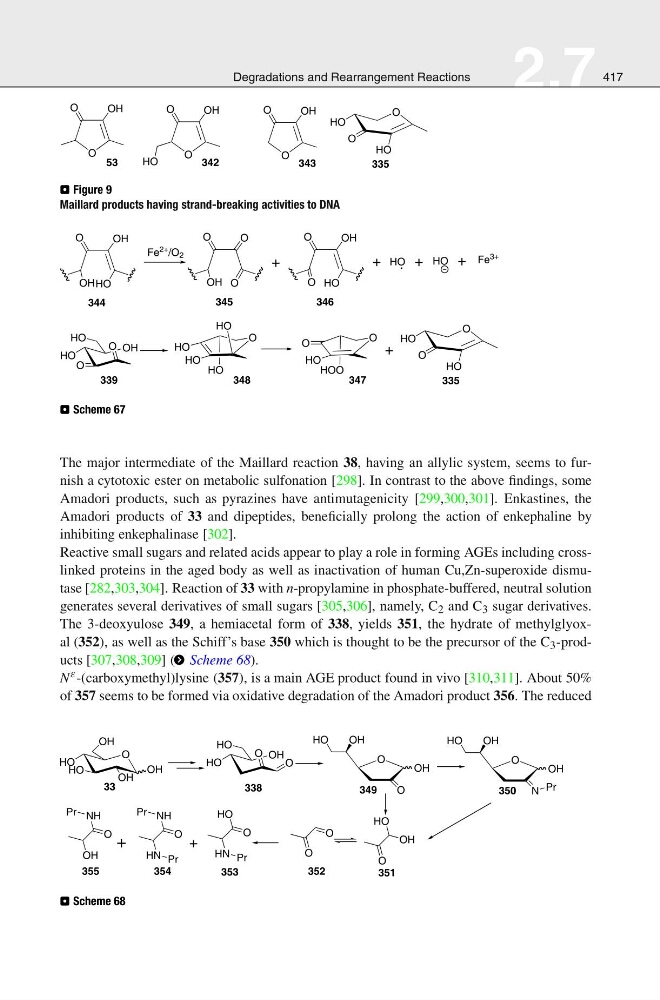
The 3-deoxyulose 349, a hemiacetal form of 338, yields 351, the hydrate of methylglyoxal (352), as well as the Schiff’s base 350 which is thought to be the precursor of the C 3 -products [307,308,309] ( > Scheme 68).
N ε -(carboxymethyl)lysine (357), is a main AGE product found in vivo [310,311]. About 50%
of 357 seems to be formed via oxidative degradation of the Amadori product 356. The reduced
⊡ Scheme 68
2.7
417
⊡ Figure 9
Maillard products having strand-breaking activities to DNA
⊡ Scheme 67
The major intermediate of the Maillard reaction 38, having an allylic system, seems to furnish a cytotoxic ester on metabolic sulfonation [298]. In contrast to the above findings, some
Amadori products, such as pyrazines have antimutagenicity [299,300,301]. Enkastines, the
Amadori products of 33 and dipeptides, beneficially prolong the action of enkephaline by
inhibiting enkephalinase [302].
Reactive small sugars and related acids appear to play a role in forming AGEs including crosslinked proteins in the aged body as well as inactivation of human Cu,Zn-superoxide dismutase [282,303,304]. Reaction of 33 with n-propylamine in phosphate-buffered, neutral solution
generates several derivatives of small sugars [305,306], namely, C 2 and C 3 sugar derivatives.
The 3-deoxyulose 349, a hemiacetal form of 338, yields 351, the hydrate of methylglyoxal (352), as well as the Schiff’s base 350 which is thought to be the precursor of the C 3 -products [307,308,309] ( > Scheme 68).
N ε -(carboxymethyl)lysine (357), is a main AGE product found in vivo [310,311]. About 50%
of 357 seems to be formed via oxidative degradation of the Amadori product 356. The reduced
⊡ Scheme 68