

408
2
General Synthetic Methods
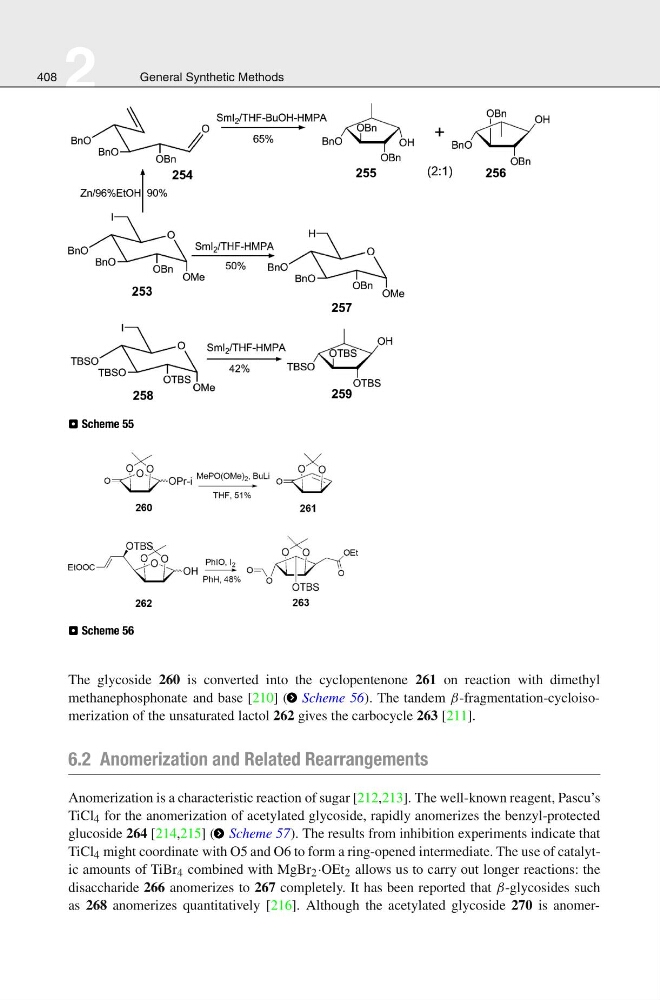
⊡ Scheme 55
⊡ Scheme 56
The glycoside 260 is converted into the cyclopentenone 261 on reaction with dimethyl
methanephosphonate and base [210] ( > Scheme 56). The tandem β-fragmentation-cycloisomerization of the unsaturated lactol 262 gives the carbocycle 263 [211].
6.2 Anomerization and Related Rearrangements
Anomerization is a characteristic reaction of sugar [212,213]. The well-known reagent, Pascu’s
TiCl 4 for the anomerization of acetylated glycoside, rapidly anomerizes the benzyl-protected
glucoside 264 [214,215] ( > Scheme 57). The results from inhibition experiments indicate that
TiCl 4 might coordinate with O5 and O6 to form a ring-opened intermediate. The use of catalytic amounts of TiBr 4 combined with MgBr 2 ·OEt 2 allows us to carry out longer reactions: the
disaccharide 266 anomerizes to 267 completely. It has been reported that β-glycosides such
as 268 anomerizes quantitatively [216]. Although the acetylated glycoside 270 is anomer-
2
General Synthetic Methods
⊡ Scheme 55
⊡ Scheme 56
The glycoside 260 is converted into the cyclopentenone 261 on reaction with dimethyl
methanephosphonate and base [210] ( > Scheme 56). The tandem β-fragmentation-cycloisomerization of the unsaturated lactol 262 gives the carbocycle 263 [211].
6.2 Anomerization and Related Rearrangements
Anomerization is a characteristic reaction of sugar [212,213]. The well-known reagent, Pascu’s
TiCl 4 for the anomerization of acetylated glycoside, rapidly anomerizes the benzyl-protected
glucoside 264 [214,215] ( > Scheme 57). The results from inhibition experiments indicate that
TiCl 4 might coordinate with O5 and O6 to form a ring-opened intermediate. The use of catalytic amounts of TiBr 4 combined with MgBr 2 ·OEt 2 allows us to carry out longer reactions: the
disaccharide 266 anomerizes to 267 completely. It has been reported that β-glycosides such
as 268 anomerizes quantitatively [216]. Although the acetylated glycoside 270 is anomer-