

Degradations and Rearrangement Reactions
2.7
407
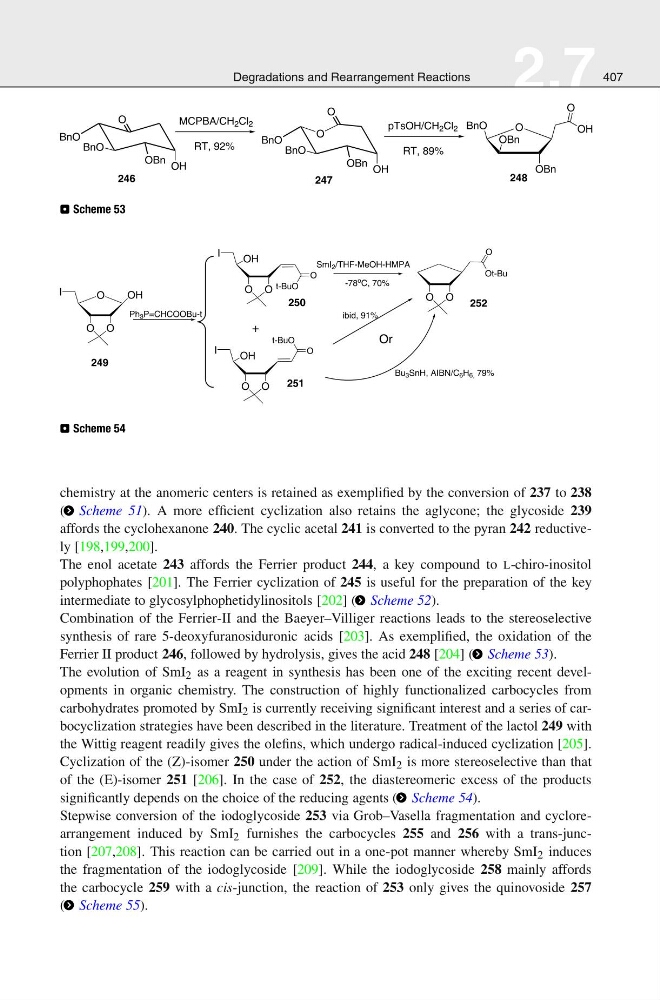
⊡ Scheme 53
⊡ Scheme 54
chemistry at the anomeric centers is retained as exemplified by the conversion of 237 to 238
( > Scheme 51). A more efficient cyclization also retains the aglycone; the glycoside 239
affords the cyclohexanone 240. The cyclic acetal 241 is converted to the pyran 242 reductively [198,199,200].
The enol acetate 243 affords the Ferrier product 244, a key compound to L-chiro-inositol
polyphophates [201]. The Ferrier cyclization of 245 is useful for the preparation of the key
intermediate to glycosylphophetidylinositols [202] ( > Scheme 52).
Combination of the Ferrier-II and the Baeyer–Villiger reactions leads to the stereoselective
synthesis of rare 5-deoxyfuranosiduronic acids [203]. As exemplified, the oxidation of the
Ferrier II product 246, followed by hydrolysis, gives the acid 248 [204] ( > Scheme 53).
The evolution of SmI 2 as a reagent in synthesis has been one of the exciting recent developments in organic chemistry. The construction of highly functionalized carbocycles from
carbohydrates promoted by SmI 2 is currently receiving significant interest and a series of carbocyclization strategies have been described in the literature. Treatment of the lactol 249 with
the Wittig reagent readily gives the olefins, which undergo radical-induced cyclization [205].
Cyclization of the (Z)-isomer 250 under the action of SmI 2 is more stereoselective than that
of the (E)-isomer 251 [206]. In the case of 252, the diastereomeric excess of the products
significantly depends on the choice of the reducing agents ( > Scheme 54).
Stepwise conversion of the iodoglycoside 253 via Grob–Vasella fragmentation and cyclorearrangement induced by SmI 2 furnishes the carbocycles 255 and 256 with a trans-junction [207,208]. This reaction can be carried out in a one-pot manner whereby SmI 2 induces
the fragmentation of the iodoglycoside [209]. While the iodoglycoside 258 mainly affords
the carbocycle 259 with a cis-junction, the reaction of 253 only gives the quinovoside 257
( > Scheme 55).
2.7
407
⊡ Scheme 53
⊡ Scheme 54
chemistry at the anomeric centers is retained as exemplified by the conversion of 237 to 238
( > Scheme 51). A more efficient cyclization also retains the aglycone; the glycoside 239
affords the cyclohexanone 240. The cyclic acetal 241 is converted to the pyran 242 reductively [198,199,200].
The enol acetate 243 affords the Ferrier product 244, a key compound to L-chiro-inositol
polyphophates [201]. The Ferrier cyclization of 245 is useful for the preparation of the key
intermediate to glycosylphophetidylinositols [202] ( > Scheme 52).
Combination of the Ferrier-II and the Baeyer–Villiger reactions leads to the stereoselective
synthesis of rare 5-deoxyfuranosiduronic acids [203]. As exemplified, the oxidation of the
Ferrier II product 246, followed by hydrolysis, gives the acid 248 [204] ( > Scheme 53).
The evolution of SmI 2 as a reagent in synthesis has been one of the exciting recent developments in organic chemistry. The construction of highly functionalized carbocycles from
carbohydrates promoted by SmI 2 is currently receiving significant interest and a series of carbocyclization strategies have been described in the literature. Treatment of the lactol 249 with
the Wittig reagent readily gives the olefins, which undergo radical-induced cyclization [205].
Cyclization of the (Z)-isomer 250 under the action of SmI 2 is more stereoselective than that
of the (E)-isomer 251 [206]. In the case of 252, the diastereomeric excess of the products
significantly depends on the choice of the reducing agents ( > Scheme 54).
Stepwise conversion of the iodoglycoside 253 via Grob–Vasella fragmentation and cyclorearrangement induced by SmI 2 furnishes the carbocycles 255 and 256 with a trans-junction [207,208]. This reaction can be carried out in a one-pot manner whereby SmI 2 induces
the fragmentation of the iodoglycoside [209]. While the iodoglycoside 258 mainly affords
the carbocycle 259 with a cis-junction, the reaction of 253 only gives the quinovoside 257
( > Scheme 55).