

Structure and Conformation of Carbohydrates
1.1
15
1.3.2 Conformations of Pyranoses
Ring Conformations The two chair conformations of pyranose sugars are named by defining
a reference plane that contains four ring atoms and has the lowest numbered carbon atom out
of the plane [124]. In the chair, abbreviated C, the positions of the atoms above and below
the plane are given as superscripts and subscripts, respectively. To remove ambiguity, it is
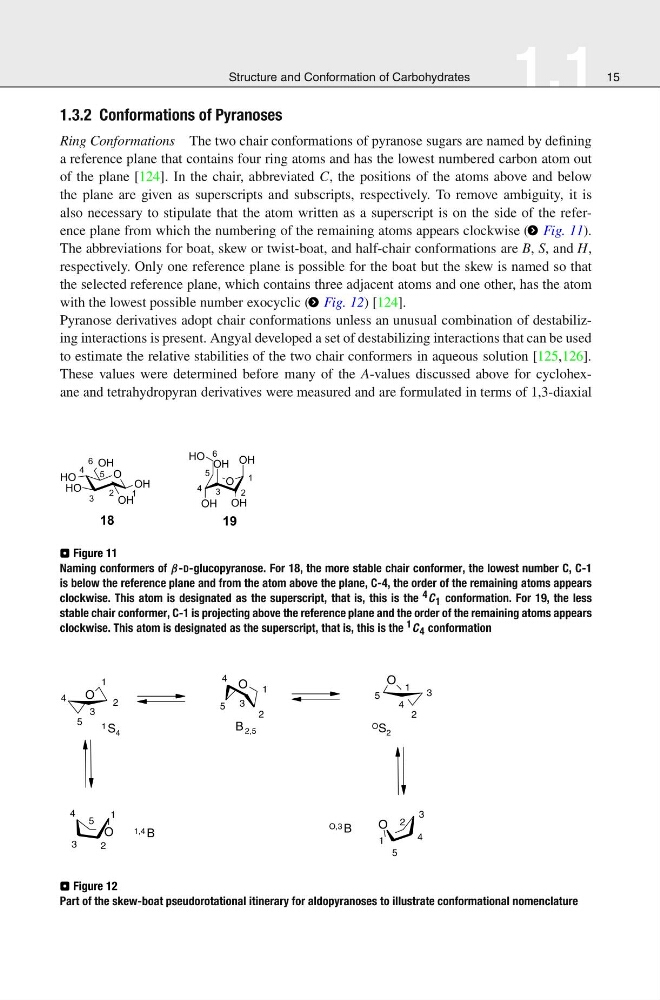
also necessary to stipulate that the atom written as a superscript is on the side of the reference plane from which the numbering of the remaining atoms appears clockwise ( > Fig. 11).
The abbreviations for boat, skew or twist-boat, and half-chair conformations are B, S, and H,
respectively. Only one reference plane is possible for the boat but the skew is named so that
the selected reference plane, which contains three adjacent atoms and one other, has the atom
with the lowest possible number exocyclic ( > Fig. 12) [124].
Pyranose derivatives adopt chair conformations unless an unusual combination of destabilizing interactions is present. Angyal developed a set of destabilizing interactions that can be used
to estimate the relative stabilities of the two chair conformers in aqueous solution [125,126].
These values were determined before many of the A-values discussed above for cyclohexane and tetrahydropyran derivatives were measured and are formulated in terms of 1,3-diaxial
⊡ Figure 11
Naming conformers of β-D-glucopyranose. For 18, the more stable chair conformer, the lowest number C, C-1
is below the reference plane and from the atom above the plane, C-4, the order of the remaining atoms appears
clockwise. This atom is designated as the superscript, that is, this is the 4 C 1 conformation. For 19, the less
stable chair conformer, C-1 is projecting above the reference plane and the order of the remaining atoms appears
clockwise. This atom is designated as the superscript, that is, this is the 1 C 4 conformation
⊡ Figure 12
Part of the skew-boat pseudorotational itinerary for aldopyranoses to illustrate conformational nomenclature
1.1
15
1.3.2 Conformations of Pyranoses
Ring Conformations The two chair conformations of pyranose sugars are named by defining
a reference plane that contains four ring atoms and has the lowest numbered carbon atom out
of the plane [124]. In the chair, abbreviated C, the positions of the atoms above and below
the plane are given as superscripts and subscripts, respectively. To remove ambiguity, it is
also necessary to stipulate that the atom written as a superscript is on the side of the reference plane from which the numbering of the remaining atoms appears clockwise ( > Fig. 11).
The abbreviations for boat, skew or twist-boat, and half-chair conformations are B, S, and H,
respectively. Only one reference plane is possible for the boat but the skew is named so that
the selected reference plane, which contains three adjacent atoms and one other, has the atom
with the lowest possible number exocyclic ( > Fig. 12) [124].
Pyranose derivatives adopt chair conformations unless an unusual combination of destabilizing interactions is present. Angyal developed a set of destabilizing interactions that can be used
to estimate the relative stabilities of the two chair conformers in aqueous solution [125,126].
These values were determined before many of the A-values discussed above for cyclohexane and tetrahydropyran derivatives were measured and are formulated in terms of 1,3-diaxial
⊡ Figure 11
Naming conformers of β-D-glucopyranose. For 18, the more stable chair conformer, the lowest number C, C-1
is below the reference plane and from the atom above the plane, C-4, the order of the remaining atoms appears
clockwise. This atom is designated as the superscript, that is, this is the 4 C 1 conformation. For 19, the less
stable chair conformer, C-1 is projecting above the reference plane and the order of the remaining atoms appears
clockwise. This atom is designated as the superscript, that is, this is the 1 C 4 conformation
⊡ Figure 12
Part of the skew-boat pseudorotational itinerary for aldopyranoses to illustrate conformational nomenclature