

14
1
General Principles
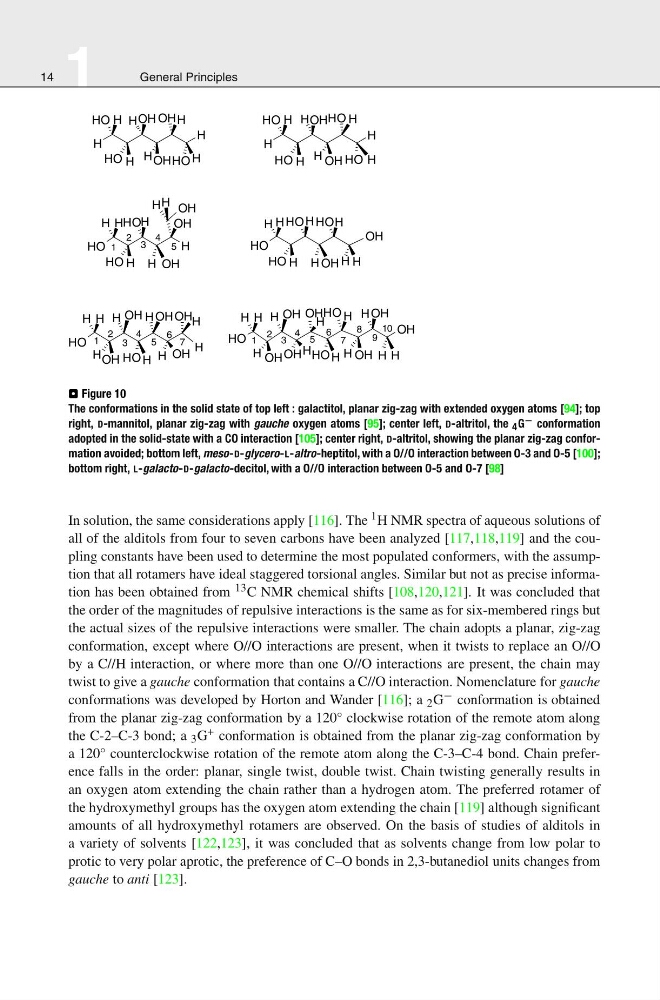
⊡ Figure 10
The conformations in the solid state of top left : galactitol, planar zig-zag with extended oxygen atoms [94]; top
right, D-mannitol, planar zig-zag with gauche oxygen atoms [95]; center left, D-altritol, the 4 G − conformation
adopted in the solid-state with a CO interaction [105]; center right, D-altritol, showing the planar zig-zag conformation avoided; bottom left, meso-D-glycero-L-altro-heptitol, with a O//O interaction between O-3 and O-5 [100];
bottom right, L-galacto-D-galacto-decitol, with a O//O interaction between O-5 and O-7 [98]
In solution, the same considerations apply [116]. The 1 H NMR spectra of aqueous solutions of
all of the alditols from four to seven carbons have been analyzed [117,118,119] and the coupling constants have been used to determine the most populated conformers, with the assumption that all rotamers have ideal staggered torsional angles. Similar but not as precise information has been obtained from 13 C NMR chemical shifts [108,120,121]. It was concluded that
the order of the magnitudes of repulsive interactions is the same as for six-membered rings but
the actual sizes of the repulsive interactions were smaller. The chain adopts a planar, zig-zag
conformation, except where O//O interactions are present, when it twists to replace an O//O
by a C//H interaction, or where more than one O//O interactions are present, the chain may
twist to give a gauche conformation that contains a C//O interaction. Nomenclature for gauche
conformations was developed by Horton and Wander [116]; a 2 G − conformation is obtained
from the planar zig-zag conformation by a 120° clockwise rotation of the remote atom along
the C-2–C-3 bond; a 3 G + conformation is obtained from the planar zig-zag conformation by
a 120° counterclockwise rotation of the remote atom along the C-3–C-4 bond. Chain preference falls in the order: planar, single twist, double twist. Chain twisting generally results in
an oxygen atom extending the chain rather than a hydrogen atom. The preferred rotamer of
the hydroxymethyl groups has the oxygen atom extending the chain [119] although significant
amounts of all hydroxymethyl rotamers are observed. On the basis of studies of alditols in
a variety of solvents [122,123], it was concluded that as solvents change from low polar to
protic to very polar aprotic, the preference of C–O bonds in 2,3-butanediol units changes from
gauche to anti [123].
1
General Principles
⊡ Figure 10
The conformations in the solid state of top left : galactitol, planar zig-zag with extended oxygen atoms [94]; top
right, D-mannitol, planar zig-zag with gauche oxygen atoms [95]; center left, D-altritol, the 4 G − conformation
adopted in the solid-state with a CO interaction [105]; center right, D-altritol, showing the planar zig-zag conformation avoided; bottom left, meso-D-glycero-L-altro-heptitol, with a O//O interaction between O-3 and O-5 [100];
bottom right, L-galacto-D-galacto-decitol, with a O//O interaction between O-5 and O-7 [98]
In solution, the same considerations apply [116]. The 1 H NMR spectra of aqueous solutions of
all of the alditols from four to seven carbons have been analyzed [117,118,119] and the coupling constants have been used to determine the most populated conformers, with the assumption that all rotamers have ideal staggered torsional angles. Similar but not as precise information has been obtained from 13 C NMR chemical shifts [108,120,121]. It was concluded that
the order of the magnitudes of repulsive interactions is the same as for six-membered rings but
the actual sizes of the repulsive interactions were smaller. The chain adopts a planar, zig-zag
conformation, except where O//O interactions are present, when it twists to replace an O//O
by a C//H interaction, or where more than one O//O interactions are present, the chain may
twist to give a gauche conformation that contains a C//O interaction. Nomenclature for gauche
conformations was developed by Horton and Wander [116]; a 2 G − conformation is obtained
from the planar zig-zag conformation by a 120° clockwise rotation of the remote atom along
the C-2–C-3 bond; a 3 G + conformation is obtained from the planar zig-zag conformation by
a 120° counterclockwise rotation of the remote atom along the C-3–C-4 bond. Chain preference falls in the order: planar, single twist, double twist. Chain twisting generally results in
an oxygen atom extending the chain rather than a hydrogen atom. The preferred rotamer of
the hydroxymethyl groups has the oxygen atom extending the chain [119] although significant
amounts of all hydroxymethyl rotamers are observed. On the basis of studies of alditols in
a variety of solvents [122,123], it was concluded that as solvents change from low polar to
protic to very polar aprotic, the preference of C–O bonds in 2,3-butanediol units changes from
gauche to anti [123].