

C=C Bond Formation
2.6
347
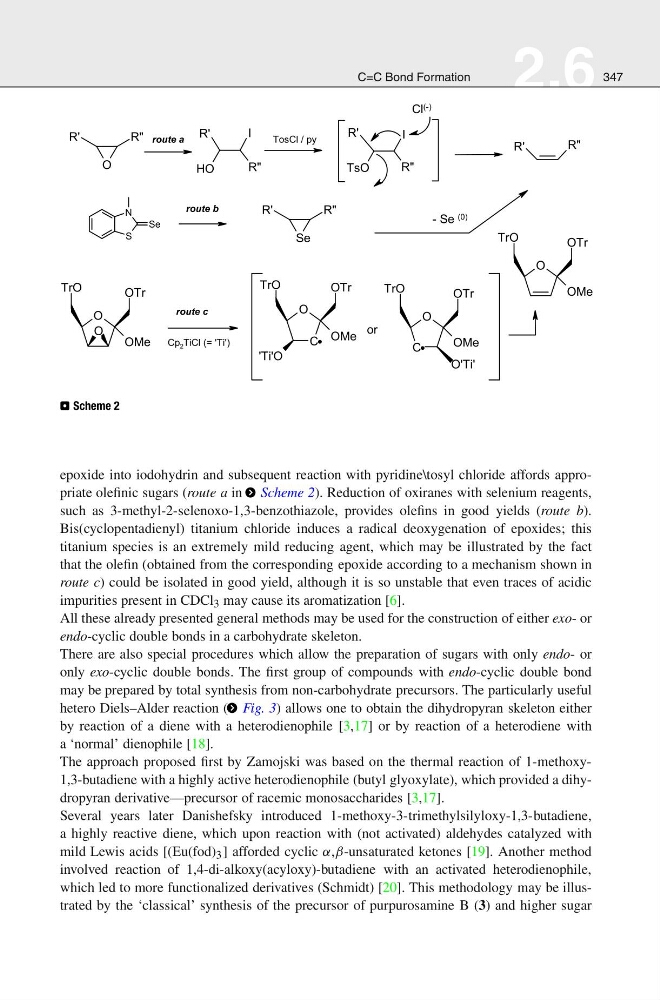
⊡ Scheme 2
epoxide into iodohydrin and subsequent reaction with pyridine\tosyl chloride affords appropriate olefinic sugars (route a in > Scheme 2). Reduction of oxiranes with selenium reagents,
such as 3-methyl-2-selenoxo-1,3-benzothiazole, provides olefins in good yields (route b).
Bis(cyclopentadienyl) titanium chloride induces a radical deoxygenation of epoxides; this
titanium species is an extremely mild reducing agent, which may be illustrated by the fact
that the olefin (obtained from the corresponding epoxide according to a mechanism shown in
route c) could be isolated in good yield, although it is so unstable that even traces of acidic
impurities present in CDCl 3 may cause its aromatization [6].
All these already presented general methods may be used for the construction of either exo- or
endo-cyclic double bonds in a carbohydrate skeleton.
There are also special procedures which allow the preparation of sugars with only endo- or
only exo-cyclic double bonds. The first group of compounds with endo-cyclic double bond
may be prepared by total synthesis from non-carbohydrate precursors. The particularly useful
hetero Diels–Alder reaction ( > Fig. 3) allows one to obtain the dihydropyran skeleton either
by reaction of a diene with a heterodienophile [3,17] or by reaction of a heterodiene with
a ‘normal’ dienophile [18].
The approach proposed first by Zamojski was based on the thermal reaction of 1-methoxy1,3-butadiene with a highly active heterodienophile (butyl glyoxylate), which provided a dihydropyran derivative—precursor of racemic monosaccharides [3,17].
Several years later Danishefsky introduced 1-methoxy-3-trimethylsilyloxy-1,3-butadiene,
a highly reactive diene, which upon reaction with (not activated) aldehydes catalyzed with
mild Lewis acids [(Eu(fod) 3 ] afforded cyclic α,β-unsaturated ketones [19]. Another method
involved reaction of 1,4-di-alkoxy(acyloxy)-butadiene with an activated heterodienophile,
which led to more functionalized derivatives (Schmidt) [20]. This methodology may be illustrated by the ‘classical’ synthesis of the precursor of purpurosamine B (3) and higher sugar
2.6
347
⊡ Scheme 2
epoxide into iodohydrin and subsequent reaction with pyridine\tosyl chloride affords appropriate olefinic sugars (route a in > Scheme 2). Reduction of oxiranes with selenium reagents,
such as 3-methyl-2-selenoxo-1,3-benzothiazole, provides olefins in good yields (route b).
Bis(cyclopentadienyl) titanium chloride induces a radical deoxygenation of epoxides; this
titanium species is an extremely mild reducing agent, which may be illustrated by the fact
that the olefin (obtained from the corresponding epoxide according to a mechanism shown in
route c) could be isolated in good yield, although it is so unstable that even traces of acidic
impurities present in CDCl 3 may cause its aromatization [6].
All these already presented general methods may be used for the construction of either exo- or
endo-cyclic double bonds in a carbohydrate skeleton.
There are also special procedures which allow the preparation of sugars with only endo- or
only exo-cyclic double bonds. The first group of compounds with endo-cyclic double bond
may be prepared by total synthesis from non-carbohydrate precursors. The particularly useful
hetero Diels–Alder reaction ( > Fig. 3) allows one to obtain the dihydropyran skeleton either
by reaction of a diene with a heterodienophile [3,17] or by reaction of a heterodiene with
a ‘normal’ dienophile [18].
The approach proposed first by Zamojski was based on the thermal reaction of 1-methoxy1,3-butadiene with a highly active heterodienophile (butyl glyoxylate), which provided a dihydropyran derivative—precursor of racemic monosaccharides [3,17].
Several years later Danishefsky introduced 1-methoxy-3-trimethylsilyloxy-1,3-butadiene,
a highly reactive diene, which upon reaction with (not activated) aldehydes catalyzed with
mild Lewis acids [(Eu(fod) 3 ] afforded cyclic α,β-unsaturated ketones [19]. Another method
involved reaction of 1,4-di-alkoxy(acyloxy)-butadiene with an activated heterodienophile,
which led to more functionalized derivatives (Schmidt) [20]. This methodology may be illustrated by the ‘classical’ synthesis of the precursor of purpurosamine B (3) and higher sugar