

346
2
General Synthetic Methods
2 General Methods of the Formation of the Double Bond
The double bond may be introduced into the carbohydrate skeleton in several different ways.
The methodology of the preparation of unsaturated sugars is well developed and almost any
derivative can be prepared using classical methods described in a number of monographs and
text-books. These methods include reduction of oxygen functions, elimination reactions, reactions of carbonyl compounds with the Wittig-type reagents, and rearrangements of a sugar
skeleton (e. g. preparation of 2,3-unsaturated sugars from glycals). Carbohydrates are polyhydroxylated compounds and conversion of the vic-diol function into an olefin is the simplest
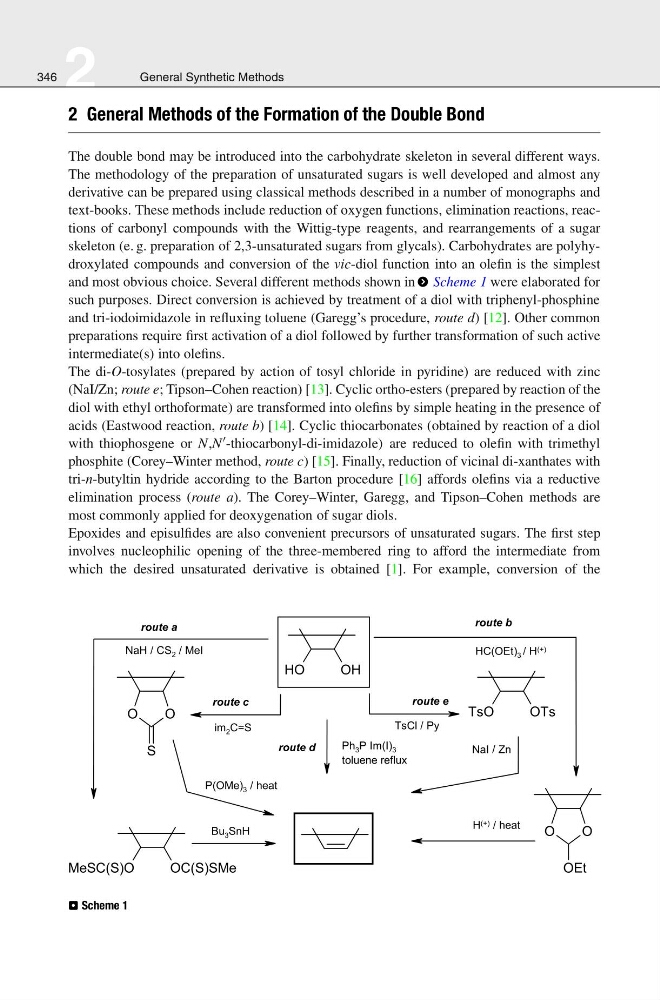
and most obvious choice. Several different methods shown in > Scheme 1 were elaborated for
such purposes. Direct conversion is achieved by treatment of a diol with triphenyl-phosphine
and tri-iodoimidazole in refluxing toluene (Garegg’s procedure, route d) [12]. Other common
preparations require first activation of a diol followed by further transformation of such active
intermediate(s) into olefins.
The di-O-tosylates (prepared by action of tosyl chloride in pyridine) are reduced with zinc
(NaI/Zn; route e; Tipson–Cohen reaction) [13]. Cyclic ortho-esters (prepared by reaction of the
diol with ethyl orthoformate) are transformed into olefins by simple heating in the presence of
acids (Eastwood reaction, route b) [14]. Cyclic thiocarbonates (obtained by reaction of a diol
with thiophosgene or N,N -thiocarbonyl-di-imidazole) are reduced to olefin with trimethyl
phosphite (Corey–Winter method, route c) [15]. Finally, reduction of vicinal di-xanthates with
tri-n-butyltin hydride according to the Barton procedure [16] affords olefins via a reductive
elimination process (route a). The Corey–Winter, Garegg, and Tipson–Cohen methods are
most commonly applied for deoxygenation of sugar diols.
Epoxides and episulfides are also convenient precursors of unsaturated sugars. The first step
involves nucleophilic opening of the three-membered ring to afford the intermediate from
which the desired unsaturated derivative is obtained [1]. For example, conversion of the
⊡ Scheme 1
2
General Synthetic Methods
2 General Methods of the Formation of the Double Bond
The double bond may be introduced into the carbohydrate skeleton in several different ways.
The methodology of the preparation of unsaturated sugars is well developed and almost any
derivative can be prepared using classical methods described in a number of monographs and
text-books. These methods include reduction of oxygen functions, elimination reactions, reactions of carbonyl compounds with the Wittig-type reagents, and rearrangements of a sugar
skeleton (e. g. preparation of 2,3-unsaturated sugars from glycals). Carbohydrates are polyhydroxylated compounds and conversion of the vic-diol function into an olefin is the simplest
and most obvious choice. Several different methods shown in > Scheme 1 were elaborated for
such purposes. Direct conversion is achieved by treatment of a diol with triphenyl-phosphine
and tri-iodoimidazole in refluxing toluene (Garegg’s procedure, route d) [12]. Other common
preparations require first activation of a diol followed by further transformation of such active
intermediate(s) into olefins.
The di-O-tosylates (prepared by action of tosyl chloride in pyridine) are reduced with zinc
(NaI/Zn; route e; Tipson–Cohen reaction) [13]. Cyclic ortho-esters (prepared by reaction of the
diol with ethyl orthoformate) are transformed into olefins by simple heating in the presence of
acids (Eastwood reaction, route b) [14]. Cyclic thiocarbonates (obtained by reaction of a diol
with thiophosgene or N,N -thiocarbonyl-di-imidazole) are reduced to olefin with trimethyl
phosphite (Corey–Winter method, route c) [15]. Finally, reduction of vicinal di-xanthates with
tri-n-butyltin hydride according to the Barton procedure [16] affords olefins via a reductive
elimination process (route a). The Corey–Winter, Garegg, and Tipson–Cohen methods are
most commonly applied for deoxygenation of sugar diols.
Epoxides and episulfides are also convenient precursors of unsaturated sugars. The first step
involves nucleophilic opening of the three-membered ring to afford the intermediate from
which the desired unsaturated derivative is obtained [1]. For example, conversion of the
⊡ Scheme 1