

326
2
General Synthetic Methods
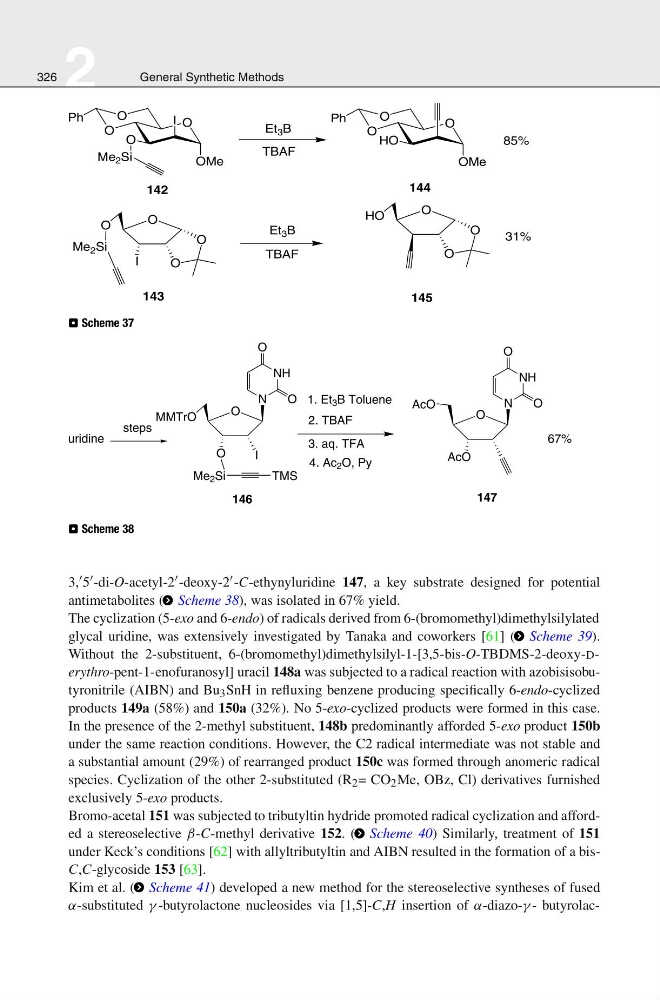
⊡ Scheme 37
⊡ Scheme 38
3, 5 -di-O-acetyl-2 -deoxy-2 -C-ethynyluridine 147, a key substrate designed for potential
antimetabolites ( > Scheme 38), was isolated in 67% yield.
The cyclization (5-exo and 6-endo) of radicals derived from 6-(bromomethyl)dimethylsilylated
glycal uridine, was extensively investigated by Tanaka and coworkers [61] ( > Scheme 39).
Without the 2-substituent, 6-(bromomethyl)dimethylsilyl-1-[3,5-bis-O-TBDMS-2-deoxy-Derythro-pent-1-enofuranosyl] uracil 148a was subjected to a radical reaction with azobisisobutyronitrile (AIBN) and Bu 3 SnH in refluxing benzene producing specifically 6-endo-cyclized
products 149a (58%) and 150a (32%). No 5-exo-cyclized products were formed in this case.
In the presence of the 2-methyl substituent, 148b predominantly afforded 5-exo product 150b
under the same reaction conditions. However, the C2 radical intermediate was not stable and
a substantial amount (29%) of rearranged product 150c was formed through anomeric radical
species. Cyclization of the other 2-substituted (R 2 = CO 2 Me, OBz, Cl) derivatives furnished
exclusively 5-exo products.
Bromo-acetal 151 was subjected to tributyltin hydride promoted radical cyclization and afforded a stereoselective β-C-methyl derivative 152. ( > Scheme 40) Similarly, treatment of 151
under Keck’s conditions [62] with allyltributyltin and AIBN resulted in the formation of a bisC,C-glycoside 153 [63].
Kim et al. ( > Scheme 41) developed a new method for the stereoselective syntheses of fused
α-substituted γ -butyrolactone nucleosides via [1,5]-C,H insertion of α-diazo-γ - butyrolac-
2
General Synthetic Methods
⊡ Scheme 37
⊡ Scheme 38
3, 5 -di-O-acetyl-2 -deoxy-2 -C-ethynyluridine 147, a key substrate designed for potential
antimetabolites ( > Scheme 38), was isolated in 67% yield.
The cyclization (5-exo and 6-endo) of radicals derived from 6-(bromomethyl)dimethylsilylated
glycal uridine, was extensively investigated by Tanaka and coworkers [61] ( > Scheme 39).
Without the 2-substituent, 6-(bromomethyl)dimethylsilyl-1-[3,5-bis-O-TBDMS-2-deoxy-Derythro-pent-1-enofuranosyl] uracil 148a was subjected to a radical reaction with azobisisobutyronitrile (AIBN) and Bu 3 SnH in refluxing benzene producing specifically 6-endo-cyclized
products 149a (58%) and 150a (32%). No 5-exo-cyclized products were formed in this case.
In the presence of the 2-methyl substituent, 148b predominantly afforded 5-exo product 150b
under the same reaction conditions. However, the C2 radical intermediate was not stable and
a substantial amount (29%) of rearranged product 150c was formed through anomeric radical
species. Cyclization of the other 2-substituted (R 2 = CO 2 Me, OBz, Cl) derivatives furnished
exclusively 5-exo products.
Bromo-acetal 151 was subjected to tributyltin hydride promoted radical cyclization and afforded a stereoselective β-C-methyl derivative 152. ( > Scheme 40) Similarly, treatment of 151
under Keck’s conditions [62] with allyltributyltin and AIBN resulted in the formation of a bisC,C-glycoside 153 [63].
Kim et al. ( > Scheme 41) developed a new method for the stereoselective syntheses of fused
α-substituted γ -butyrolactone nucleosides via [1,5]-C,H insertion of α-diazo-γ - butyrolac-