

C–C Bond Formation
2.5
325
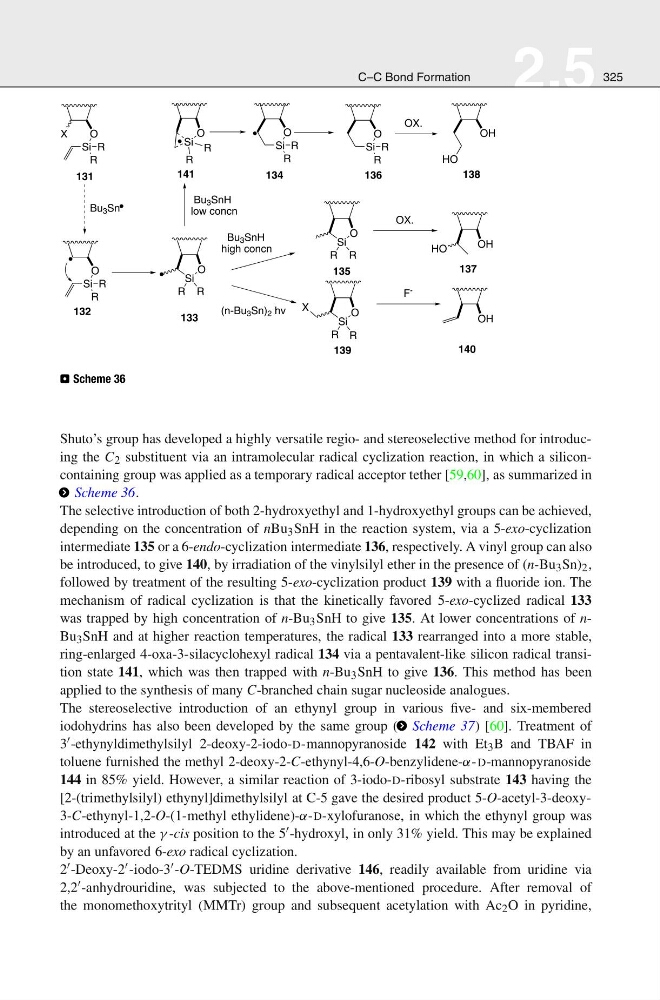
⊡ Scheme 36
Shuto’s group has developed a highly versatile regio- and stereoselective method for introducing the C 2 substituent via an intramolecular radical cyclization reaction, in which a siliconcontaining group was applied as a temporary radical acceptor tether [59,60], as summarized in
> Scheme 36.
The selective introduction of both 2-hydroxyethyl and 1-hydroxyethyl groups can be achieved,
depending on the concentration of nBu 3 SnH in the reaction system, via a 5-exo-cyclization
intermediate 135 or a 6-endo-cyclization intermediate 136, respectively. A vinyl group can also
be introduced, to give 140, by irradiation of the vinylsilyl ether in the presence of (n-Bu 3 Sn) 2 ,
followed by treatment of the resulting 5-exo-cyclization product 139 with a fluoride ion. The
mechanism of radical cyclization is that the kinetically favored 5-exo-cyclized radical 133
was trapped by high concentration of n-Bu 3 SnH to give 135. At lower concentrations of nBu 3 SnH and at higher reaction temperatures, the radical 133 rearranged into a more stable,
ring-enlarged 4-oxa-3-silacyclohexyl radical 134 via a pentavalent-like silicon radical transition state 141, which was then trapped with n-Bu 3 SnH to give 136. This method has been
applied to the synthesis of many C-branched chain sugar nucleoside analogues.
The stereoselective introduction of an ethynyl group in various five- and six-membered
iodohydrins has also been developed by the same group ( > Scheme 37) [60]. Treatment of
3 -ethynyldimethylsilyl 2-deoxy-2-iodo-D-mannopyranoside 142 with Et 3 B and TBAF in
toluene furnished the methyl 2-deoxy-2-C-ethynyl-4,6-O-benzylidene-α-D-mannopyranoside
144 in 85% yield. However, a similar reaction of 3-iodo-D-ribosyl substrate 143 having the
[2-(trimethylsilyl) ethynyl]dimethylsilyl at C-5 gave the desired product 5-O-acetyl-3-deoxy3-C-ethynyl-1,2-O-(1-methyl ethylidene)-α-D-xylofuranose, in which the ethynyl group was
introduced at the γ -cis position to the 5 -hydroxyl, in only 31% yield. This may be explained
by an unfavored 6-exo radical cyclization.
2 -Deoxy-2 -iodo-3 -O-TEDMS uridine derivative 146, readily available from uridine via
2,2 -anhydrouridine, was subjected to the above-mentioned procedure. After removal of
the monomethoxytrityl (MMTr) group and subsequent acetylation with Ac 2 O in pyridine,
2.5
325
⊡ Scheme 36
Shuto’s group has developed a highly versatile regio- and stereoselective method for introducing the C 2 substituent via an intramolecular radical cyclization reaction, in which a siliconcontaining group was applied as a temporary radical acceptor tether [59,60], as summarized in
> Scheme 36.
The selective introduction of both 2-hydroxyethyl and 1-hydroxyethyl groups can be achieved,
depending on the concentration of nBu 3 SnH in the reaction system, via a 5-exo-cyclization
intermediate 135 or a 6-endo-cyclization intermediate 136, respectively. A vinyl group can also
be introduced, to give 140, by irradiation of the vinylsilyl ether in the presence of (n-Bu 3 Sn) 2 ,
followed by treatment of the resulting 5-exo-cyclization product 139 with a fluoride ion. The
mechanism of radical cyclization is that the kinetically favored 5-exo-cyclized radical 133
was trapped by high concentration of n-Bu 3 SnH to give 135. At lower concentrations of nBu 3 SnH and at higher reaction temperatures, the radical 133 rearranged into a more stable,
ring-enlarged 4-oxa-3-silacyclohexyl radical 134 via a pentavalent-like silicon radical transition state 141, which was then trapped with n-Bu 3 SnH to give 136. This method has been
applied to the synthesis of many C-branched chain sugar nucleoside analogues.
The stereoselective introduction of an ethynyl group in various five- and six-membered
iodohydrins has also been developed by the same group ( > Scheme 37) [60]. Treatment of
3 -ethynyldimethylsilyl 2-deoxy-2-iodo-D-mannopyranoside 142 with Et 3 B and TBAF in
toluene furnished the methyl 2-deoxy-2-C-ethynyl-4,6-O-benzylidene-α-D-mannopyranoside
144 in 85% yield. However, a similar reaction of 3-iodo-D-ribosyl substrate 143 having the
[2-(trimethylsilyl) ethynyl]dimethylsilyl at C-5 gave the desired product 5-O-acetyl-3-deoxy3-C-ethynyl-1,2-O-(1-methyl ethylidene)-α-D-xylofuranose, in which the ethynyl group was
introduced at the γ -cis position to the 5 -hydroxyl, in only 31% yield. This may be explained
by an unfavored 6-exo radical cyclization.
2 -Deoxy-2 -iodo-3 -O-TEDMS uridine derivative 146, readily available from uridine via
2,2 -anhydrouridine, was subjected to the above-mentioned procedure. After removal of
the monomethoxytrityl (MMTr) group and subsequent acetylation with Ac 2 O in pyridine,