

318
2
General Synthetic Methods
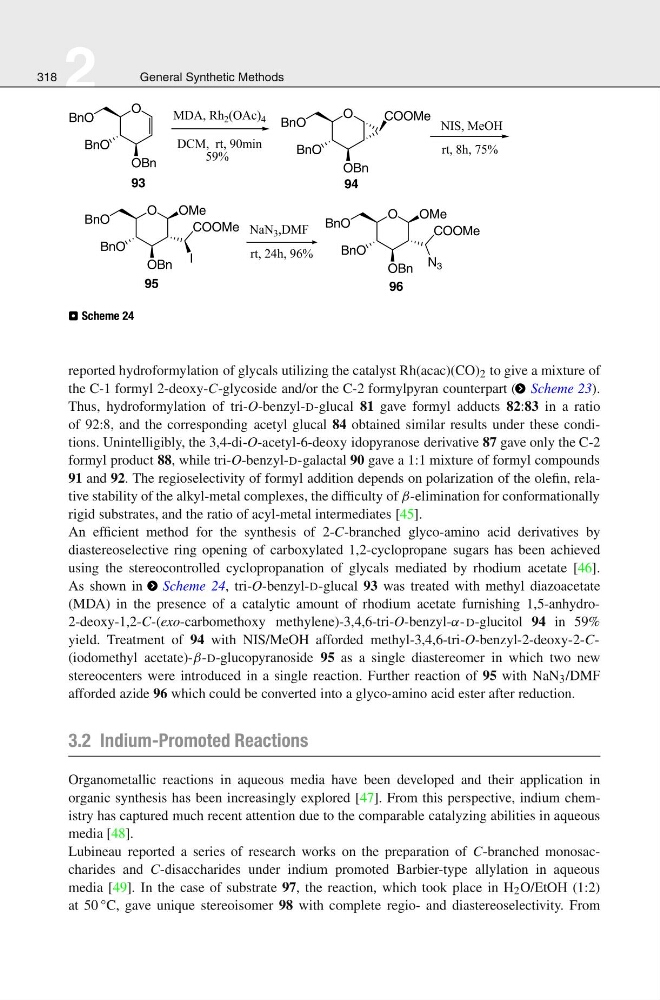
⊡ Scheme 24
reported hydroformylation of glycals utilizing the catalyst Rh(acac)(CO) 2 to give a mixture of
the C-1 formyl 2-deoxy-C-glycoside and/or the C-2 formylpyran counterpart ( > Scheme 23).
Thus, hydroformylation of tri-O-benzyl-D-glucal 81 gave formyl adducts 82:83 in a ratio
of 92:8, and the corresponding acetyl glucal 84 obtained similar results under these conditions. Unintelligibly, the 3,4-di-O-acetyl-6-deoxy idopyranose derivative 87 gave only the C-2
formyl product 88, while tri-O-benzyl-D-galactal 90 gave a 1:1 mixture of formyl compounds
91 and 92. The regioselectivity of formyl addition depends on polarization of the olefin, relative stability of the alkyl-metal complexes, the difficulty of β-elimination for conformationally
rigid substrates, and the ratio of acyl-metal intermediates [45].
An efficient method for the synthesis of 2-C-branched glyco-amino acid derivatives by
diastereoselective ring opening of carboxylated 1,2-cyclopropane sugars has been achieved
using the stereocontrolled cyclopropanation of glycals mediated by rhodium acetate [46].
As shown in > Scheme 24, tri-O-benzyl-D-glucal 93 was treated with methyl diazoacetate
(MDA) in the presence of a catalytic amount of rhodium acetate furnishing 1,5-anhydro2-deoxy-1,2-C-(exo-carbomethoxy methylene)-3,4,6-tri-O-benzyl-α-D-glucitol 94 in 59%
yield. Treatment of 94 with NIS/MeOH afforded methyl-3,4,6-tri-O-benzyl-2-deoxy-2-C(iodomethyl acetate)-β-D-glucopyranoside 95 as a single diastereomer in which two new
stereocenters were introduced in a single reaction. Further reaction of 95 with NaN 3 /DMF
afforded azide 96 which could be converted into a glyco-amino acid ester after reduction.
3.2 Indium-Promoted Reactions
Organometallic reactions in aqueous media have been developed and their application in
organic synthesis has been increasingly explored [47]. From this perspective, indium chemistry has captured much recent attention due to the comparable catalyzing abilities in aqueous
media [48].
Lubineau reported a series of research works on the preparation of C-branched monosaccharides and C-disaccharides under indium promoted Barbier-type allylation in aqueous
media [49]. In the case of substrate 97, the reaction, which took place in H 2 O/EtOH (1:2)
at 50 °C, gave unique stereoisomer 98 with complete regio- and diastereoselectivity. From
2
General Synthetic Methods
⊡ Scheme 24
reported hydroformylation of glycals utilizing the catalyst Rh(acac)(CO) 2 to give a mixture of
the C-1 formyl 2-deoxy-C-glycoside and/or the C-2 formylpyran counterpart ( > Scheme 23).
Thus, hydroformylation of tri-O-benzyl-D-glucal 81 gave formyl adducts 82:83 in a ratio
of 92:8, and the corresponding acetyl glucal 84 obtained similar results under these conditions. Unintelligibly, the 3,4-di-O-acetyl-6-deoxy idopyranose derivative 87 gave only the C-2
formyl product 88, while tri-O-benzyl-D-galactal 90 gave a 1:1 mixture of formyl compounds
91 and 92. The regioselectivity of formyl addition depends on polarization of the olefin, relative stability of the alkyl-metal complexes, the difficulty of β-elimination for conformationally
rigid substrates, and the ratio of acyl-metal intermediates [45].
An efficient method for the synthesis of 2-C-branched glyco-amino acid derivatives by
diastereoselective ring opening of carboxylated 1,2-cyclopropane sugars has been achieved
using the stereocontrolled cyclopropanation of glycals mediated by rhodium acetate [46].
As shown in > Scheme 24, tri-O-benzyl-D-glucal 93 was treated with methyl diazoacetate
(MDA) in the presence of a catalytic amount of rhodium acetate furnishing 1,5-anhydro2-deoxy-1,2-C-(exo-carbomethoxy methylene)-3,4,6-tri-O-benzyl-α-D-glucitol 94 in 59%
yield. Treatment of 94 with NIS/MeOH afforded methyl-3,4,6-tri-O-benzyl-2-deoxy-2-C(iodomethyl acetate)-β-D-glucopyranoside 95 as a single diastereomer in which two new
stereocenters were introduced in a single reaction. Further reaction of 95 with NaN 3 /DMF
afforded azide 96 which could be converted into a glyco-amino acid ester after reduction.
3.2 Indium-Promoted Reactions
Organometallic reactions in aqueous media have been developed and their application in
organic synthesis has been increasingly explored [47]. From this perspective, indium chemistry has captured much recent attention due to the comparable catalyzing abilities in aqueous
media [48].
Lubineau reported a series of research works on the preparation of C-branched monosaccharides and C-disaccharides under indium promoted Barbier-type allylation in aqueous
media [49]. In the case of substrate 97, the reaction, which took place in H 2 O/EtOH (1:2)
at 50 °C, gave unique stereoisomer 98 with complete regio- and diastereoselectivity. From