

C–C Bond Formation
2.5
317
Suresh et al. [40] reported a diastereoselective addition of carbon nucleophiles to vinyl sulfonemodified carbohydrates, in which nucleophiles added to the C-2 position from a direction
opposite to that of the anomeric methoxy group ( > Scheme 22). The nucleophile, generated
from CH 3 NO 2 and NaOMe, reacted with 75 (or 76) producing unique 77 (or 78). Similarly,
the nucleophile generated from dimethyl malonate and sodium hydride produced exclusively
79 and 80, respectively. Interestingly, α-methyl glycoside 75 gave 77 and 79 having α-D-altro
configuration, while β-methyl glycoside 76 produced β-D-gluco analogues 78 and 80 under
the same reaction conditions. Crystal structures of 77/79 and 78/80 unambiguously established
the absolute configurations at positions C-2 and C-3 of these compounds. Pentofuranosides
presented the same results.
3 C–C Bond Formation by Metal or Metal Complex Mediated Reactions
Metal or metal complex-mediated reactions have been widely applied to C-glycoside synthesis [41]. Accordingly, various metal or metal complex catalysts such as rhodium, indium,
samarium, palladium, and so forth have also been developed for the preparation of C-branchedchain sugars.
3.1 Rhodium Complex Catalyzed Reactions
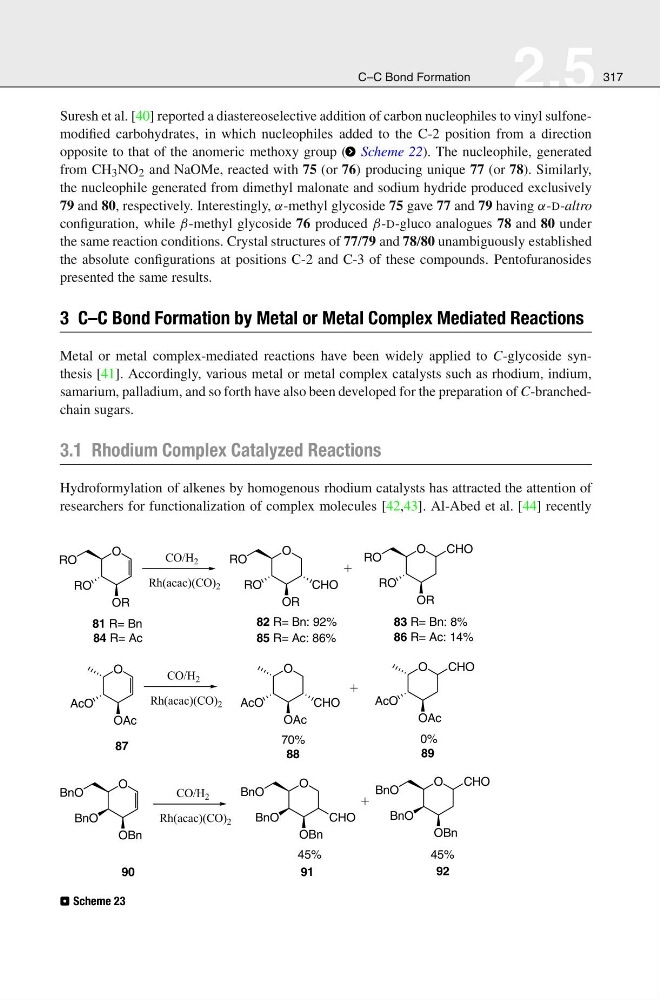
Hydroformylation of alkenes by homogenous rhodium catalysts has attracted the attention of
researchers for functionalization of complex molecules [42,43]. Al-Abed et al. [44] recently
⊡ Scheme 23
2.5
317
Suresh et al. [40] reported a diastereoselective addition of carbon nucleophiles to vinyl sulfonemodified carbohydrates, in which nucleophiles added to the C-2 position from a direction
opposite to that of the anomeric methoxy group ( > Scheme 22). The nucleophile, generated
from CH 3 NO 2 and NaOMe, reacted with 75 (or 76) producing unique 77 (or 78). Similarly,
the nucleophile generated from dimethyl malonate and sodium hydride produced exclusively
79 and 80, respectively. Interestingly, α-methyl glycoside 75 gave 77 and 79 having α-D-altro
configuration, while β-methyl glycoside 76 produced β-D-gluco analogues 78 and 80 under
the same reaction conditions. Crystal structures of 77/79 and 78/80 unambiguously established
the absolute configurations at positions C-2 and C-3 of these compounds. Pentofuranosides
presented the same results.
3 C–C Bond Formation by Metal or Metal Complex Mediated Reactions
Metal or metal complex-mediated reactions have been widely applied to C-glycoside synthesis [41]. Accordingly, various metal or metal complex catalysts such as rhodium, indium,
samarium, palladium, and so forth have also been developed for the preparation of C-branchedchain sugars.
3.1 Rhodium Complex Catalyzed Reactions
Hydroformylation of alkenes by homogenous rhodium catalysts has attracted the attention of
researchers for functionalization of complex molecules [42,43]. Al-Abed et al. [44] recently
⊡ Scheme 23