

Anhydrosugars
2.4
297
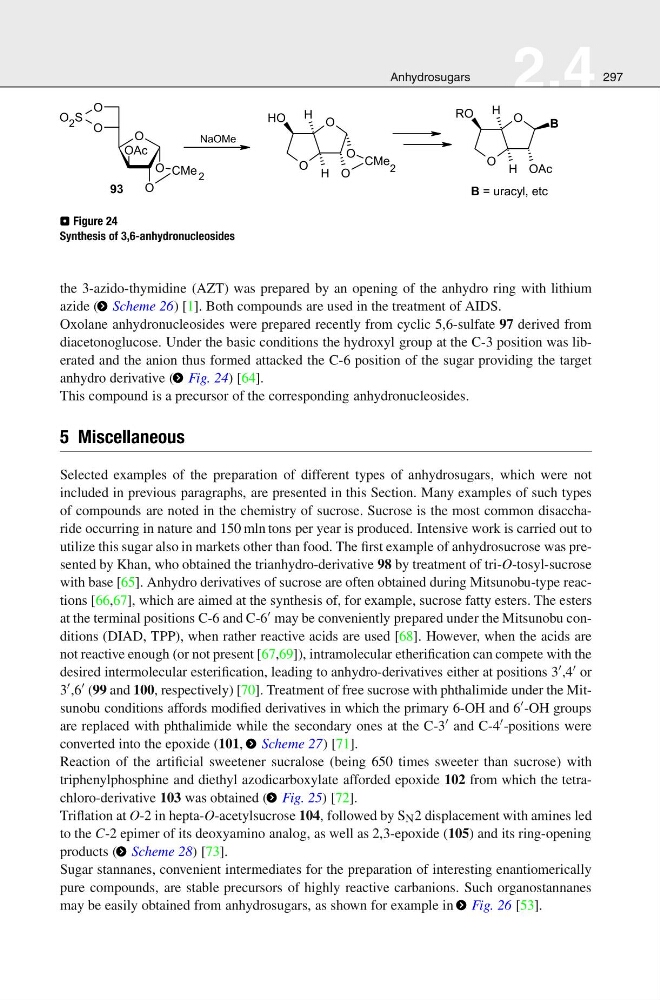
⊡ Figure 24
Synthesis of 3,6-anhydronucleosides
the 3-azido-thymidine (AZT) was prepared by an opening of the anhydro ring with lithium
azide ( > Scheme 26) [1]. Both compounds are used in the treatment of AIDS.
Oxolane anhydronucleosides were prepared recently from cyclic 5,6-sulfate 97 derived from
diacetonoglucose. Under the basic conditions the hydroxyl group at the C-3 position was liberated and the anion thus formed attacked the C-6 position of the sugar providing the target
anhydro derivative ( > Fig. 24) [64].
This compound is a precursor of the corresponding anhydronucleosides.
5 Miscellaneous
Selected examples of the preparation of different types of anhydrosugars, which were not
included in previous paragraphs, are presented in this Section. Many examples of such types
of compounds are noted in the chemistry of sucrose. Sucrose is the most common disaccharide occurring in nature and 150 mln tons per year is produced. Intensive work is carried out to
utilize this sugar also in markets other than food. The first example of anhydrosucrose was presented by Khan, who obtained the trianhydro-derivative 98 by treatment of tri-O-tosyl-sucrose
with base [65]. Anhydro derivatives of sucrose are often obtained during Mitsunobu-type reactions [66,67], which are aimed at the synthesis of, for example, sucrose fatty esters. The esters
at the terminal positions C-6 and C-6 may be conveniently prepared under the Mitsunobu conditions (DIAD, TPP), when rather reactive acids are used [68]. However, when the acids are
not reactive enough (or not present [67,69]), intramolecular etherification can compete with the
desired intermolecular esterification, leading to anhydro-derivatives either at positions 3 ,4 or
3 ,6 (99 and 100, respectively) [70]. Treatment of free sucrose with phthalimide under the Mitsunobu conditions affords modified derivatives in which the primary 6-OH and 6 -OH groups
are replaced with phthalimide while the secondary ones at the C-3 and C-4 -positions were
converted into the epoxide (101, > Scheme 27) [71].
Reaction of the artificial sweetener sucralose (being 650 times sweeter than sucrose) with
triphenylphosphine and diethyl azodicarboxylate afforded epoxide 102 from which the tetrachloro-derivative 103 was obtained ( > Fig. 25) [72].
Triflation at O-2 in hepta-O-acetylsucrose 104, followed by S N 2 displacement with amines led
to the C-2 epimer of its deoxyamino analog, as well as 2,3-epoxide (105) and its ring-opening
products ( > Scheme 28) [73].
Sugar stannanes, convenient intermediates for the preparation of interesting enantiomerically
pure compounds, are stable precursors of highly reactive carbanions. Such organostannanes
may be easily obtained from anhydrosugars, as shown for example in > Fig. 26 [53].
2.4
297
⊡ Figure 24
Synthesis of 3,6-anhydronucleosides
the 3-azido-thymidine (AZT) was prepared by an opening of the anhydro ring with lithium
azide ( > Scheme 26) [1]. Both compounds are used in the treatment of AIDS.
Oxolane anhydronucleosides were prepared recently from cyclic 5,6-sulfate 97 derived from
diacetonoglucose. Under the basic conditions the hydroxyl group at the C-3 position was liberated and the anion thus formed attacked the C-6 position of the sugar providing the target
anhydro derivative ( > Fig. 24) [64].
This compound is a precursor of the corresponding anhydronucleosides.
5 Miscellaneous
Selected examples of the preparation of different types of anhydrosugars, which were not
included in previous paragraphs, are presented in this Section. Many examples of such types
of compounds are noted in the chemistry of sucrose. Sucrose is the most common disaccharide occurring in nature and 150 mln tons per year is produced. Intensive work is carried out to
utilize this sugar also in markets other than food. The first example of anhydrosucrose was presented by Khan, who obtained the trianhydro-derivative 98 by treatment of tri-O-tosyl-sucrose
with base [65]. Anhydro derivatives of sucrose are often obtained during Mitsunobu-type reactions [66,67], which are aimed at the synthesis of, for example, sucrose fatty esters. The esters
at the terminal positions C-6 and C-6 may be conveniently prepared under the Mitsunobu conditions (DIAD, TPP), when rather reactive acids are used [68]. However, when the acids are
not reactive enough (or not present [67,69]), intramolecular etherification can compete with the
desired intermolecular esterification, leading to anhydro-derivatives either at positions 3 ,4 or
3 ,6 (99 and 100, respectively) [70]. Treatment of free sucrose with phthalimide under the Mitsunobu conditions affords modified derivatives in which the primary 6-OH and 6 -OH groups
are replaced with phthalimide while the secondary ones at the C-3 and C-4 -positions were
converted into the epoxide (101, > Scheme 27) [71].
Reaction of the artificial sweetener sucralose (being 650 times sweeter than sucrose) with
triphenylphosphine and diethyl azodicarboxylate afforded epoxide 102 from which the tetrachloro-derivative 103 was obtained ( > Fig. 25) [72].
Triflation at O-2 in hepta-O-acetylsucrose 104, followed by S N 2 displacement with amines led
to the C-2 epimer of its deoxyamino analog, as well as 2,3-epoxide (105) and its ring-opening
products ( > Scheme 28) [73].
Sugar stannanes, convenient intermediates for the preparation of interesting enantiomerically
pure compounds, are stable precursors of highly reactive carbanions. Such organostannanes
may be easily obtained from anhydrosugars, as shown for example in > Fig. 26 [53].