

296
2
General Synthetic Methods
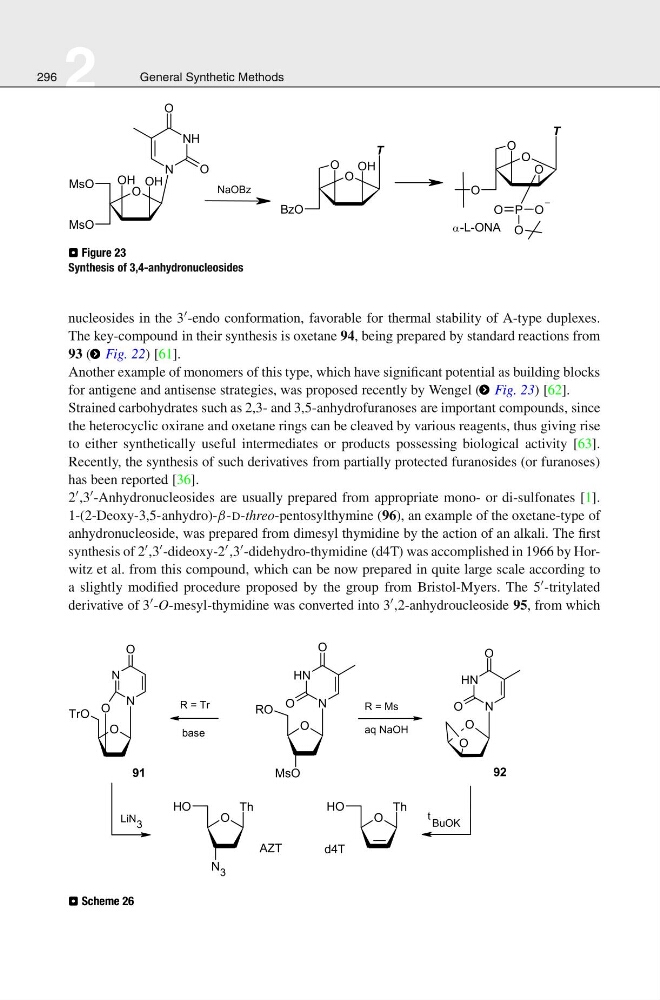
⊡ Figure 23
Synthesis of 3,4-anhydronucleosides
nucleosides in the 3 -endo conformation, favorable for thermal stability of A-type duplexes.
The key-compound in their synthesis is oxetane 94, being prepared by standard reactions from
93 ( > Fig. 22) [61].
Another example of monomers of this type, which have significant potential as building blocks
for antigene and antisense strategies, was proposed recently by Wengel ( > Fig. 23) [62].
Strained carbohydrates such as 2,3- and 3,5-anhydrofuranoses are important compounds, since
the heterocyclic oxirane and oxetane rings can be cleaved by various reagents, thus giving rise
to either synthetically useful intermediates or products possessing biological activity [63].
Recently, the synthesis of such derivatives from partially protected furanosides (or furanoses)
has been reported [36].
2 ,3 -Anhydronucleosides are usually prepared from appropriate mono- or di-sulfonates [1].
1-(2-Deoxy-3,5-anhydro)-β-D-threo-pentosylthymine (96), an example of the oxetane-type of
anhydronucleoside, was prepared from dimesyl thymidine by the action of an alkali. The first
synthesis of 2 ,3 -dideoxy-2 ,3 -didehydro-thymidine (d4T) was accomplished in 1966 by Horwitz et al. from this compound, which can be now prepared in quite large scale according to
a slightly modified procedure proposed by the group from Bristol-Myers. The 5 -tritylated
derivative of 3 -O-mesyl-thymidine was converted into 3 ,2-anhydroucleoside 95, from which
⊡ Scheme 26
2
General Synthetic Methods
⊡ Figure 23
Synthesis of 3,4-anhydronucleosides
nucleosides in the 3 -endo conformation, favorable for thermal stability of A-type duplexes.
The key-compound in their synthesis is oxetane 94, being prepared by standard reactions from
93 ( > Fig. 22) [61].
Another example of monomers of this type, which have significant potential as building blocks
for antigene and antisense strategies, was proposed recently by Wengel ( > Fig. 23) [62].
Strained carbohydrates such as 2,3- and 3,5-anhydrofuranoses are important compounds, since
the heterocyclic oxirane and oxetane rings can be cleaved by various reagents, thus giving rise
to either synthetically useful intermediates or products possessing biological activity [63].
Recently, the synthesis of such derivatives from partially protected furanosides (or furanoses)
has been reported [36].
2 ,3 -Anhydronucleosides are usually prepared from appropriate mono- or di-sulfonates [1].
1-(2-Deoxy-3,5-anhydro)-β-D-threo-pentosylthymine (96), an example of the oxetane-type of
anhydronucleoside, was prepared from dimesyl thymidine by the action of an alkali. The first
synthesis of 2 ,3 -dideoxy-2 ,3 -didehydro-thymidine (d4T) was accomplished in 1966 by Horwitz et al. from this compound, which can be now prepared in quite large scale according to
a slightly modified procedure proposed by the group from Bristol-Myers. The 5 -tritylated
derivative of 3 -O-mesyl-thymidine was converted into 3 ,2-anhydroucleoside 95, from which
⊡ Scheme 26