

Anhydrosugars
2.4
289
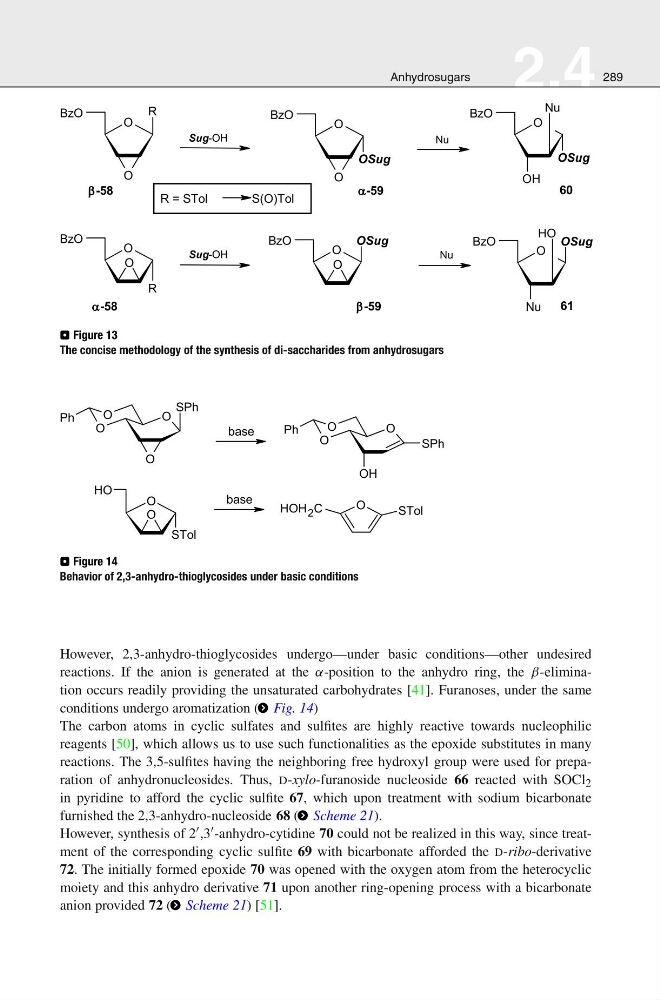
⊡ Figure 13
The concise methodology of the synthesis of di-saccharides from anhydrosugars
⊡ Figure 14
Behavior of 2,3-anhydro-thioglycosides under basic conditions
However, 2,3-anhydro-thioglycosides undergo—under basic conditions—other undesired
reactions. If the anion is generated at the α-position to the anhydro ring, the β-elimination occurs readily providing the unsaturated carbohydrates [41]. Furanoses, under the same
conditions undergo aromatization ( > Fig. 14)
The carbon atoms in cyclic sulfates and sulfites are highly reactive towards nucleophilic
reagents [50], which allows us to use such functionalities as the epoxide substitutes in many
reactions. The 3,5-sulfites having the neighboring free hydroxyl group were used for preparation of anhydronucleosides. Thus, D-xylo-furanoside nucleoside 66 reacted with SOCl 2
in pyridine to afford the cyclic sulfite 67, which upon treatment with sodium bicarbonate
furnished the 2,3-anhydro-nucleoside 68 ( > Scheme 21).
However, synthesis of 2 ,3 -anhydro-cytidine 70 could not be realized in this way, since treatment of the corresponding cyclic sulfite 69 with bicarbonate afforded the D-ribo-derivative
72. The initially formed epoxide 70 was opened with the oxygen atom from the heterocyclic
moiety and this anhydro derivative 71 upon another ring-opening process with a bicarbonate
anion provided 72 ( > Scheme 21) [51].
2.4
289
⊡ Figure 13
The concise methodology of the synthesis of di-saccharides from anhydrosugars
⊡ Figure 14
Behavior of 2,3-anhydro-thioglycosides under basic conditions
However, 2,3-anhydro-thioglycosides undergo—under basic conditions—other undesired
reactions. If the anion is generated at the α-position to the anhydro ring, the β-elimination occurs readily providing the unsaturated carbohydrates [41]. Furanoses, under the same
conditions undergo aromatization ( > Fig. 14)
The carbon atoms in cyclic sulfates and sulfites are highly reactive towards nucleophilic
reagents [50], which allows us to use such functionalities as the epoxide substitutes in many
reactions. The 3,5-sulfites having the neighboring free hydroxyl group were used for preparation of anhydronucleosides. Thus, D-xylo-furanoside nucleoside 66 reacted with SOCl 2
in pyridine to afford the cyclic sulfite 67, which upon treatment with sodium bicarbonate
furnished the 2,3-anhydro-nucleoside 68 ( > Scheme 21).
However, synthesis of 2 ,3 -anhydro-cytidine 70 could not be realized in this way, since treatment of the corresponding cyclic sulfite 69 with bicarbonate afforded the D-ribo-derivative
72. The initially formed epoxide 70 was opened with the oxygen atom from the heterocyclic
moiety and this anhydro derivative 71 upon another ring-opening process with a bicarbonate
anion provided 72 ( > Scheme 21) [51].