

288
2
General Synthetic Methods
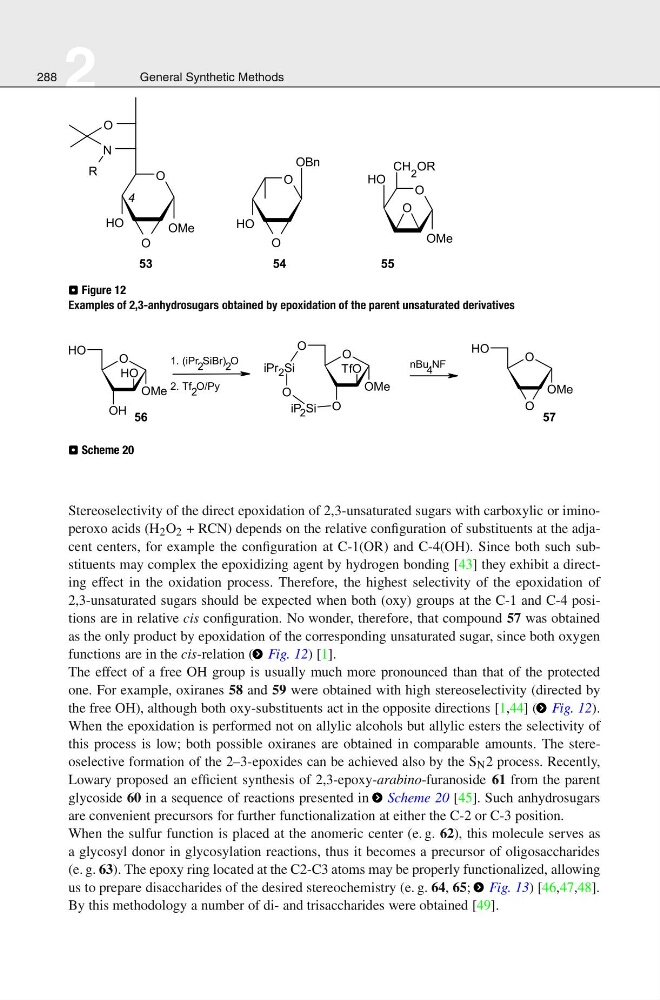
⊡ Figure 12
Examples of 2,3-anhydrosugars obtained by epoxidation of the parent unsaturated derivatives
⊡ Scheme 20
Stereoselectivity of the direct epoxidation of 2,3-unsaturated sugars with carboxylic or iminoperoxo acids (H 2 O 2 + RCN) depends on the relative configuration of substituents at the adjacent centers, for example the configuration at C-1(OR) and C-4(OH). Since both such substituents may complex the epoxidizing agent by hydrogen bonding [43] they exhibit a directing effect in the oxidation process. Therefore, the highest selectivity of the epoxidation of
2,3-unsaturated sugars should be expected when both (oxy) groups at the C-1 and C-4 positions are in relative cis configuration. No wonder, therefore, that compound 57 was obtained
as the only product by epoxidation of the corresponding unsaturated sugar, since both oxygen
functions are in the cis-relation ( > Fig. 12) [1].
The effect of a free OH group is usually much more pronounced than that of the protected
one. For example, oxiranes 58 and 59 were obtained with high stereoselectivity (directed by
the free OH), although both oxy-substituents act in the opposite directions [1,44] ( > Fig. 12).
When the epoxidation is performed not on allylic alcohols but allylic esters the selectivity of
this process is low; both possible oxiranes are obtained in comparable amounts. The stereoselective formation of the 2–3-epoxides can be achieved also by the S N 2 process. Recently,
Lowary proposed an efficient synthesis of 2,3-epoxy-arabino-furanoside 61 from the parent
glycoside 60 in a sequence of reactions presented in > Scheme 20 [45]. Such anhydrosugars
are convenient precursors for further functionalization at either the C-2 or C-3 position.
When the sulfur function is placed at the anomeric center (e. g. 62), this molecule serves as
a glycosyl donor in glycosylation reactions, thus it becomes a precursor of oligosaccharides
(e. g. 63). The epoxy ring located at the C2-C3 atoms may be properly functionalized, allowing
us to prepare disaccharides of the desired stereochemistry (e. g. 64, 65; > Fig. 13) [46,47,48].
By this methodology a number of di- and trisaccharides were obtained [49].
2
General Synthetic Methods
⊡ Figure 12
Examples of 2,3-anhydrosugars obtained by epoxidation of the parent unsaturated derivatives
⊡ Scheme 20
Stereoselectivity of the direct epoxidation of 2,3-unsaturated sugars with carboxylic or iminoperoxo acids (H 2 O 2 + RCN) depends on the relative configuration of substituents at the adjacent centers, for example the configuration at C-1(OR) and C-4(OH). Since both such substituents may complex the epoxidizing agent by hydrogen bonding [43] they exhibit a directing effect in the oxidation process. Therefore, the highest selectivity of the epoxidation of
2,3-unsaturated sugars should be expected when both (oxy) groups at the C-1 and C-4 positions are in relative cis configuration. No wonder, therefore, that compound 57 was obtained
as the only product by epoxidation of the corresponding unsaturated sugar, since both oxygen
functions are in the cis-relation ( > Fig. 12) [1].
The effect of a free OH group is usually much more pronounced than that of the protected
one. For example, oxiranes 58 and 59 were obtained with high stereoselectivity (directed by
the free OH), although both oxy-substituents act in the opposite directions [1,44] ( > Fig. 12).
When the epoxidation is performed not on allylic alcohols but allylic esters the selectivity of
this process is low; both possible oxiranes are obtained in comparable amounts. The stereoselective formation of the 2–3-epoxides can be achieved also by the S N 2 process. Recently,
Lowary proposed an efficient synthesis of 2,3-epoxy-arabino-furanoside 61 from the parent
glycoside 60 in a sequence of reactions presented in > Scheme 20 [45]. Such anhydrosugars
are convenient precursors for further functionalization at either the C-2 or C-3 position.
When the sulfur function is placed at the anomeric center (e. g. 62), this molecule serves as
a glycosyl donor in glycosylation reactions, thus it becomes a precursor of oligosaccharides
(e. g. 63). The epoxy ring located at the C2-C3 atoms may be properly functionalized, allowing
us to prepare disaccharides of the desired stereochemistry (e. g. 64, 65; > Fig. 13) [46,47,48].
By this methodology a number of di- and trisaccharides were obtained [49].