

282
2
General Synthetic Methods
⊡ Scheme 13
The 1,2-anhydrosugars are convenient synthons for the preparation of a variety of important
derivatives. Generally, opening of the oxirane ring with various nucleophiles (alcoholates,
amines, sulfides, carboanions, etc.) proceeds with the inversion of the configuration at the
anomeric center [28,29,30].
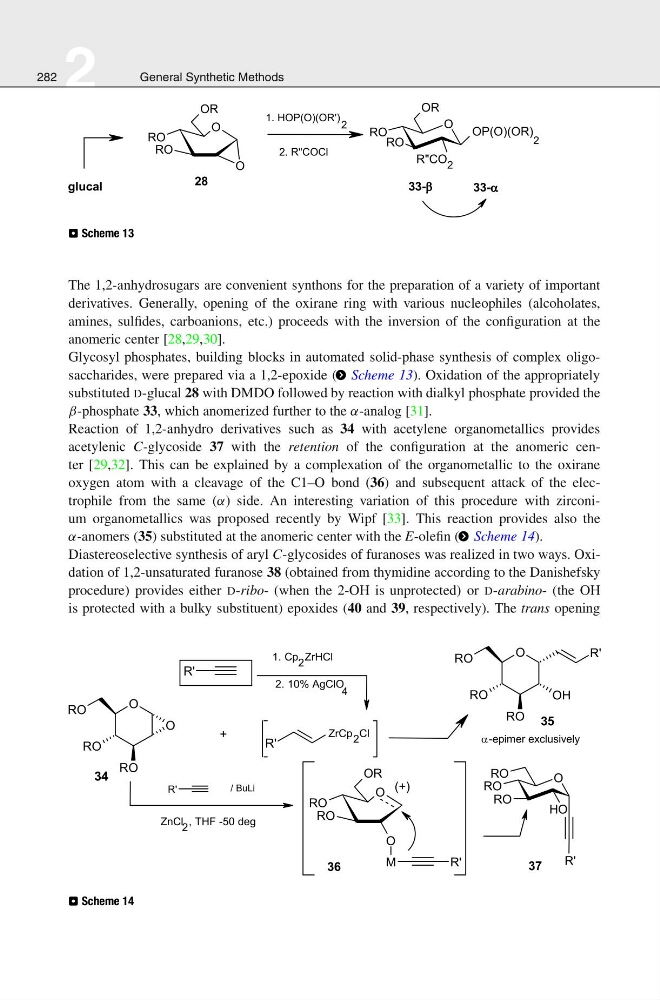
Glycosyl phosphates, building blocks in automated solid-phase synthesis of complex oligosaccharides, were prepared via a 1,2-epoxide ( > Scheme 13). Oxidation of the appropriately
substituted D-glucal 28 with DMDO followed by reaction with dialkyl phosphate provided the
β-phosphate 33, which anomerized further to the α-analog [31].
Reaction of 1,2-anhydro derivatives such as 34 with acetylene organometallics provides
acetylenic C-glycoside 37 with the retention of the configuration at the anomeric center [29,32]. This can be explained by a complexation of the organometallic to the oxirane
oxygen atom with a cleavage of the C1–O bond (36) and subsequent attack of the electrophile from the same (α) side. An interesting variation of this procedure with zirconium organometallics was proposed recently by Wipf [33]. This reaction provides also the
α-anomers (35) substituted at the anomeric center with the E-olefin ( > Scheme 14).
Diastereoselective synthesis of aryl C-glycosides of furanoses was realized in two ways. Oxidation of 1,2-unsaturated furanose 38 (obtained from thymidine according to the Danishefsky
procedure) provides either D-ribo- (when the 2-OH is unprotected) or D-arabino- (the OH
is protected with a bulky substituent) epoxides (40 and 39, respectively). The trans opening
⊡ Scheme 14
2
General Synthetic Methods
⊡ Scheme 13
The 1,2-anhydrosugars are convenient synthons for the preparation of a variety of important
derivatives. Generally, opening of the oxirane ring with various nucleophiles (alcoholates,
amines, sulfides, carboanions, etc.) proceeds with the inversion of the configuration at the
anomeric center [28,29,30].
Glycosyl phosphates, building blocks in automated solid-phase synthesis of complex oligosaccharides, were prepared via a 1,2-epoxide ( > Scheme 13). Oxidation of the appropriately
substituted D-glucal 28 with DMDO followed by reaction with dialkyl phosphate provided the
β-phosphate 33, which anomerized further to the α-analog [31].
Reaction of 1,2-anhydro derivatives such as 34 with acetylene organometallics provides
acetylenic C-glycoside 37 with the retention of the configuration at the anomeric center [29,32]. This can be explained by a complexation of the organometallic to the oxirane
oxygen atom with a cleavage of the C1–O bond (36) and subsequent attack of the electrophile from the same (α) side. An interesting variation of this procedure with zirconium organometallics was proposed recently by Wipf [33]. This reaction provides also the
α-anomers (35) substituted at the anomeric center with the E-olefin ( > Scheme 14).
Diastereoselective synthesis of aryl C-glycosides of furanoses was realized in two ways. Oxidation of 1,2-unsaturated furanose 38 (obtained from thymidine according to the Danishefsky
procedure) provides either D-ribo- (when the 2-OH is unprotected) or D-arabino- (the OH
is protected with a bulky substituent) epoxides (40 and 39, respectively). The trans opening
⊡ Scheme 14