

Anhydrosugars
2.4
281
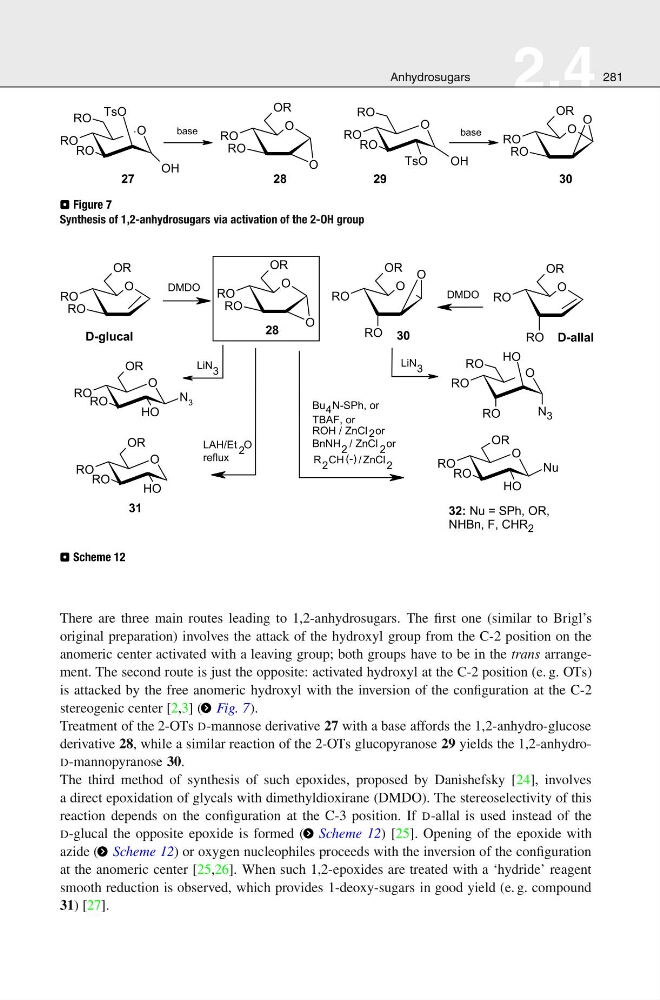
⊡ Figure 7
Synthesis of 1,2-anhydrosugars via activation of the 2-OH group
⊡ Scheme 12
There are three main routes leading to 1,2-anhydrosugars. The first one (similar to Brigl’s
original preparation) involves the attack of the hydroxyl group from the C-2 position on the
anomeric center activated with a leaving group; both groups have to be in the trans arrangement. The second route is just the opposite: activated hydroxyl at the C-2 position (e. g. OTs)
is attacked by the free anomeric hydroxyl with the inversion of the configuration at the C-2
stereogenic center [2,3] ( > Fig. 7).
Treatment of the 2-OTs D-mannose derivative 27 with a base affords the 1,2-anhydro-glucose
derivative 28, while a similar reaction of the 2-OTs glucopyranose 29 yields the 1,2-anhydroD-mannopyranose 30.
The third method of synthesis of such epoxides, proposed by Danishefsky [24], involves
a direct epoxidation of glycals with dimethyldioxirane (DMDO). The stereoselectivity of this
reaction depends on the configuration at the C-3 position. If D-allal is used instead of the
D-glucal the opposite epoxide is formed ( > Scheme 12) [25]. Opening of the epoxide with
azide ( > Scheme 12) or oxygen nucleophiles proceeds with the inversion of the configuration
at the anomeric center [25,26]. When such 1,2-epoxides are treated with a ‘hydride’ reagent
smooth reduction is observed, which provides 1-deoxy-sugars in good yield (e. g. compound
31) [27].
2.4
281
⊡ Figure 7
Synthesis of 1,2-anhydrosugars via activation of the 2-OH group
⊡ Scheme 12
There are three main routes leading to 1,2-anhydrosugars. The first one (similar to Brigl’s
original preparation) involves the attack of the hydroxyl group from the C-2 position on the
anomeric center activated with a leaving group; both groups have to be in the trans arrangement. The second route is just the opposite: activated hydroxyl at the C-2 position (e. g. OTs)
is attacked by the free anomeric hydroxyl with the inversion of the configuration at the C-2
stereogenic center [2,3] ( > Fig. 7).
Treatment of the 2-OTs D-mannose derivative 27 with a base affords the 1,2-anhydro-glucose
derivative 28, while a similar reaction of the 2-OTs glucopyranose 29 yields the 1,2-anhydroD-mannopyranose 30.
The third method of synthesis of such epoxides, proposed by Danishefsky [24], involves
a direct epoxidation of glycals with dimethyldioxirane (DMDO). The stereoselectivity of this
reaction depends on the configuration at the C-3 position. If D-allal is used instead of the
D-glucal the opposite epoxide is formed ( > Scheme 12) [25]. Opening of the epoxide with
azide ( > Scheme 12) or oxygen nucleophiles proceeds with the inversion of the configuration
at the anomeric center [25,26]. When such 1,2-epoxides are treated with a ‘hydride’ reagent
smooth reduction is observed, which provides 1-deoxy-sugars in good yield (e. g. compound
31) [27].