

276
2
General Synthetic Methods
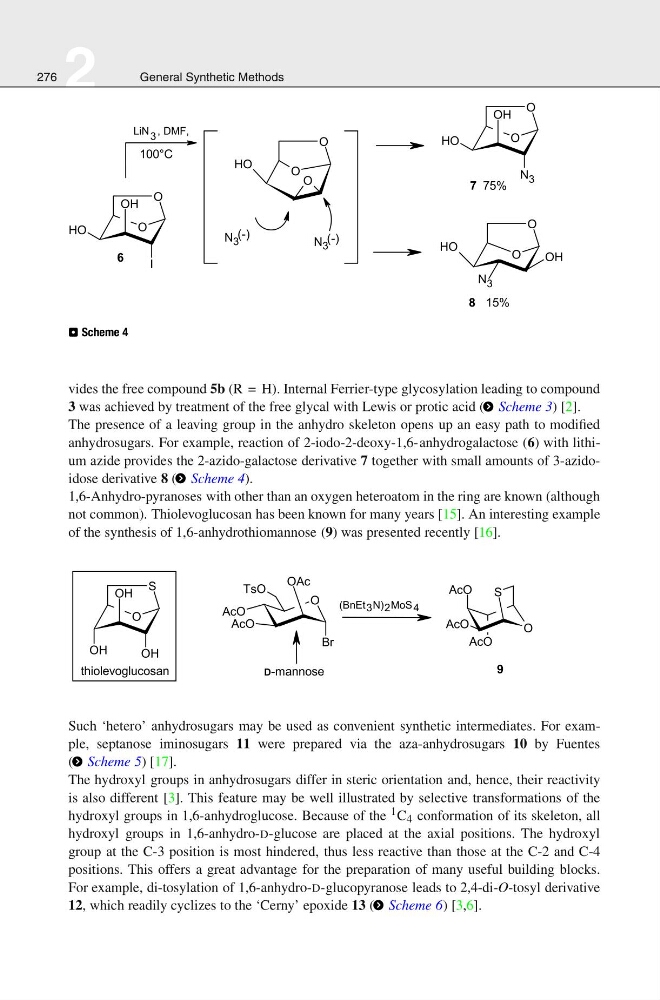
⊡ Scheme 4
vides the free compound 5b (R = H). Internal Ferrier-type glycosylation leading to compound
3 was achieved by treatment of the free glycal with Lewis or protic acid ( > Scheme 3) [2].
The presence of a leaving group in the anhydro skeleton opens up an easy path to modified
anhydrosugars. For example, reaction of 2-iodo-2-deoxy-1,6-anhydrogalactose (6) with lithium azide provides the 2-azido-galactose derivative 7 together with small amounts of 3-azidoidose derivative 8 ( > Scheme 4).
1,6-Anhydro-pyranoses with other than an oxygen heteroatom in the ring are known (although
not common). Thiolevoglucosan has been known for many years [15]. An interesting example
of the synthesis of 1,6-anhydrothiomannose (9) was presented recently [16].
Such ‘hetero’ anhydrosugars may be used as convenient synthetic intermediates. For example, septanose iminosugars 11 were prepared via the aza-anhydrosugars 10 by Fuentes
( > Scheme 5) [17].
The hydroxyl groups in anhydrosugars differ in steric orientation and, hence, their reactivity
is also different [3]. This feature may be well illustrated by selective transformations of the
hydroxyl groups in 1,6-anhydroglucose. Because of the 1 C 4 conformation of its skeleton, all
hydroxyl groups in 1,6-anhydro-D-glucose are placed at the axial positions. The hydroxyl
group at the C-3 position is most hindered, thus less reactive than those at the C-2 and C-4
positions. This offers a great advantage for the preparation of many useful building blocks.
For example, di-tosylation of 1,6-anhydro-D-glucopyranose leads to 2,4-di-O-tosyl derivative
12, which readily cyclizes to the ‘Cerny’ epoxide 13 ( > Scheme 6) [3,6].
2
General Synthetic Methods
⊡ Scheme 4
vides the free compound 5b (R = H). Internal Ferrier-type glycosylation leading to compound
3 was achieved by treatment of the free glycal with Lewis or protic acid ( > Scheme 3) [2].
The presence of a leaving group in the anhydro skeleton opens up an easy path to modified
anhydrosugars. For example, reaction of 2-iodo-2-deoxy-1,6-anhydrogalactose (6) with lithium azide provides the 2-azido-galactose derivative 7 together with small amounts of 3-azidoidose derivative 8 ( > Scheme 4).
1,6-Anhydro-pyranoses with other than an oxygen heteroatom in the ring are known (although
not common). Thiolevoglucosan has been known for many years [15]. An interesting example
of the synthesis of 1,6-anhydrothiomannose (9) was presented recently [16].
Such ‘hetero’ anhydrosugars may be used as convenient synthetic intermediates. For example, septanose iminosugars 11 were prepared via the aza-anhydrosugars 10 by Fuentes
( > Scheme 5) [17].
The hydroxyl groups in anhydrosugars differ in steric orientation and, hence, their reactivity
is also different [3]. This feature may be well illustrated by selective transformations of the
hydroxyl groups in 1,6-anhydroglucose. Because of the 1 C 4 conformation of its skeleton, all
hydroxyl groups in 1,6-anhydro-D-glucose are placed at the axial positions. The hydroxyl
group at the C-3 position is most hindered, thus less reactive than those at the C-2 and C-4
positions. This offers a great advantage for the preparation of many useful building blocks.
For example, di-tosylation of 1,6-anhydro-D-glucopyranose leads to 2,4-di-O-tosyl derivative
12, which readily cyclizes to the ‘Cerny’ epoxide 13 ( > Scheme 6) [3,6].