

Anhydrosugars
2.4
275
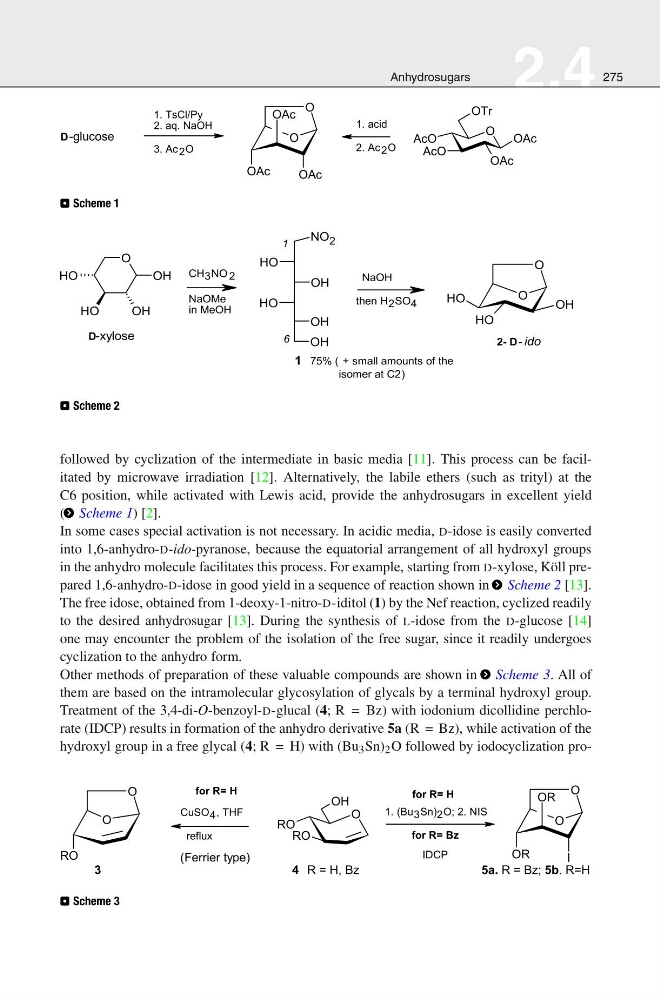
⊡ Scheme 1
⊡ Scheme 2
followed by cyclization of the intermediate in basic media [11]. This process can be facilitated by microwave irradiation [12]. Alternatively, the labile ethers (such as trityl) at the
C6 position, while activated with Lewis acid, provide the anhydrosugars in excellent yield
( > Scheme 1) [2].
In some cases special activation is not necessary. In acidic media, D-idose is easily converted
into 1,6-anhydro-D-ido-pyranose, because the equatorial arrangement of all hydroxyl groups
in the anhydro molecule facilitates this process. For example, starting from D-xylose, Köll prepared 1,6-anhydro-D-idose in good yield in a sequence of reaction shown in > Scheme 2 [13].
The free idose, obtained from 1-deoxy-1-nitro-D-iditol (1) by the Nef reaction, cyclized readily
to the desired anhydrosugar [13]. During the synthesis of L-idose from the D-glucose [14]
one may encounter the problem of the isolation of the free sugar, since it readily undergoes
cyclization to the anhydro form.
Other methods of preparation of these valuable compounds are shown in > Scheme 3. All of
them are based on the intramolecular glycosylation of glycals by a terminal hydroxyl group.
Treatment of the 3,4-di-O-benzoyl-D-glucal (4; R = Bz) with iodonium dicollidine perchlorate (IDCP) results in formation of the anhydro derivative 5a (R = Bz), while activation of the
hydroxyl group in a free glycal (4; R = H) with (Bu 3 Sn) 2 O followed by iodocyclization pro⊡ Scheme 3
2.4
275
⊡ Scheme 1
⊡ Scheme 2
followed by cyclization of the intermediate in basic media [11]. This process can be facilitated by microwave irradiation [12]. Alternatively, the labile ethers (such as trityl) at the
C6 position, while activated with Lewis acid, provide the anhydrosugars in excellent yield
( > Scheme 1) [2].
In some cases special activation is not necessary. In acidic media, D-idose is easily converted
into 1,6-anhydro-D-ido-pyranose, because the equatorial arrangement of all hydroxyl groups
in the anhydro molecule facilitates this process. For example, starting from D-xylose, Köll prepared 1,6-anhydro-D-idose in good yield in a sequence of reaction shown in > Scheme 2 [13].
The free idose, obtained from 1-deoxy-1-nitro-D-iditol (1) by the Nef reaction, cyclized readily
to the desired anhydrosugar [13]. During the synthesis of L-idose from the D-glucose [14]
one may encounter the problem of the isolation of the free sugar, since it readily undergoes
cyclization to the anhydro form.
Other methods of preparation of these valuable compounds are shown in > Scheme 3. All of
them are based on the intramolecular glycosylation of glycals by a terminal hydroxyl group.
Treatment of the 3,4-di-O-benzoyl-D-glucal (4; R = Bz) with iodonium dicollidine perchlorate (IDCP) results in formation of the anhydro derivative 5a (R = Bz), while activation of the
hydroxyl group in a free glycal (4; R = H) with (Bu 3 Sn) 2 O followed by iodocyclization pro⊡ Scheme 3