

Oxidation, Reduction, and Deoxygenation
2.2
201
2.6 Bromination at Ring Positions
In tetrahydrofuran and –pyran systems homolytic hydrogen abstraction will occur at the ether
carbon atoms due to the stabilization of the developing radical by one of the oxygen lone-pairs.
In aldose derivatives this hydrogen abstraction can be directed towards the non-anomeric carbon adjacent to the ring oxygen if all hydroxy groups are protected with radical destabilizing
protecting groups. In this way, bromine atoms can be substituted directly onto these ring positions by free radical photobromination [151]. The reaction is carried out with bromine or NBS
in refluxing carbon tetrachloride under a tungsten or heat lamp. Bromine is the most reactive
brominating agent, while NBS is more selective in some cases. In addition, bromine produces
hydrogen bromide during the course of the reaction, which can lead to side reactions if not
trapped with an acid scavenger. The hydroxy groups are most efficiently protected with acetyl
or benzoyl groups. Sometimes side reactions can occur with acetyl groups, which can undergo
α-bromination to the corresponding bromoacetate [151].
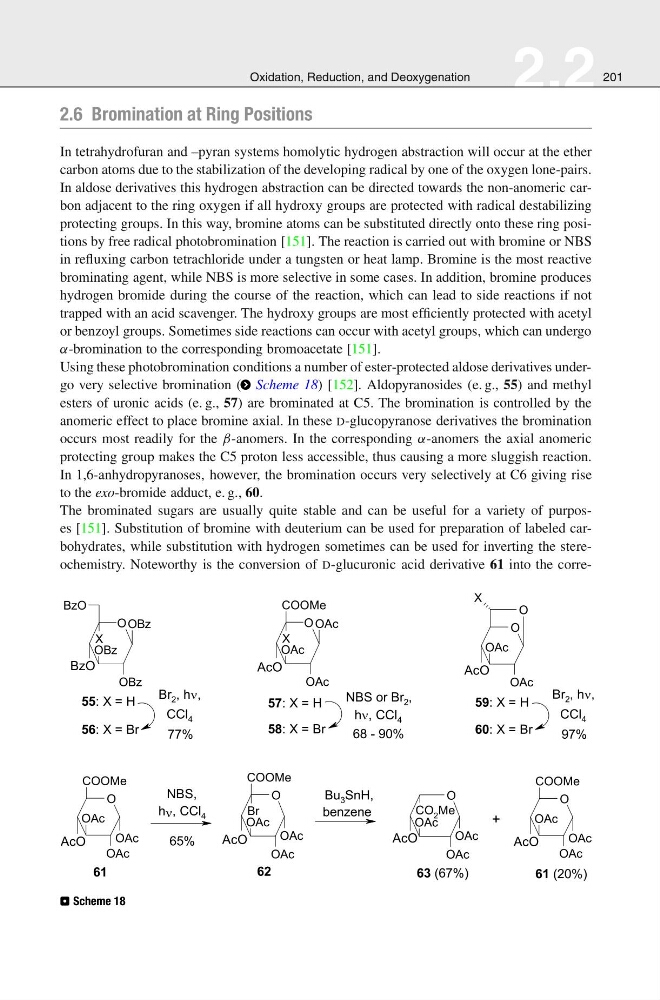
Using these photobromination conditions a number of ester-protected aldose derivatives undergo very selective bromination ( > Scheme 18) [152]. Aldopyranosides (e. g., 55) and methyl
esters of uronic acids (e. g., 57) are brominated at C5. The bromination is controlled by the
anomeric effect to place bromine axial. In these D-glucopyranose derivatives the bromination
occurs most readily for the β-anomers. In the corresponding α-anomers the axial anomeric
protecting group makes the C5 proton less accessible, thus causing a more sluggish reaction.
In 1,6-anhydropyranoses, however, the bromination occurs very selectively at C6 giving rise
to the exo-bromide adduct, e. g., 60.
The brominated sugars are usually quite stable and can be useful for a variety of purposes [151]. Substitution of bromine with deuterium can be used for preparation of labeled carbohydrates, while substitution with hydrogen sometimes can be used for inverting the stereochemistry. Noteworthy is the conversion of D-glucuronic acid derivative 61 into the corre⊡ Scheme 18
2.2
201
2.6 Bromination at Ring Positions
In tetrahydrofuran and –pyran systems homolytic hydrogen abstraction will occur at the ether
carbon atoms due to the stabilization of the developing radical by one of the oxygen lone-pairs.
In aldose derivatives this hydrogen abstraction can be directed towards the non-anomeric carbon adjacent to the ring oxygen if all hydroxy groups are protected with radical destabilizing
protecting groups. In this way, bromine atoms can be substituted directly onto these ring positions by free radical photobromination [151]. The reaction is carried out with bromine or NBS
in refluxing carbon tetrachloride under a tungsten or heat lamp. Bromine is the most reactive
brominating agent, while NBS is more selective in some cases. In addition, bromine produces
hydrogen bromide during the course of the reaction, which can lead to side reactions if not
trapped with an acid scavenger. The hydroxy groups are most efficiently protected with acetyl
or benzoyl groups. Sometimes side reactions can occur with acetyl groups, which can undergo
α-bromination to the corresponding bromoacetate [151].
Using these photobromination conditions a number of ester-protected aldose derivatives undergo very selective bromination ( > Scheme 18) [152]. Aldopyranosides (e. g., 55) and methyl
esters of uronic acids (e. g., 57) are brominated at C5. The bromination is controlled by the
anomeric effect to place bromine axial. In these D-glucopyranose derivatives the bromination
occurs most readily for the β-anomers. In the corresponding α-anomers the axial anomeric
protecting group makes the C5 proton less accessible, thus causing a more sluggish reaction.
In 1,6-anhydropyranoses, however, the bromination occurs very selectively at C6 giving rise
to the exo-bromide adduct, e. g., 60.
The brominated sugars are usually quite stable and can be useful for a variety of purposes [151]. Substitution of bromine with deuterium can be used for preparation of labeled carbohydrates, while substitution with hydrogen sometimes can be used for inverting the stereochemistry. Noteworthy is the conversion of D-glucuronic acid derivative 61 into the corre⊡ Scheme 18