

200
2
General Synthetic Methods
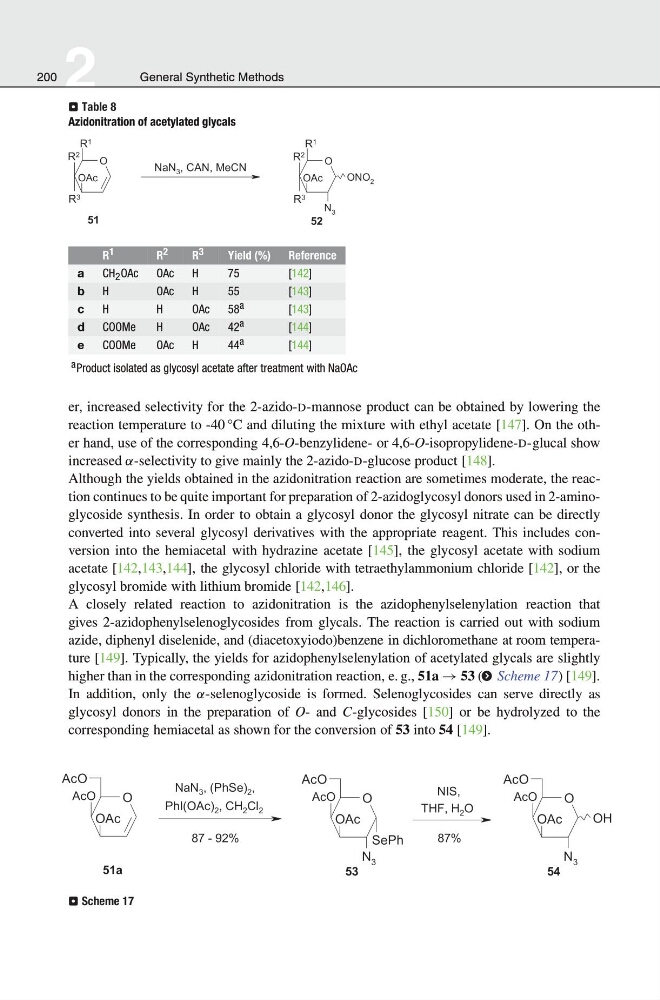
⊡ Table 8
Azidonitration of acetylated glycals
R 1
R 2
R 3
Yield (%) Reference
a
CH 2 OAc
OAc
H
75
[142]
b H
OAc
H
55
[143]
c
H
H
OAc
58 a
[143]
d COOMe
H
OAc
42 a
[144]
e
COOMe
OAc
H
44 a
[144]
a Product isolated as glycosyl acetate after treatment with NaOAc
er, increased selectivity for the 2-azido-D-mannose product can be obtained by lowering the
reaction temperature to -40 °C and diluting the mixture with ethyl acetate [147]. On the other hand, use of the corresponding 4,6-O-benzylidene- or 4,6-O-isopropylidene-D-glucal show
increased α-selectivity to give mainly the 2-azido-D-glucose product [148].
Although the yields obtained in the azidonitration reaction are sometimes moderate, the reaction continues to be quite important for preparation of 2-azidoglycosyl donors used in 2-aminoglycoside synthesis. In order to obtain a glycosyl donor the glycosyl nitrate can be directly
converted into several glycosyl derivatives with the appropriate reagent. This includes conversion into the hemiacetal with hydrazine acetate [145], the glycosyl acetate with sodium
acetate [142,143,144], the glycosyl chloride with tetraethylammonium chloride [142], or the
glycosyl bromide with lithium bromide [142,146].
A closely related reaction to azidonitration is the azidophenylselenylation reaction that
gives 2-azidophenylselenoglycosides from glycals. The reaction is carried out with sodium
azide, diphenyl diselenide, and (diacetoxyiodo)benzene in dichloromethane at room temperature [149]. Typically, the yields for azidophenylselenylation of acetylated glycals are slightly
higher than in the corresponding azidonitration reaction, e. g., 51a → 53 ( > Scheme 17) [149].
In addition, only the α-selenoglycoside is formed. Selenoglycosides can serve directly as
glycosyl donors in the preparation of O- and C-glycosides [150] or be hydrolyzed to the
corresponding hemiacetal as shown for the conversion of 53 into 54 [149].
⊡ Scheme 17
2
General Synthetic Methods
⊡ Table 8
Azidonitration of acetylated glycals
R 1
R 2
R 3
Yield (%) Reference
a
CH 2 OAc
OAc
H
75
[142]
b H
OAc
H
55
[143]
c
H
H
OAc
58 a
[143]
d COOMe
H
OAc
42 a
[144]
e
COOMe
OAc
H
44 a
[144]
a Product isolated as glycosyl acetate after treatment with NaOAc
er, increased selectivity for the 2-azido-D-mannose product can be obtained by lowering the
reaction temperature to -40 °C and diluting the mixture with ethyl acetate [147]. On the other hand, use of the corresponding 4,6-O-benzylidene- or 4,6-O-isopropylidene-D-glucal show
increased α-selectivity to give mainly the 2-azido-D-glucose product [148].
Although the yields obtained in the azidonitration reaction are sometimes moderate, the reaction continues to be quite important for preparation of 2-azidoglycosyl donors used in 2-aminoglycoside synthesis. In order to obtain a glycosyl donor the glycosyl nitrate can be directly
converted into several glycosyl derivatives with the appropriate reagent. This includes conversion into the hemiacetal with hydrazine acetate [145], the glycosyl acetate with sodium
acetate [142,143,144], the glycosyl chloride with tetraethylammonium chloride [142], or the
glycosyl bromide with lithium bromide [142,146].
A closely related reaction to azidonitration is the azidophenylselenylation reaction that
gives 2-azidophenylselenoglycosides from glycals. The reaction is carried out with sodium
azide, diphenyl diselenide, and (diacetoxyiodo)benzene in dichloromethane at room temperature [149]. Typically, the yields for azidophenylselenylation of acetylated glycals are slightly
higher than in the corresponding azidonitration reaction, e. g., 51a → 53 ( > Scheme 17) [149].
In addition, only the α-selenoglycoside is formed. Selenoglycosides can serve directly as
glycosyl donors in the preparation of O- and C-glycosides [150] or be hydrolyzed to the
corresponding hemiacetal as shown for the conversion of 53 into 54 [149].
⊡ Scheme 17