

Reactions at Oxygen Atoms
2.1
165
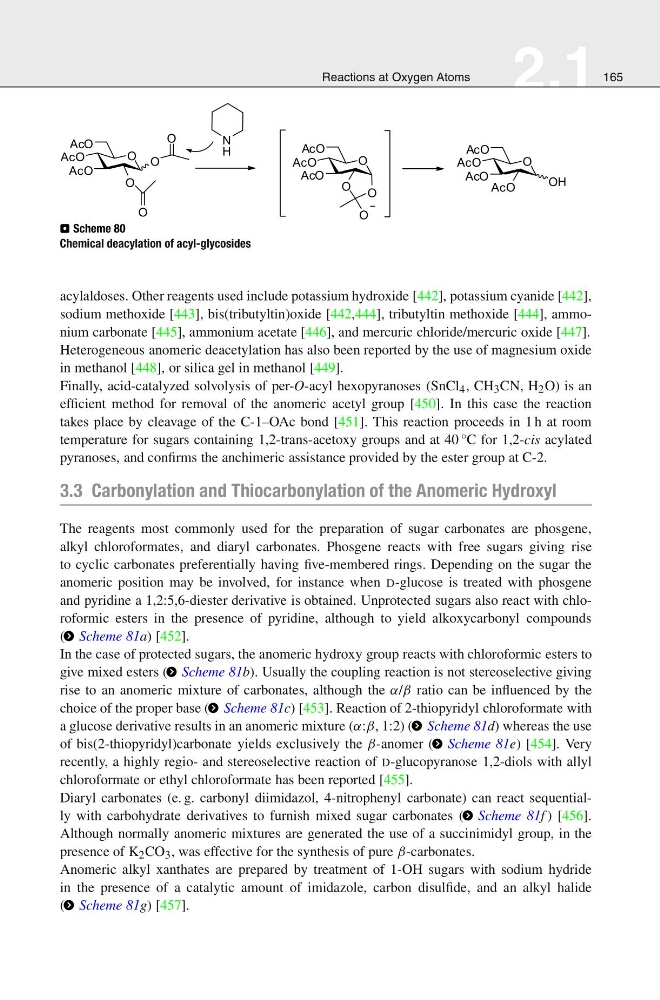
⊡ Scheme 80
Chemical deacylation of acyl-glycosides
acylaldoses. Other reagents used include potassium hydroxide [442], potassium cyanide [442],
sodium methoxide [443], bis(tributyltin)oxide [442,444], tributyltin methoxide [444], ammonium carbonate [445], ammonium acetate [446], and mercuric chloride/mercuric oxide [447].
Heterogeneous anomeric deacetylation has also been reported by the use of magnesium oxide
in methanol [448], or silica gel in methanol [449].
Finally, acid-catalyzed solvolysis of per-O-acyl hexopyranoses (SnCl 4 , CH 3 CN, H 2 O) is an
efficient method for removal of the anomeric acetyl group [450]. In this case the reaction
takes place by cleavage of the C-1–OAc bond [451]. This reaction proceeds in 1 h at room
temperature for sugars containing 1,2-trans-acetoxy groups and at 40 °C for 1,2-cis acylated
pyranoses, and confirms the anchimeric assistance provided by the ester group at C-2.
3.3 Carbonylation and Thiocarbonylation of the Anomeric Hydroxyl
The reagents most commonly used for the preparation of sugar carbonates are phosgene,
alkyl chloroformates, and diaryl carbonates. Phosgene reacts with free sugars giving rise
to cyclic carbonates preferentially having five-membered rings. Depending on the sugar the
anomeric position may be involved, for instance when D-glucose is treated with phosgene
and pyridine a 1,2:5,6-diester derivative is obtained. Unprotected sugars also react with chloroformic esters in the presence of pyridine, although to yield alkoxycarbonyl compounds
( > Scheme 81a) [452].
In the case of protected sugars, the anomeric hydroxy group reacts with chloroformic esters to
give mixed esters ( > Scheme 81b). Usually the coupling reaction is not stereoselective giving
rise to an anomeric mixture of carbonates, although the α/β ratio can be influenced by the
choice of the proper base ( > Scheme 81c) [453]. Reaction of 2-thiopyridyl chloroformate with
a glucose derivative results in an anomeric mixture (α:β, 1:2) ( > Scheme 81d) whereas the use
of bis(2-thiopyridyl)carbonate yields exclusively the β-anomer ( > Scheme 81e) [454]. Very
recently, a highly regio- and stereoselective reaction of D-glucopyranose 1,2-diols with allyl
chloroformate or ethyl chloroformate has been reported [455].
Diaryl carbonates (e. g. carbonyl diimidazol, 4-nitrophenyl carbonate) can react sequentially with carbohydrate derivatives to furnish mixed sugar carbonates ( > Scheme 81f ) [456].
Although normally anomeric mixtures are generated the use of a succinimidyl group, in the
presence of K 2 CO 3 , was effective for the synthesis of pure β-carbonates.
Anomeric alkyl xanthates are prepared by treatment of 1-OH sugars with sodium hydride
in the presence of a catalytic amount of imidazole, carbon disulfide, and an alkyl halide
( > Scheme 81g) [457].
2.1
165
⊡ Scheme 80
Chemical deacylation of acyl-glycosides
acylaldoses. Other reagents used include potassium hydroxide [442], potassium cyanide [442],
sodium methoxide [443], bis(tributyltin)oxide [442,444], tributyltin methoxide [444], ammonium carbonate [445], ammonium acetate [446], and mercuric chloride/mercuric oxide [447].
Heterogeneous anomeric deacetylation has also been reported by the use of magnesium oxide
in methanol [448], or silica gel in methanol [449].
Finally, acid-catalyzed solvolysis of per-O-acyl hexopyranoses (SnCl 4 , CH 3 CN, H 2 O) is an
efficient method for removal of the anomeric acetyl group [450]. In this case the reaction
takes place by cleavage of the C-1–OAc bond [451]. This reaction proceeds in 1 h at room
temperature for sugars containing 1,2-trans-acetoxy groups and at 40 °C for 1,2-cis acylated
pyranoses, and confirms the anchimeric assistance provided by the ester group at C-2.
3.3 Carbonylation and Thiocarbonylation of the Anomeric Hydroxyl
The reagents most commonly used for the preparation of sugar carbonates are phosgene,
alkyl chloroformates, and diaryl carbonates. Phosgene reacts with free sugars giving rise
to cyclic carbonates preferentially having five-membered rings. Depending on the sugar the
anomeric position may be involved, for instance when D-glucose is treated with phosgene
and pyridine a 1,2:5,6-diester derivative is obtained. Unprotected sugars also react with chloroformic esters in the presence of pyridine, although to yield alkoxycarbonyl compounds
( > Scheme 81a) [452].
In the case of protected sugars, the anomeric hydroxy group reacts with chloroformic esters to
give mixed esters ( > Scheme 81b). Usually the coupling reaction is not stereoselective giving
rise to an anomeric mixture of carbonates, although the α/β ratio can be influenced by the
choice of the proper base ( > Scheme 81c) [453]. Reaction of 2-thiopyridyl chloroformate with
a glucose derivative results in an anomeric mixture (α:β, 1:2) ( > Scheme 81d) whereas the use
of bis(2-thiopyridyl)carbonate yields exclusively the β-anomer ( > Scheme 81e) [454]. Very
recently, a highly regio- and stereoselective reaction of D-glucopyranose 1,2-diols with allyl
chloroformate or ethyl chloroformate has been reported [455].
Diaryl carbonates (e. g. carbonyl diimidazol, 4-nitrophenyl carbonate) can react sequentially with carbohydrate derivatives to furnish mixed sugar carbonates ( > Scheme 81f ) [456].
Although normally anomeric mixtures are generated the use of a succinimidyl group, in the
presence of K 2 CO 3 , was effective for the synthesis of pure β-carbonates.
Anomeric alkyl xanthates are prepared by treatment of 1-OH sugars with sodium hydride
in the presence of a catalytic amount of imidazole, carbon disulfide, and an alkyl halide
( > Scheme 81g) [457].